
Convert Celsius to Rankine as a temperature reading or a temperature change so the offset is used only when it should be.
Table of contents
How to use our Celsius to Rankine Converter
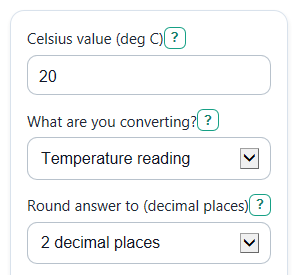
- Enter the number in Celsius value; commas and spaces are fine, and a minus sign is allowed.
- Use What are you converting? to choose a thermometer reading or a temperature change like 10 deg C warmer.
- Pick Round answer to for how many decimal places you want in the displayed answer.
- Press Calculate, then read Rankine answer first and use Kelvin cross-check or Fahrenheit cross-check to sanity-check the result.
Definitions
Celsius value: The temperature number you enter in deg C. It can be a thermometer reading or the size of a temperature change.
Rankine: An absolute temperature scale that starts at absolute zero, using degree sizes that match Fahrenheit degree sizes.
Temperature reading: A thermometer-style value, such as 20 deg C. Readings need the 273.15 offset before converting to Rankine.
Temperature change: A rise or drop in temperature, such as +10 deg C or -5 deg C. Changes do not use the 273.15 offset.
Kelvin cross-check: A related absolute-scale check. For readings, K equals deg C plus 273.15; for changes, the K change has the same size as the deg C change.
Fahrenheit cross-check: A related deg F check. For readings, F = C * 9 / 5 + 32; for changes, deg F-sized change equals deg R-sized change.
Absolute zero: The lowest point of the absolute temperature scale. It is 0 K, 0 deg R, and -273.15 deg C for readings.
Common mistakes and quick fixes
Mistake: Using What are you converting? = Temperature reading for a warming or cooling amount.
Fix: Choose Temperature change so the Rankine answer uses only the 9/5 size change and does not add 273.15.
Mistake: Entering a Celsius value below -273.15 while converting a temperature reading.
Fix: Use -273.15 or higher for a reading, because lower readings are below absolute zero.
Mistake: Expecting a negative Rankine answer to be allowed for a temperature reading.
Fix: Check What are you converting? ; negative Rankine can make sense for a temperature change, not for an absolute reading.
Mistake: Treating Kelvin cross-check as the same kind of value in both modes.
Fix: In reading mode it is K = C + 273.15, but in change mode it is the same size as the Celsius change.
Mistake: Thinking Round answer to changes the actual conversion math.
Fix: Use it only for display; the calculator still computes with the full value before rounding.
Limitations & Key Assumptions / Boundary Conditions
- The converter handles Celsius-to-Rankine only. It does not replace a full temperature-unit table or reverse Rankine-to-Celsius tool.
- Reading mode rejects Celsius values below -273.15 deg C, because that would be below absolute zero.
- Change mode allows negative values. A negative Rankine answer means a temperature drop, not an impossible temperature reading.
- Rounding changes only the displayed number. Small differences can appear if another tool rounds earlier in the calculation.
- The formulas use standard scale relationships and do not account for sensor error, calibration error, or whether a real material can exist at the entered temperature.
Methodology
How readings are converted
A Celsius temperature reading is first shifted to the absolute scale by adding 273.15, then resized from Celsius-sized degrees to Rankine-sized degrees.
R = (C + 273.15) * 9 / 5
In this formula, R is the Rankine answer in deg R and C is the Celsius value in deg C. The 273.15 offset comes from the Celsius-to-Kelvin relationship, and 0 K is absolute zero [1].
How temperature changes are converted
A temperature change is only a size difference, so the absolute-zero offset is not added.
dR = dC * 9 / 5
Here, dR is the Rankine-sized change and dC is the Celsius-sized change. A negative dC stays negative, which means the temperature went down.
Cross-checks
For reading mode, the Kelvin and Fahrenheit checks use the standard reading formulas.
K = C + 273.15
F = C * 9 / 5 + 32
For change mode, the Kelvin check equals the Celsius change, and the Fahrenheit check equals the Rankine-sized change. The Fahrenheit formula uses the 9/5 multiplier and +32 offset for readings [3].
Mini-example
If Celsius value is 20 and What are you converting? is Temperature reading, the calculation is (20 + 273.15) * 9 / 5 = 527.67 deg R. The cross-checks are 293.15 K and 68 deg F.
If the same 20 deg C is a Temperature change, the calculation is 20 * 9 / 5 = 36 deg R, with a 20 K change and a 36 deg F-sized change.