
Convert Rankine to Celsius as an actual temperature or as a temperature change, so the offset is used only when it should be.
Table of contents
How to use our Rankine to Celsius Converter
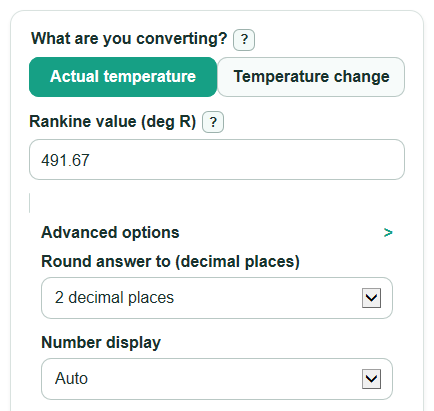
- Choose What are you converting?: use Actual temperature for a thermometer reading, or Temperature change for an increase or drop.
- Enter the Rankine value in deg R. In actual temperature mode, the value must be 0 deg R or higher.
- Pick Round answer to and, if shown, choose a Number display format that is easy to read.
- Select Calculate, then check Formula used to make sure the converter used the actual-temperature formula or the temperature-change formula you intended.
- Sanity-check the output: in temperature-change mode, Fahrenheit check should match the Rankine change, and Kelvin check should equal the Celsius change.
Definitions
Rankine value: The number entered in degrees Rankine, written as deg R. Rankine starts at absolute zero and uses Fahrenheit-size steps.
Actual temperature: A thermometer-style temperature, such as 491.67 deg R. This type needs an offset when converting to Celsius.
Temperature change: An increase or drop, such as up by 18 deg R or down by 9 deg R. This type does not use the -273.15 offset.
Celsius answer: The converted value in deg C. In actual mode it is a Celsius temperature; in change mode it is a Celsius degree change.
Kelvin check: The matching kelvin value or kelvin-size change. Rankine converts to kelvin by multiplying by 5/9.
Fahrenheit check: A second check in deg F. For temperature changes, the number is the same as the Rankine change.
Round answer to: The number of decimal places shown in the results. Rounding changes the display, not the conversion formula.
Common mistakes and quick fixes
Mistake: Choosing Actual temperature under What are you converting? for a change such as "up by 18 deg R."
Fix: Choose Temperature change so the converter does not subtract 273.15.
Mistake: Entering a negative Rankine value while converting an actual temperature.
Fix: Use 0 deg R or higher, or choose Temperature change if the negative number means a drop.
Mistake: Reading Celsius answer as a temperature when What are you converting? is set to Temperature change .
Fix: Treat that result as the size of the increase or drop in deg C, not as a thermometer reading.
Mistake: Assuming Kelvin check always has to be positive.
Fix: In actual temperature mode it cannot be negative, but in temperature-change mode a negative Kelvin change is a valid drop.
Mistake: Using too few digits in Round answer to for a value that will be used in another calculation.
Fix: Choose more decimal places, then round only the final answer you plan to report.
Mistake: Thinking Fahrenheit check should always use the Fahrenheit offset.
Fix: In temperature-change mode, Fahrenheit check equals the Rankine change because deg R and deg F have the same step size.
Limitations & Key Assumptions / Boundary Conditions
- The converter uses decimal approximations for Rankine and Fahrenheit offsets, including 459.67 and 491.67. These are standard for everyday temperature conversion, but very high-precision work may keep more digits in intermediate steps.
- Actual Rankine temperatures below 0 deg R are not allowed because 0 deg R is absolute zero.
- Negative values are allowed only as temperature changes, where a negative Rankine value means a temperature drop.
- Rounding affects displayed outputs only. If you copy a rounded answer into another calculation, the next result may differ slightly from using full precision.
- The converter treats all inputs as plain numbers in deg R. It does not detect text such as "R", "Rankine", or mixed units in the input box.
Methodology
How the conversion is chosen
The converter first checks What are you converting?. An actual Rankine temperature is a point on an absolute temperature scale, so Celsius needs an offset. A Rankine temperature change is only a size of a change, so it uses the scale factor without the offset.
Formulas
Actual Celsius temperature: C = R * 5 / 9 - 273.15
Rankine temperature change to Celsius change: C_change = R_change * 5 / 9
Actual Kelvin check: K = R * 5 / 9
Actual Fahrenheit check: F = R - 459.67
Fahrenheit change check: F_change = R_change
For actual temperatures, 0 deg C equals 273.15 K, and multiplying by 9/5 gives 491.67 deg R. That is why the actual-temperature Celsius formula can also be written as C = (R - 491.67) * 5 / 9. For changes, do not subtract 273.15, because a change has no fixed starting point.
Mini-example
If the input is 491.67 deg R and What are you converting? is set to Actual temperature, the Celsius answer is 491.67 * 5 / 9 - 273.15 = 0 deg C. The Kelvin check is 491.67 * 5 / 9 = 273.15 K, and the Fahrenheit check is 491.67 - 459.67 = 32 deg F.
If the input is 18 deg R and the mode is Temperature change, the Celsius change is 18 * 5 / 9 = 10 deg C. The Kelvin check is also a 10 K change, and the Fahrenheit check is 18 deg F.
Display rules
The calculator removes commas and spaces before reading the Rankine number. It blocks blank or nonnumeric entries, and it blocks actual Rankine temperatures below 0 deg R. It keeps full precision while calculating, then applies Round answer to only when showing the results. If a rounded result would display as -0, it is shown as 0.