
Enter a pressure in kilopascals (kPa) to find its standard atmospheres (atm), or switch directions to convert atm to kPa.
Advanced options
Table of contents
How to use our kPa to Atmospheres Converter
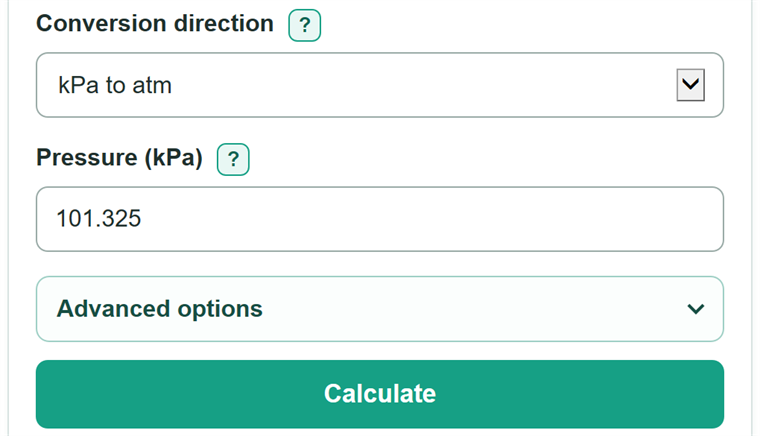
- Choose the direction that matches the unit beside your source number: "kPa to atm" or "atm to kPa."
- Enter the pressure from a gauge, display, worksheet, or specification. You can type a matching unit after the number, such as "101.325 kPa."
- Click "Calculate" to see the converted pressure in the first result card.
- Open "Advanced options" if your assignment, lab record, or equipment notes require a different number of displayed decimal places.
- Check the direction before using the answer: 101.325 kPa equals 1 atm, while 100 kPa is slightly less than 1 atm.
Definitions
Kilopascal (kPa): A pressure unit equal to 1,000 pascals (Pa).
Standard atmosphere (atm): A pressure unit equal to exactly 101,325 Pa, or 101.325 kPa.
Gauge pressure: Pressure measured compared with the surrounding air pressure.
Absolute pressure: Pressure measured compared with a perfect vacuum.
Technical atmosphere (at): A different pressure unit. Do not use at in place of atm.
Common mistakes and quick fixes
Mistake: Expecting 100 kPa to equal exactly 1 atm.
Fix: Check Conversion direction and then recalculate. Use 101.325 kPa for exactly 1 standard atmosphere. One hundred kPa is about 0.986923 atm.
Mistake: Selecting "atm to kPa" when the source value is labeled kPa.
Fix: Check Conversion direction and then recalculate. Choose "kPa to atm" before entering a value stated in kPa.
Mistake: Typing "1 atm" while the direction is set to "kPa to atm."
Fix: Check Conversion direction and then recalculate. Enter a kPa value, or change the direction to "atm to kPa" first.
Mistake: Writing a decimal with a comma, such as 1,01.
Fix: Check Conversion direction and then recalculate. Use a decimal point for decimals. Use commas only for thousands, such as 1,000.5.
Mistake: Rounding before the final answer.
Fix: Check Conversion direction and then recalculate. Keep enough displayed decimal places for your work, then round only as required by the assignment or record.
Mistake: Assuming the conversion changes gauge pressure into absolute pressure.
Fix: Check Conversion direction and then recalculate. Unit conversion changes only kPa and atm. Keep the same pressure reference used by the source reading.
Limitations & Key Assumptions / Boundary Conditions
- The calculator converts only between kPa and standard atmosphere, written atm, using 101.325 kPa per atm.
- It does not change gauge pressure to absolute pressure, or absolute pressure to gauge pressure. The source pressure reference stays the same.
- Negative values stay negative because they can describe gauge pressure below its reference pressure. Negative absolute pressure is not physically valid.
- The decimal-place setting rounds only the visible answer. Use the rounding required by your worksheet, lab report, or equipment record.
- Technical atmosphere, written at, is not supported because it is a different unit from standard atmosphere, atm.
Methodology
Conversion method
One standard atmosphere equals exactly 101.325 kPa. To convert kPa to atm, divide the kPa value by 101.325. To convert atm to kPa, multiply the atm value by 101.325.
atm = kPa / 101.325
kPa = atm * 101.325
Worked example
For 50.6625 kPa, divide 50.6625 by 101.325. The result is 0.5 atm. Checking backward, 0.5 multiplied by 101.325 equals 50.6625 kPa.
Calculation limits
The calculator uses a fixed unit factor and does not add or remove atmospheric pressure. It keeps the entered pressure reference, such as gauge or absolute. It stores the unrounded conversion and applies the selected decimal-place setting only when showing the answer.