
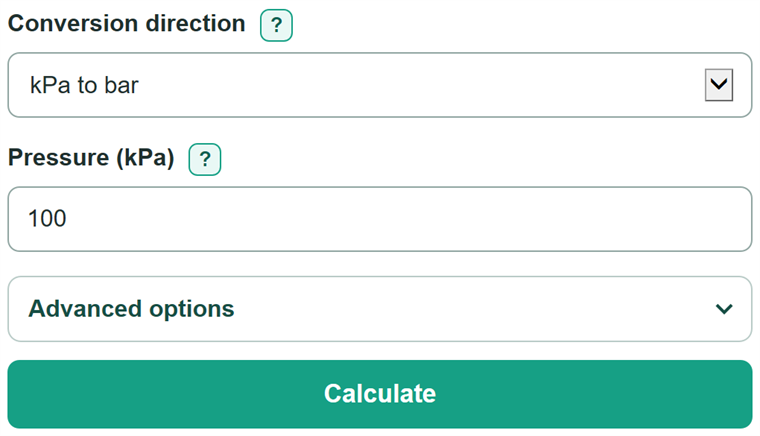
Enter a pressure in kPa to get bar, or switch directions to convert a bar reading into kPa.
Advanced options
The unit conversion is exact. Keep the same gauge, absolute, or differential pressure reference as the source reading.
Table of contents
How to use our kPa to Bar Converter
- Choose the unit printed beside the pressure you are starting with: kPa to bar or bar to kPa.
- Enter the number from the gauge, label, placard, report, or equipment manual. You may include the matching unit, such as 250 kPa.
- Click Calculate. The first card shows the converted pressure in the target unit.
- Check that the result has the unit you need and keeps the same pressure reference, such as gauge pressure or absolute pressure.
- Use Automatic decimal places unless you must copy a rounded value into a form, report, or gauge setting.
Definitions
kPa (kilopascal): A pressure unit equal to 1,000 pascals.
bar: A pressure unit equal to 100,000 pascals. One bar equals 100 kPa.
Gauge pressure: Pressure measured relative to the surrounding air pressure.
Absolute pressure: Pressure measured relative to a perfect vacuum.
Decimal places: Digits displayed to the right of the decimal point. Changing this setting rounds the display but does not change the conversion.
Common mistakes and quick fixes
Mistake: Multiplying kPa by 100 to convert it to bar.
Fix: Divide kPa by 100. For example, 250 kPa equals 2.5 bar.
Mistake: Dividing bar by 100 to convert it to kPa.
Fix: Multiply bar by 100. For example, 2 bar equals 200 kPa.
Mistake: Copying the number but missing the unit beside it.
Fix: Check whether the source says kPa or bar, then choose the matching starting unit.
Mistake: Entering commas incorrectly, such as 1,00.
Fix: Use commas only in groups of three digits, such as 1,000, or enter 1000 without a comma.
Mistake: Mixing gauge pressure with absolute pressure.
Fix: Keep the same reference after conversion. The unit factor changes the number, not what the pressure is measured against.
Mistake: Rounding a very small converted value to zero too early.
Fix: Start with Automatic decimal places, then use a rounded display only when the destination requires it.
Limitations & Key Assumptions / Boundary Conditions
- This converter changes pressure units only. It does not identify a safe pressure for a tire, tank, pipe, tool, or other equipment.
- Gauge pressure and absolute pressure use the same kPa-to-bar factor, but they are different pressure references and cannot be substituted for each other.
- Negative values can occur in gauge or differential pressure readings. Negative absolute pressure is not physically valid.
- A chosen decimal-place setting can display a small nonzero value as zero. Use Automatic when small values matter.
- Follow the unit, pressure reference, and permitted range stated by the equipment label, manual, or engineering specification.
Methodology
Conversion rule
One bar equals 100 kPa, based on the definitions of bar and kilopascal.
pressure in bar = pressure in kPa / 100
pressure in kPa = pressure in bar * 100
Worked example
For 250 kPa, divide by 100: 250 / 100 = 2.5, so the converted pressure is 2.5 bar. In the reverse direction, 0.125 bar * 100 = 12.5 kPa.
Display rounding
The calculator converts the full entered value before formatting the answer. Automatic display keeps enough digits to show a small nonzero conversion. A selected number of decimal places changes only the displayed rounding.