
Enter a pressure in bar to find the same pressure in kilopascals (kPa), using exactly 100 kPa for each bar.
Table of contents
How to use our Bar to kPa Converter
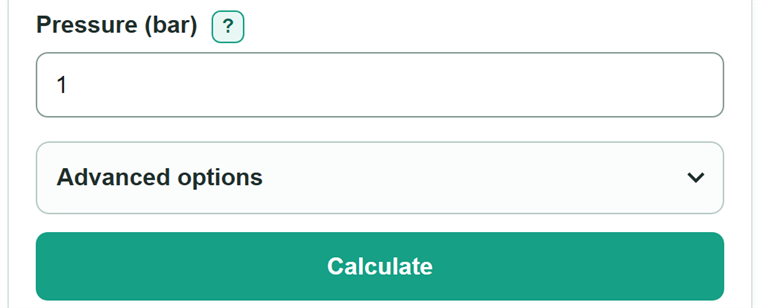
- Copy the value from your gauge, label, manual, or data sheet into Pressure (bar).
- Enter one number, such as 1.5 or 1.5 bar. Do not enter a range or a calculation.
- Open Advanced options and change Result decimal places only if you need a different displayed precision.
- Select Calculate to see Pressure in kilopascals.
- Sanity-check the answer by multiplying bar by 100: 1.5 bar should become 150 kPa.
Definitions
bar: A unit of pressure equal to exactly 100,000 pascals.
kilopascal (kPa): A pressure unit equal to 1,000 pascals. The prefix "kilo" means 1,000.
Pressure in kilopascals: The entered pressure after it is converted from bar to kPa.
Kilopascals per bar: The exact conversion factor: 100 kPa for each bar.
Gauge pressure: Pressure measured compared with the surrounding air pressure.
Absolute pressure: Pressure measured compared with a perfect vacuum.
Common mistakes and quick fixes
Mistake: Entering a kPa value into Pressure (bar).
Fix: Enter the source value in bar. The calculator changes it to kPa.
Mistake: Using 101.325 bar because standard atmospheric pressure is 101.325 kPa.
Fix: Keep the source unit straight. One bar converts exactly to 100 kPa.
Mistake: Typing a calculation or range, such as "1 + 2" or "1 to 2".
Fix: Work out the value first, then enter one number, such as 3 or 1.5.
Mistake: Typing a comma incorrectly, such as "1,01".
Fix: Use commas only for thousands, such as "1,000." Use a decimal point for decimals.
Mistake: Treating a converted gauge reading as absolute pressure.
Fix: Keep the original reference. A barg value becomes kPa gauge, while a bara value becomes kPa absolute.
Limitations & Key Assumptions / Boundary Conditions
- This calculator changes pressure units only. It does not change gauge pressure into absolute pressure or absolute pressure into gauge pressure.
- The conversion is exact before display rounding because 1 bar equals exactly 100 kPa.
- A negative input remains negative. Negative gauge pressure can occur, but negative absolute pressure is not physically possible.
- A small nonzero value can display as zero when few decimal places are selected. Increase Result decimal places when small differences matter.
- Enter one finite value in bar. The calculator does not accept formulas, ranges, malformed comma grouping, or other unit suffixes.
Methodology
Conversion method
One bar is exactly 100,000 pascals, while one kilopascal is 1,000 pascals. That makes one bar exactly 100 kPa. [1]
kPa = bar x 100
The calculator multiplies the entered bar value by 100 and rounds only the displayed pressure to the selected number of decimal places.
Worked example
For 1.01325 bar, multiply by 100.
1.01325 x 100 = 101.325 kPa
With three decimal places selected, the displayed answer is 101.325 kPa.
Pressure reference
The factor is the same for gauge and absolute pressure, but the reference remains part of the measurement. For example, 2 barg becomes 200 kPa gauge, and 2 bara becomes 200 kPa absolute.