
Enter a BTU energy amount to find its equivalent in joules, using the BTU definition named by your source.
Table of contents
How to use our BTU to Joules Converter
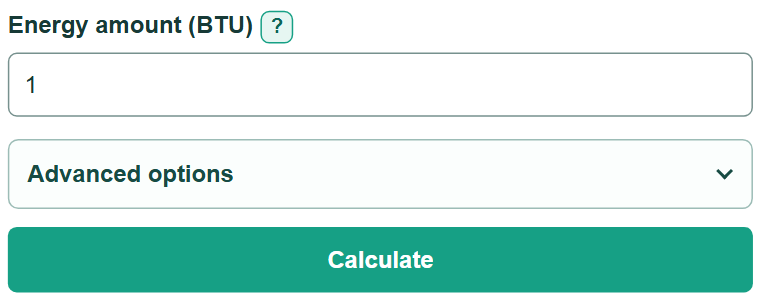
- Enter the energy value in "Energy amount (BTU)." You can type 2.5, 2,500, or 2 BTU.
- Open "Advanced options" and leave "BTU definition" set to "BTU (IT)" unless your source specifically says thermochemical BTU or Btu_th.
- Set "Result decimal places" to match the rounding requested by your assignment or report.
- Click "Calculate" and use "Converted energy (J)" as the matching energy in joules.
- Check that the selected conversion factor matches the BTU definition in your source. A positive BTU amount should produce a positive joule amount.
Definitions
BTU: British thermal unit, a unit of energy often used for heating and energy calculations.
Joule (J): The SI unit of energy.
BTU (IT): International Table BTU. One BTU (IT) equals 1055.05585262 J. [1]
Thermochemical BTU: A separate BTU definition used in some scientific work. One thermochemical BTU equals 1054.35026444 J. [1]
Conversion factor: The number of joules in one BTU for the definition you selected.
BTU/h: BTU per hour, which measures energy transferred over time. It is a rate, not an energy amount.
Common mistakes and quick fixes
Mistake: Entering 12,000 BTU/h, Btu/hr, or BTUH.
Fix: Enter an energy amount in BTU only. These are energy-transfer rates and need a time period before they can be converted to energy.
Mistake: Assuming every BTU uses the same definition.
Fix: Use "BTU (IT)" when the source only says BTU. Choose "Thermochemical BTU" only when the source identifies that basis or says Btu_th.
Mistake: Typing commas in an invalid pattern, such as 1,01.
Fix: Use commas only in thousands groups, such as 1,000, or enter 1000 without commas.
Mistake: Treating display rounding as a different conversion.
Fix: Change "Result decimal places" to show more digits. The calculator multiplies first and rounds only the displayed result.
Mistake: Omitting a negative sign from a signed energy change.
Fix: Enter the signed BTU value from the source. A negative energy change converts to a negative number of joules.
Limitations & Key Assumptions / Boundary Conditions
- This calculator converts energy amounts only. It does not convert rates such as BTU/h, Btu/hr, or BTUH.
- Select thermochemical BTU only when the original source identifies that basis. An unspecified BTU uses the BTU (IT) default.
- The decimal-place setting rounds only the displayed result. Use sufficient digits from the unrounded value in later technical calculations.
- Negative inputs are allowed and produce negative joules. They describe a signed energy change or balance, not an absolute energy amount.
- Extremely large or small values are limited by JavaScript number precision and the selected displayed decimal places.
Methodology
Conversion method
The calculator multiplies the entered BTU amount by the joules-per-BTU factor for the selected definition. NIST lists 1 BTU (IT) as 1.05505585262 kJ and 1 thermochemical BTU as 1.05435026444 kJ. Multiplying each value by 1,000 gives the factors in joules. [1]
joules = BTU amount x selected joules-per-BTU factor
BTU (IT) factor = 1055.05585262 J per BTU
thermochemical factor = 1054.35026444 J per BTU
Worked example
For 2.5 BTU (IT), multiply 2.5 by 1055.05585262 J per BTU. The unrounded result is 2637.63963155 J. With "Result decimal places" set to 2, the calculator displays 2637.64 J.
Calculation boundaries
The calculator keeps the full conversion result until it formats the visible answer. It accepts zero and signed energy amounts. It rejects blank values, malformed comma grouping, nonfinite numbers, and rate labels such as BTU/h because a rate cannot be directly converted to an energy amount without time.