
Enter an energy amount in joules, kilojoules, or megajoules to find its equivalent in British thermal units (BTU).
Table of contents
How to use our Joules to BTU Converter
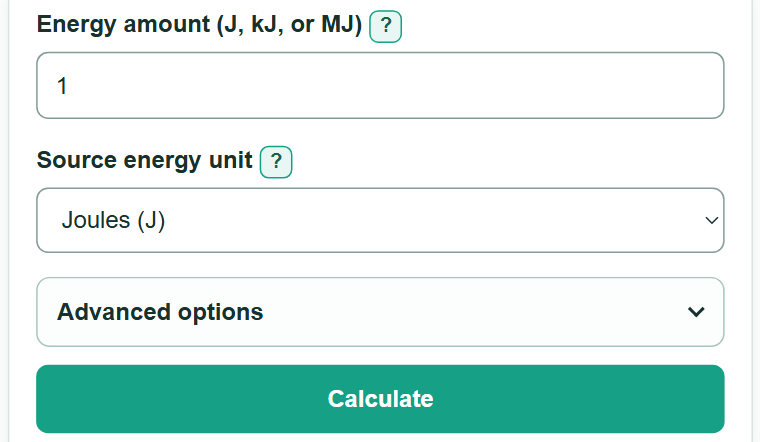
- First choose the unit printed beside your source number in "Source energy unit".
- Then enter the original number from your worksheet, instrument, specification, or calculation in "Energy amount (J, kJ, or MJ)". If you change "Source energy unit" after entering a number, the displayed number is converted to keep the same energy.
- Select "Calculate" to see the equivalent energy in BTU.
- Check "BTU for 1 selected source unit" if you want to confirm the factor being applied to each J, kJ, or MJ.
- Open "Advanced options" and change "Result decimal places" when you need more or fewer displayed digits. This changes display rounding only, not the conversion.
Definitions
Joule (J): The SI unit of energy.
Kilojoule (kJ): 1,000 joules.
Megajoule (MJ): 1,000,000 joules.
British thermal unit (BTU): A unit of energy. This calculator uses the International Table BTU, where 1 BTU equals 1,055.05585262 J.
BTU per hour (BTU/h): A power rate, meaning energy transferred each hour. It is not the same as BTU.
Common mistakes and quick fixes
Mistake: Entering a value stated in kJ or MJ while "Source energy unit" is set to J.
Fix: Choose the unit printed beside the source number before entering the amount. If you already entered the number with the wrong unit selected, choose the correct unit and then re-enter the original source number. Changing the unit alone preserves the energy already entered. One kJ is 1,000 J, and one MJ is 1,000,000 J.
Mistake: Typing 1,01 as a grouped number.
Fix: Use commas only in groups of three digits, such as 1,000. Use a decimal point for a fraction, such as 1.01.
Mistake: Using a BTU result as though it were BTU per hour.
Fix: BTU is an amount of energy. BTU per hour is a power rate and requires a time basis.
Limitations & Key Assumptions / Boundary Conditions
- This calculator converts energy only. It does not convert power, watts, BTU per hour, or equipment capacity without a time basis.
- The calculation uses the International Table definition of BTU. Other historical BTU definitions differ slightly.
- The displayed answer is rounded to the selected number of decimal places, while the calculation uses the unrounded value.
- Negative energy inputs remain negative. Their physical meaning depends on the sign convention used by the original measurement or calculation.
Methodology
Conversion method
The calculator first converts the entered amount to joules, then divides by the number of joules in one International Table BTU. NIST gives 1 International Table BTU as 1,055.05585262 J.
energy in J = entered amount x 1 for J, x 1,000 for kJ, or x 1,000,000 for MJ
BTU = energy in J / 1,055.05585262
Worked example
For 1 kJ, the calculator first converts 1 kJ to 1,000 J. Then 1,000 divided by 1,055.05585262 equals 0.947817120313 BTU, displayed as 0.947817 BTU at six decimal places.
The supporting factor uses the same calculation. One MJ equals 1,000,000 J, so it equals 947.817120313317 BTU.