
Convert stones, plus optional extra pounds, into US short tons, UK long tons, or metric tons.
Table of contents
How to use our Stones to Tons Converter
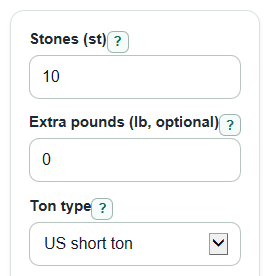
- Enter the main weight in Stones (st); one stone means 14 pounds.
- If your weight is written like 11 st 4 lb, put the 4 in Extra pounds (lb, optional); leave it as 0 for whole stones.
- Choose Ton type: US short ton for most US uses, UK long ton for some imperial contexts, or metric ton for tonne-based weights.
- Select Calculate, then read Weight in selected tons first and use Total weight in pounds as a quick check.
- Sanity-check small answers: 10 stones is only 140 lb, so a result well under 1 ton is expected.
Definitions
Stone (st): A weight unit equal to 14 pounds.
Extra pounds (lb, optional): Pounds added after the stone amount, as in 11 st 4 lb.
US short ton: A ton equal to 2,000 pounds. This is the default because it is the common US ton.
UK long ton: A ton equal to 2,240 pounds. This may appear in older or UK imperial weight contexts.
Metric ton: A metric unit equal to 1,000 kilograms. It is also called a tonne.
Conversion factor used: The number of selected tons in 1 stone, based on the chosen Ton type.
Common mistakes and quick fixes
Mistake: Entering pounds in Stones (st).
Fix: Put stones in Stones (st) and put leftover pounds in Extra pounds (lb, optional).
Mistake: Leaving Ton type on US short ton when your source means metric ton.
Fix: Change Ton type to Metric ton before using Weight in selected tons.
Mistake: Typing 18 in Extra pounds (lb, optional) for standard stone-and-pound notation.
Fix: Convert 18 lb to 1 st 4 lb, or keep it as 18 only if you want the calculator to add pounds directly and show Check your entry.
Mistake: Comparing Weight in selected tons from one Ton type with another ton definition.
Fix: Check Ton type used before copying the result.
Mistake: Rounding too early from Total weight in kilograms and then converting again.
Fix: Use Weight in selected tons as the final ton answer and Total weight in kilograms only as a supporting check.
Limitations & Key Assumptions / Boundary Conditions
- The converter treats a stone as exactly 14 pounds.
- The default Ton type is US short ton, but the word ton can also mean UK long ton or metric ton.
- Extra pounds (lb, optional) can be 14 or more, but standard stone-and-pound writing usually keeps it below 14.
- Metric ton results use pounds converted to kilograms with 1 lb = 0.45359237 kg, then divide by 1,000.
- Results are unit conversions only. They do not include scale accuracy, package tare weight, or rounding rules from a shipping or legal document.
- Very large entries are formatted for readability, but the useful precision still depends on how accurately you measured the original weight.
Methodology
How the conversion is done
The calculator first changes the stone-and-pound entry into one pound value. It then divides by the selected ton size, or converts to kilograms first for metric tons.
total_pounds = stones * 14 + extra_pounds
short_tons = total_pounds / 2000
long_tons = total_pounds / 2240
kilograms = total_pounds * 0.45359237
metric_tons = kilograms / 1000
conversion_factor = tons for 1 stone using the selected ton type
Worked example
For 11 st 4 lb with US short ton selected, total pounds = 11 * 14 + 4 = 158 lb. The ton result is 158 / 2000 = 0.079 US short tons. The kilogram support value is 158 * 0.45359237 = 71.66759446 kg.
Validation choices
A blank Stones (st) entry is an error because the main weight is missing. A blank Extra pounds (lb, optional) entry is treated as 0. Negative weights are blocked. Extra pounds of 14 or more are allowed because the math still works, but the result includes a note because standard stone-and-pound notation usually rolls 14 lb into 1 more stone.