
Convert a heating or cooling rate between BTU/h and thermal watts, or estimate an air conditioner's electrical input using its EER or CEER.
Table of contents
How to use our BTU to Watts Converter
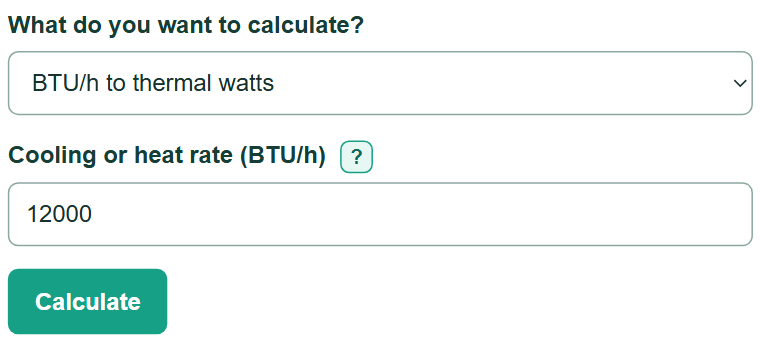
- Choose "BTU/h to thermal watts" if you have a heating or cooling capacity, "Watts to BTU/h" if you have thermal watts, or "AC electrical input estimate" for an air conditioner.
- Enter the active value from the equipment label, product listing, quote, or specification sheet.
- For "AC electrical input estimate", enter the EER or CEER printed for that exact unit.
- Click "Calculate" to see the conversion or estimated electrical input.
- Sanity-check the unit: 12,000 BTU/h is about 3,516.9 thermal watts, but it is not automatically the electricity the AC draws from the wall.
Definitions
BTU/h: British thermal units per hour. This is a heat-flow rate commonly used for heating and air-conditioning capacity.
Watt (W): A unit of power, or energy transferred each second.
Thermal power: Heating or cooling capacity expressed as a rate. For an air conditioner, it is different from electrical power drawn from an outlet.
EER: Energy efficiency ratio. It divides cooling capacity in Btu/h by electrical input in watts.
CEER: Combined energy efficiency ratio. This equipment rating can also be used in the electrical-input estimate when it is provided for the unit.
Common mistakes and quick fixes
Mistake: Entering a plain BTU total.
Fix: Enter a rate in BTU/h. A BTU total is energy, while watts measure a rate of energy use or transfer.
Mistake: Treating thermal watts as an air conditioner's electrical input.
Fix: Select "AC electrical input estimate" and enter the unit's EER or CEER.
Mistake: Leaving EER or CEER blank, or entering 0.
Fix: Copy a rating greater than 0 from the EnergyGuide label or product specifications.
Mistake: Using electrical watts in the "BTU/h to thermal watts" calculation.
Fix: Select "Watts to BTU/h" only when the starting number is already thermal power in watts.
Limitations & Key Assumptions / Boundary Conditions
- The direct conversion needs a heat-flow rate in BTU/h, not a plain BTU energy total.
- Thermal watts describe heating or cooling capacity and are not an air conditioner or heat pump's actual electrical demand.
- The AC estimate is capacity divided by the entered EER or CEER; actual electrical input can vary with operating conditions.
- This calculator does not estimate run time, kWh use, utility cost, duct losses, or room size.
- Thermal power inputs must be 0 or greater, and EER or CEER must be greater than 0.
Methodology
Conversion method
The calculator uses the International Table BTU conversion basis published by NIST to convert a per-hour heat rate to watts.
thermal watts = BTU/h x 0.2930710701722222
thermal BTU/h = thermal watts / 0.2930710701722222
thermal kilowatts = thermal watts / 1000
AC electrical-input estimate
EER and CEER state cooling capacity per electrical watt. The estimate divides the entered cooling capacity by the entered rating.
estimated AC electrical input (W) = BTU/h / EER or CEER
Mini-example
A 12,000 BTU/h unit converts to 3,516.8528 thermal W, or 3.516853 kW. With an EER of 12 Btu/Wh, the estimated electrical input is 12,000 divided by 12, which is 1,000 W.
Calculation boundaries
The direct conversion is exact for the stated units. The AC value is an estimate because EER or CEER is an equipment rating, while real electrical input can change during operation.