
Convert cubic feet to U.S. liquid, U.S. dry, or Imperial quarts using the selected definition.
Advanced options
Table of contents
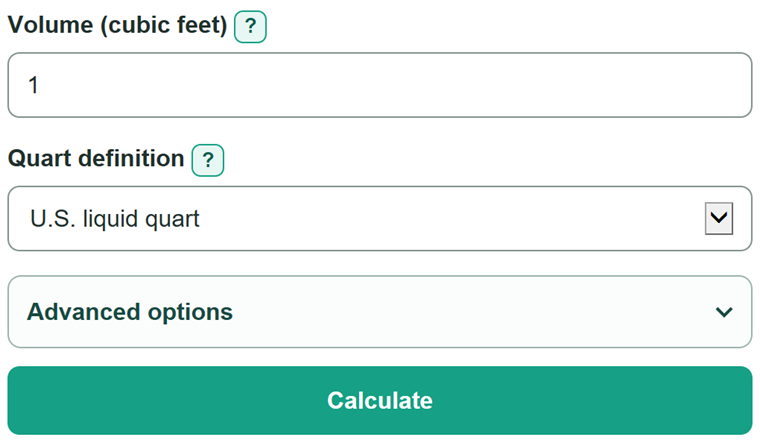
How to use our Cubic Feet to Quarts Converter
- Enter the volume in cubic feet from a label, measurement, specification, or worksheet. Type a value such as 1.5 or 1.5 ft3.
- Choose the quart definition used by the source: U.S. liquid, U.S. dry, or Imperial.
- Select Calculate to see the selected quart amount first, followed by the other two quart amounts for comparison.
- Sanity-check the unit label before using the answer. A liquid-capacity problem normally needs U.S. liquid quarts, while some dry-material labels use U.S. dry quarts.
Definitions
Cubic foot (ft3): A volume equal to a cube that is 1 foot long, 1 foot wide, and 1 foot high.
U.S. liquid quart: A U.S. capacity unit for liquids. One cubic foot is about 29.9221 U.S. liquid quarts.
U.S. dry quart: A U.S. dry-volume unit. It is larger than a U.S. liquid quart, so one cubic foot is about 25.7140 U.S. dry quarts.
Imperial quart: A quart in the Imperial measurement system. It differs from both U.S. quart definitions.
Conversion factor: The number of quarts in 1 cubic foot for a particular quart definition.
Common mistakes and quick fixes
Mistake: Treating all quarts as the same size.
Fix: Choose the quart definition printed on the source. U.S. liquid, U.S. dry, and Imperial quarts give different answers.
Mistake: Entering gallons, cubic inches, or another unit in the cubic-feet field.
Fix: Convert the source amount to cubic feet first, then enter that value.
Mistake: Using U.S. liquid quarts for a dry-volume label.
Fix: Check the product label or assignment. Some soil and other dry materials use U.S. dry quarts.
Mistake: Typing a negative volume.
Fix: Enter zero or a positive physical volume. Negative values are not supported.
Mistake: Typing a malformed number such as 1,01.
Fix: Use commas only for thousands, such as 1,000.5, and use a decimal point for fractions.
Limitations & Key Assumptions / Boundary Conditions
- This converter accepts physical volumes of zero or more cubic feet; negative volumes are not supported.
- The correct answer depends on the quart definition. Confirm an unlabeled use of "quart" before relying on the result.
- The calculation converts volume only. It does not account for settling, compaction, moisture, air gaps, or container shape in materials such as soil or gravel.
- Changing the decimal-place setting changes displayed rounding only, not the underlying conversion.
Methodology
Conversion method
The calculator multiplies the entered cubic-foot volume by a fixed number of quarts per cubic foot. The factor changes because U.S. liquid, U.S. dry, and Imperial quarts are different units. The unit relationships used for the conversion factors follow NIST conversion guidance.
U.S. liquid quarts = cubic feet * 29.922077922077922
U.S. dry quarts = cubic feet * 25.714046558345
Imperial quarts = cubic feet * 24.915341836171
Worked example
For 1 cubic foot, multiply each factor by 1. Shown to four decimal places, the answers are 29.9221 U.S. liquid quarts, 25.7140 U.S. dry quarts, and 24.9153 Imperial quarts. The lower dry and Imperial counts do not mean less volume; each of those quart units is larger.
Rounding
The calculator uses the stored conversion factors before rounding the displayed answer. Zero cubic feet is valid and converts to zero quarts for every definition.