
Convert cubic feet to cubic meters with the exact factor, plus liters and a quick check back to cubic feet.
Table of contents
How to use our Cubic Feet to Cubic Meters Converter
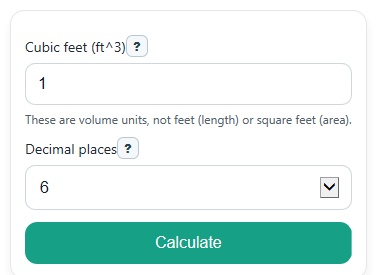
- Enter your volume in Cubic feet (ft^3). This should be a volume, not a length in feet or an area in square feet.
- Pick Decimal places to control how much rounding you want in the displayed results.
- Click Calculate to see Cubic meters, Liters, Check back in cubic feet, and the Conversion factor used.
- Sanity-check the answer by comparing Check back in cubic feet to your starting value. If they differ a little, that is usually just display rounding.
Definitions
Cubic foot (ft^3): A unit of volume based on a cube that is 1 foot long, 1 foot wide, and 1 foot high.
Cubic meter (m^3): A metric unit of volume based on a cube that is 1 meter long, 1 meter wide, and 1 meter high.
Liter (L): A metric volume unit. One cubic meter equals 1,000 liters.
Conversion factor used: The number multiplied by cubic feet to get cubic meters. In this calculator, it is 0.028316846592 m^3 per ft^3.
Reverse check: The converted cubic meter value changed back into cubic feet so you can confirm the result makes sense.
Decimal places: How many digits appear after the decimal point in the displayed results.
Common mistakes and quick fixes
Mistake: Entering square feet or plain feet into Cubic feet (ft^3) .
Fix: Use a volume value only. If you have length, width, and height, multiply them first to get cubic feet.
Mistake: Leaving Cubic feet (ft^3) blank or typing text that is not a number.
Fix: Enter a numeric volume such as 1, 25.5, or 1,250.5.
Mistake: Typing a negative value into Cubic feet (ft^3) for a real box, room, or container.
Fix: Enter 0 or a positive number for direct volume measurements.
Mistake: Thinking Liters is a different amount than Cubic meters .
Fix: They are the same volume in different units. 1 cubic meter equals 1,000 liters.
Mistake: Expecting Check back in cubic feet to always match exactly digit for digit.
Fix: Small differences can come from the Decimal places setting. Increase it if you want less visible rounding.
Limitations & Key Assumptions / Boundary Conditions
- This converter is for volume only. It does not convert length in feet or area in square feet.
- The math uses the exact basis 1 foot = 0.3048 meter, so 1 ft^3 = 0.028316846592 m^3. Displayed results can still look slightly different because of rounding.
- Negative values are not appropriate for direct physical volume such as a room, tank, or box. Use 0 or more unless you are intentionally working with signed differences.
- Very small or very large inputs may be harder to read after rounding, even though the conversion method stays the same.
- Liters are shown as a convenience output. For large volumes, many specs prefer cubic meters instead of liters.
Methodology
Calculation method
The calculator converts Cubic feet (ft^3) to Cubic meters by multiplying by the exact cubic-foot factor. That exact factor comes from the exact length definition 1 foot = 0.3048 meter, then cubing both sides [2].
m^3 = ft^3 x 0.028316846592
The Liters output is then found from cubic meters.
L = m^3 x 1000
The Check back in cubic feet output converts the result back to the starting unit.
ft^3 check = m^3 / 0.028316846592
Mini example
If Cubic feet (ft^3) is 100, the calculator multiplies 100 by 0.028316846592.
m^3 = 100 x 0.028316846592 = 2.8316846592
Then it converts that to liters.
L = 2.8316846592 x 1000 = 2831.6846592
With 6 decimal places shown, the main result displays as 2.831685 m^3, and the reverse check displays about 100 ft^3 after rounding.
Rounding and display
Decimal places changes only how many digits are shown on screen. It does not change the exact factor used in the calculation. A lower setting is fine for rough estimates, while a higher setting is better for paperwork, shipping math, or checking another tool.
Assumptions used
This calculator assumes your input is already a volume in cubic feet, uses the exact international foot basis [4], and uses the exact SI relationship 1 m^3 = 1000 L. Real-world packing, usable room space, and container fill levels can differ from pure geometric volume.
Sources
- NIST Guide to the SI, Appendix B.9: Factors for units listed by kind of quantity or field of science - NIST
- Considerations of Current and Emerging Transportation Management Center Data - SI* (Modern Metric) Conversion Factors - FHWA Office of Operations - DOT
- Unit Conversion - NIST
- Cubic Feet & Cubic Meters Conversion (m³ = ft³) - Ginifab