
Convert pressure from atmospheres (atm) to pounds per square inch (psi) with clear rounding and quick cross-checks in kPa and Pa.
Advanced options
Table of contents
How to use our Atmospheres to PSI Converter
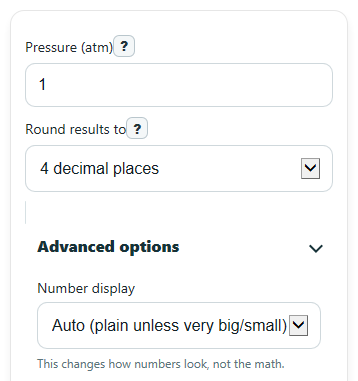
- Enter your value in Pressure (atm). Use decimals if needed, and use a minus sign only if you are doing pure unit-conversion math.
- Choose how many digits to show in Round results to.
- Click Calculate to see Pressure in psi first, then the same pressure in Pressure in kPa and Pressure in Pa.
- Sanity-check the answer with a known reference: 1 atm should be about 14.6959 psi and 101.325 kPa.
- Read the Note output so you do not mix standard atmosphere (atm) with changing local air pressure or gauge readings.
Definitions
atm: Standard atmosphere, a pressure unit defined as 101325 pascals.
psi: Pounds per square inch, a pressure unit commonly used in the US.
Pa: Pascal, the SI pressure unit.
kPa: Kilopascal, equal to 1000 Pa.
Round results to: The number of decimal places shown in the outputs. It changes display precision, not the underlying conversion.
Formula used: The exact conversion relationship the calculator applies so you can check the math by hand.
Common mistakes and quick fixes
Mistake: Leaving Pressure (atm) blank and expecting the converter to guess the value.
Fix: Enter a number in Pressure (atm) , such as 1 or 0.5, then calculate again.
Mistake: Typing psi into Pressure (atm) .
Fix: Make sure Pressure (atm) is in atmospheres, not psi. If your pressure is already in psi, this page is the wrong conversion direction.
Mistake: Picking a low setting in Round results to and thinking the math changed.
Fix: The conversion stays the same. Increase Round results to if you want more detail in Pressure in psi , Pressure in kPa , or Pressure in Pa .
Mistake: Confusing Pressure in psi with a gauge reading from a tire tool or pump.
Fix: Check the Note output. This converter uses standard atmosphere (atm) as a unit definition, not a live local weather reading.
Mistake: Assuming Pressure in Pa should always be a small number.
Fix: Pascals are a small unit, so the Pressure in Pa value is often much larger than Pressure in kPa or Pressure in psi .
Limitations & Key Assumptions / Boundary Conditions
- This page converts the unit atm as a standard defined pressure. It does not estimate live weather pressure at your location.
- The calculator is one-way for atm to psi, with kPa and Pa shown only as cross-check outputs.
- Displayed values are rounded to the setting in Round results to, so what you see may differ slightly from the full internal value.
- Negative values are allowed because unit conversion math can be applied to any number, even though some real pressure situations would not use negative absolute pressure.
- The result does not interpret gauge pressure versus absolute pressure for a specific device. You must know which pressure meaning your original number uses.
Methodology
How the conversion is done
The calculator first converts atmospheres to pascals, then converts pascals to pounds per square inch. It also shows kPa as a quick metric cross-check.
Pa = atm x 101325
psi = Pa / 6894.757
kPa = Pa / 1000
psi = atm x 14.6959
Worked mini-example
If Pressure (atm) is 0.5, then the calculator computes:
Pa = 0.5 x 101325 = 50662.5
psi = 50662.5 / 6894.757 = 7.3479
kPa = 50662.5 / 1000 = 50.6625
With 4 decimal places selected, the main result is 7.3479 psi.
Display and rounding
The calculator keeps the internal conversion value, then rounds the displayed outputs to your chosen setting in Round results to. If a very small result rounds to 0, that is only a display effect.
Assumptions used
This converter treats atm as the standard pressure unit equal to 101325 Pa and uses 6894.757 Pa per psi [2]. The Note output is there to remind you that atm in this page is the standard unit, not a changing local atmospheric reading.