
Convert pressure from kilopascals to psi, choose your rounding, and see the exact value for tire, air, or fluid pressure checks.
Table of contents
How to use our kPa to PSI Converter
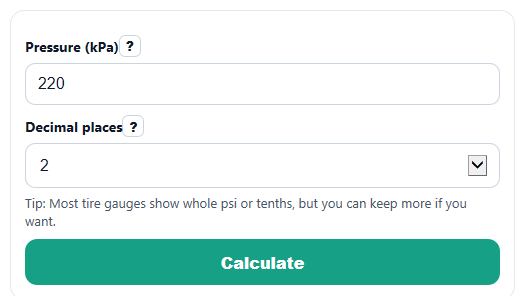
- Enter your value in Pressure (kPa). You can type a whole number or a decimal, such as 220 or 101.325.
- Choose Decimal places to control how rounded the main Pressure in psi result should be.
- Click Calculate to see Pressure in psi, More exact psi value, the Conversion factor used, and the Quick note.
- Sanity-check the answer: if you entered about 200 to 250 kPa for a car tire, the psi result should usually land around the upper 20s to mid 30s, not single digits or hundreds.
Definitions
kPa: Kilopascal, a metric pressure unit. One kPa equals 1,000 pascals.
psi: Pounds per square inch, a pressure unit commonly used on US tire gauges.
Pressure in psi: The main converted result after your Pressure (kPa) value is changed into psi.
More exact psi value: The same conversion shown with more digits so you can round it yourself if needed.
Conversion factor used: The fixed number used to change kPa into psi. In this calculator, it is 0.1450377377 psi per kPa.
Gauge pressure: Pressure measured relative to the air around you. Tire gauges usually show this value [1].
Absolute pressure: Pressure measured relative to a perfect vacuum. It is higher than gauge pressure by about one atmosphere [1].
Common mistakes and quick fixes
Mistake: Leaving Pressure (kPa) blank and expecting a result.
Fix: Enter a number in Pressure (kPa) , such as 220, then calculate again.
Mistake: Typing psi into Pressure (kPa) by accident.
Fix: Make sure the number you enter is really in kPa before reading Pressure in psi .
Mistake: Using a negative value in Pressure (kPa) for a tire or normal gauge reading.
Fix: Enter 0 or greater in Pressure (kPa) for this converter.
Mistake: Choosing 0 in Decimal places and thinking the rounded Pressure in psi is the exact answer.
Fix: Check More exact psi value when you need extra precision.
Mistake: Reading Pressure in psi as absolute pressure for a tire.
Fix: Read the Quick note ; tire gauges usually show gauge pressure, not absolute pressure.
Limitations & Key Assumptions / Boundary Conditions
- This converter only changes Pressure (kPa) into psi. It does not do reverse conversion on this page.
- The input must be 0 or greater because this page is aimed at common tire, air, and fluid pressure use.
- Pressure in psi is rounded to your chosen Decimal places, so small differences can appear if another tool rounds differently.
- More exact psi value is still a formatted display, not an unlimited-digit value.
- This converter does not change gauge pressure into absolute pressure or absolute pressure into gauge pressure. That difference matters for tire readings [1].
- Real gauges can read a little high or low, so your measured tire pressure may not match the converted number exactly.
Methodology
How the conversion works
The calculator converts the number from Pressure (kPa) into psi using one fixed unit conversion.
psi = kPa / 6.894757293168361
psi = kPa * 0.1450377377
Both formulas mean the same thing. The second one uses the direct factor in psi per kPa.
Where the factor comes from
The factor is built from standard pressure-unit relationships.
1 kPa = 1000 Pa
1 psi = 6894.757 Pa
psi = (kPa * 1000) / 6894.757
1 kPa = 0.1450377377 psi
Worked example
If Pressure (kPa) is 220, then:
psi = 220 * 0.1450377377 = 31.908302294
If Decimal places is 2, the displayed Pressure in psi becomes 31.91 psi, while More exact psi value stays 31.908302294 psi.
Rounding used
The main result uses the number of digits chosen in Decimal places. The exact result is shown with higher precision so you can check whether rounding changed the reading much.
Assumptions and scope
This page assumes you are converting a nonnegative kPa value for normal pressure uses such as tires, air, or fluids. It does not adjust for gauge versus absolute pressure; it only converts units. Tire gauges usually report gauge pressure, while absolute pressure includes the surrounding air pressure too [1].