
Convert pressure from bar to psi with clear rounding, a reverse-check back to bar, and a simple method you can verify.
Table of contents
How to use our Bar to PSI Converter
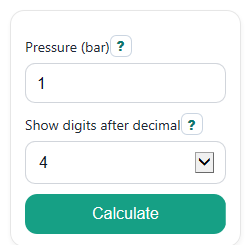
- Enter the value in Pressure (bar).
- Choose Show digits after decimal to control how much rounding you want in the displayed answer.
- Click Calculate to see Pressure in psi, the back-check in Check by converting back to bar, and the method lines.
- Sanity-check the result: 1 bar should be about 14.5038 psi, and if your input was 0, the psi result should also be 0.
- If the back-check is a tiny bit different from your starting value, read Rounding note; that small difference usually comes from display rounding, not bad math.
Definitions
Bar: A pressure unit. In this calculator, it is the starting unit you enter in Pressure (bar).
PSI: Pounds per square inch, a pressure unit commonly used in the US. It is the unit shown in Pressure in psi.
Pascal (Pa): The SI pressure unit. This calculator shows the bar-to-psi conversion path through pascals in Using pascals in between.
Conversion factor: The number used to change bar into psi. Here, 1 bar = 14.5037738 psi.
Reverse-check: A check that takes the displayed psi result and converts it back into bar using the same factor, so you can spot rounding effects.
Rounding: Shortening a number to a chosen number of decimal places for display. The visible answer may be rounded even when the internal math uses more digits.
Common mistakes and quick fixes
Mistake: Leaving Pressure (bar) blank and expecting 0 to be used.
Fix: Enter a real number in Pressure (bar). A blank field should be corrected, not treated as zero.
Mistake: Typing text like "two" or extra symbols into Pressure (bar).
Fix: Use numbers only in Pressure (bar), such as 2, 2.5, or -1.2.
Mistake: Reading Pressure in psi as exact to every hidden digit.
Fix: Remember that Show digits after decimal changes only the displayed rounding. The calculator keeps more precision before rounding the visible result.
Mistake: Thinking Check by converting back to bar must always match the starting bar value perfectly.
Fix: A tiny difference is normal when the displayed psi value has been rounded first. Use Rounding note to interpret that difference.
Mistake: Forgetting that negative values in Pressure (bar) are allowed by the math.
Fix: If you enter a negative number, Pressure in psi will also be negative. For most everyday gauges, check whether a negative reading makes sense for your reference system.
Mistake: Ignoring Using pascals in between when you want to verify the factor.
Fix: Use Using pascals in between to see the standard path from bar to pascals to psi, then compare it with Formula used.
Limitations & Key Assumptions / Boundary Conditions
- This converter handles bar to psi only. It does not convert to other pressure units.
- The displayed value depends on Show digits after decimal. Fewer digits can make the reverse-check differ slightly from the original bar input.
- The reverse-check intentionally starts from the displayed psi value, not the hidden full-precision value, so you can see the effect of rounding.
- Negative inputs are allowed because the unit conversion math still works, but many real gauge readings are expected to be nonnegative unless a specific reference system is used.
- The pascal bridge uses 1 bar = 100,000 Pa and 1 psi = 6,894.757 Pa. Very small last-digit differences can appear if another source uses a different rounded psi-to-pascal value.
- This page converts units only. It does not judge whether a pressure is safe, normal, or correct for your equipment.
Methodology
How the conversion is calculated
The main conversion multiplies the entered bar value by the bar-to-psi factor.
psi = bar x 14.5037738
This calculator keeps full internal precision, then rounds the displayed answer to the number chosen in Show digits after decimal.
Reverse-check
To help you see rounding effects, the calculator takes the displayed psi result and converts that rounded display value back to bar.
bar_check = psi_displayed / 14.5037738
If the back-check is slightly different from your starting value, that usually means the displayed psi value was rounded first.
Pascal bridge
The factor can also be shown through pascals. One bar equals 100,000 pascals, and one psi is commonly published as 6,894.757 pascals [1].
psi = (bar x 100000) / 6894.757
Using that path gives the same conversion factor used by the calculator, apart from tiny last-digit differences caused by rounding of published constants.
Mini-example
If Pressure (bar) is 2.5, then:
psi = 2.5 x 14.5037738 = 36.2594345
If you choose 4 digits after the decimal, the displayed Pressure in psi is 36.2594.
bar_check = 36.2594 / 14.5037738 = about 2.499998
That tiny difference from 2.5 bar is just display rounding.
Calculation choices
The calculator allows zero and negative numbers because unit conversion math works for any real number. It blocks blank or non-numeric input because those do not define a pressure value. Large results are shown in plain decimal form with commas for easier reading instead of scientific notation.