
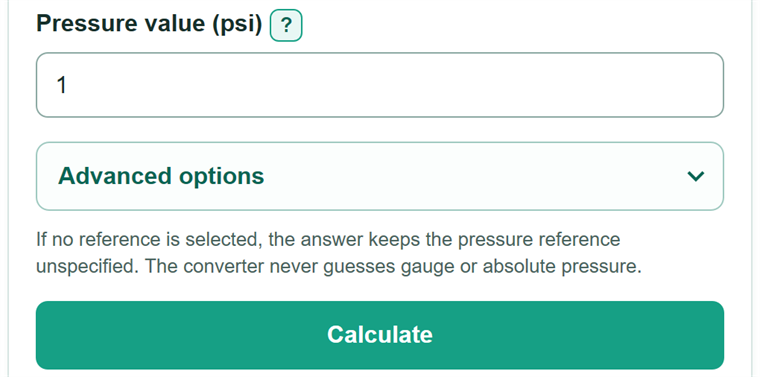
Enter a pressure in psi to find its kPa equivalent, while keeping a gauge or absolute pressure reference unchanged.
Advanced options
If no reference is selected, the answer keeps the pressure reference unspecified. The converter never guesses gauge or absolute pressure.
This is the same pressure in kPa. The unit changes, but the gauge or absolute reference does not.
Gauge stays gauge, absolute stays absolute, and an unspecified reference remains unspecified.
Formula: pressure in kPa = pressure in psi x 6.894757.
Table of contents
How to use our PSI to kPa Converter
- Enter the psi value from your gauge, placard, manual, or specification in Pressure value (psi).
- Enter a number alone, or add psi, psig, or psia after it if that is how the source labels the reading.
- Open Advanced options if the source says psig, psia, gauge, or absolute, or if you need a specific number of decimal places.
- Click Calculate to read the matching value under Pressure in kilopascals (kPa).
- Check the scale: 1 psi equals about 6.9 kPa, so 32 psi should convert to about 221 kPa.
Definitions
psi: Pounds per square inch, a pressure unit commonly used in the United States.
kPa: Kilopascal, a metric pressure unit. One psi equals 6.894757 kPa.
Gauge pressure (psig): Pressure measured relative to the surrounding air pressure.
Absolute pressure (psia): Pressure measured relative to a perfect vacuum. It cannot be below zero.
kPag and kPaa: kPa gauge and kPa absolute. These labels preserve the same pressure reference after conversion.
Common mistakes and quick fixes
Mistake: Entering a kPa reading in the psi field.
Fix: Check Pressure value (psi) and then recalculate. Enter the source number only when it is stated in psi. The calculator converts that value to kPa.
Mistake: Typing another unit, such as "32 bar," in Pressure value (psi).
Fix: Use a psi value, or add only psi, psig, or psia after the number. This converter does not convert bar to kPa.
Mistake: Treating psig and psia as the same reference.
Fix: Check Pressure value (psi) and then recalculate. Choose gauge for psig and absolute for psia in Advanced options. The unit changes, but the pressure reference stays the same.
Mistake: Entering a negative absolute pressure.
Fix: Check Pressure value (psi) and then recalculate. Absolute pressure must be 0 psi or higher. A negative gauge pressure can be valid.
Mistake: Using a rounded kPa display as an exact technical value.
Fix: Increase Result decimal places when you need to match a manual, specification, or calculation more closely.
Limitations & Key Assumptions / Boundary Conditions
- This converter changes units only. It does not add or subtract atmospheric pressure.
- Select gauge or absolute only when the source identifies the reading as psig, psia, gauge, or absolute. An unqualified psi value remains unspecified.
- A negative value is allowed for gauge pressure but not for absolute pressure.
- Displayed rounding can hide small differences. Increase Result decimal places when matching a technical specification.
- For tire inflation, use the recommended cold pressure on the vehicle placard or in the owner's manual. Do not assume a tire sidewall marking is the vehicle's recommended pressure.
- Values too large to calculate as a finite number are rejected.
Methodology
Calculation
The converter multiplies the entered psi value by 6.894757 kPa per psi. It applies rounding only after calculating the full result.
pressure in kPa = pressure in psi x 6.894757
Worked example
For 32 psi, multiply 32 by 6.894757. The unrounded answer is 220.632224 kPa. With Result decimal places set to 1, the displayed answer is 220.6 kPa.
32 x 6.894757 = 220.632224 kPa
Pressure reference
Choosing gauge or absolute changes the result label, not the multiplication. A gauge reading stays gauge pressure after conversion, and an absolute reading stays absolute pressure. The calculator does not estimate local air pressure or convert between gauge and absolute pressure.