
Convert milliliters to pints and make sure you use the right pint type: US liquid, US dry, or Imperial.
Table of contents
How to use our mL to Pints Converter
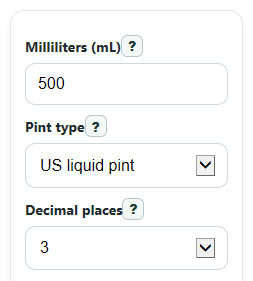
- Enter your amount in Milliliters (mL).
- Choose the correct Pint type for your recipe, package, or country.
- Select Decimal places to control how detailed the answer looks.
- Click Calculate to see Pints, Pint system used, Milliliters in 1 pint, and Calculation used.
- Sanity-check the result by confirming Pint system used matches what you meant, since the same mL value gives different answers for different pint systems.
Definitions
Milliliter (mL): A metric unit of volume. 1000 mL equals 1 liter.
Pint: A volume unit, but it does not always mean the same size. This page lets you choose the pint system you want.
US liquid pint: The US pint used for liquid volume, equal to 473.176473 mL.
US dry pint: The US pint used for dry volume, equal to 550.6104713575 mL.
Imperial pint (UK): The British Imperial pint, equal to 568.26125 mL [1].
Decimal places: The number of digits shown after the decimal point in the Pints result.
Common mistakes and quick fixes
Mistake: Leaving Milliliters (mL) blank and expecting it to count as 0.
Fix: Enter a real number in Milliliters (mL) , such as 500 or 1000.
Mistake: Picking the wrong Pint type , especially mixing up US liquid pint and Imperial pint (UK) .
Fix: Check Pint system used after calculating and switch Pint type if it does not match your source.
Mistake: Typing a negative value in Milliliters (mL) .
Fix: Use 0 or a positive amount only, because volume cannot be negative in this converter.
Mistake: Thinking Decimal places changes the actual conversion.
Fix: Use Decimal places only to control rounding on the display; the underlying math for Pints stays the same.
Mistake: Reading only Pints and ignoring Milliliters in 1 pint .
Fix: Check Milliliters in 1 pint if you want to verify the answer or compare pint systems.
Mistake: Rounding too early when checking the math by hand.
Fix: Use the full value shown in Calculation used and round only the final Pints result.
Limitations & Key Assumptions / Boundary Conditions
- This converter only changes Milliliters (mL) into Pints; it does not convert other starting units.
- The answer depends completely on the selected Pint type. Choosing the wrong pint system gives the wrong result even if the math is done correctly.
- Displayed values are rounded to the chosen Decimal places, so the screen result may be slightly shorter than the full precision value.
- This tool assumes standard defined pint values and does not adjust for recipe conventions, container labeling habits, or regional shorthand.
- Milliliters (mL) must be 0 or greater. Blank, negative, or non-numeric entries should be corrected before using the result.
- Very small results can look like 0.00 or 0.000 if you choose too few Decimal places.
Methodology
How the conversion works
The converter divides your Milliliters (mL) value by the number of milliliters in 1 pint for the pint system you selected.
pints = mL / mL_per_pint
US liquid pint: mL_per_pint = 473.176473
US dry pint: mL_per_pint = 550.6104713575
Imperial pint: mL_per_pint = 568.26125
Worked mini-example
If you enter 500 for Milliliters (mL) and choose US liquid pint, the calculation is:
pints = 500 / 473.176473 = 1.056688...
If Decimal places is set to 3, the displayed Pints result is 1.057.
If you choose Imperial pint (UK) instead, the same 500 mL becomes a smaller number of pints because each Imperial pint is larger [3].
How to interpret the result
Pints is your main answer. A larger pint value means your milliliter amount fills more of the selected pint units. The Pint system used and Milliliters in 1 pint outputs help you confirm that you used the correct conversion basis.
Assumptions used
This method assumes standard pint definitions and rounds only at the final display step. It does not guess which pint you meant, so you must choose the correct Pint type before trusting the answer.