
Convert liters to pints and compare US liquid, Imperial, and US dry pint values so you can avoid choosing the wrong pint size.
Table of contents
How to use our Liters to Pints Converter
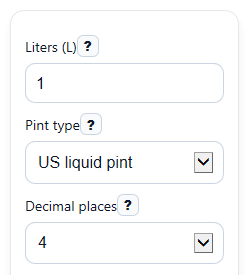
- Enter your amount in Liters (L).
- Choose the correct Pint type: US liquid pint, Imperial pint (UK), or US dry pint.
- Pick Decimal places if you want shorter or more detailed results, then click Calculate.
- Read Pints as your main answer, then check Same volume in US liquid pints, Same volume in Imperial pints, and Same volume in US dry pints to make sure you chose the pint system you actually needed.
- Use Same volume in milliliters as a quick sanity check because 1 liter always equals 1000 milliliters.
Definitions
Liter (L): A metric unit of volume. This calculator also shows the same amount in milliliters.
Pint type: The pint system you want to use for the main conversion. Different systems use different pint sizes.
US liquid pint: A US volume unit commonly used for drinks and other liquids.
Imperial pint (UK): The larger pint used in the British Imperial system.
US dry pint: A US dry-measure pint used for some dry goods, not the same size as a US liquid pint.
Decimal places: How many digits appear after the decimal point in displayed results.
Formula used: The exact conversion rule the calculator applied for your selected pint system.
Milliliters (mL): A smaller metric volume unit. 1 liter equals 1000 milliliters.
Common mistakes and quick fixes
Mistake: Leaving Pint type on the default when you really needed a UK pint or a dry-measure pint.
Fix: Double-check Pint type before you calculate, then compare the three side outputs to see whether the main Pints answer matches your use case.
Mistake: Typing milliliters into Liters (L) , such as entering 500 when you mean 500 mL.
Fix: Enter liters only. For 500 mL, type 0.5 in Liters (L) and confirm with Same volume in milliliters .
Mistake: Thinking Pints is a single universal size.
Fix: Read the Formula used and the selected Pint type together, because the pint size changes by system.
Mistake: Entering a negative number in Liters (L) .
Fix: Use 0 or a positive value only. If the volume is zero, the calculator will show 0 for Pints and the comparison outputs.
Mistake: Expecting rounded display choices to change the real conversion.
Fix: Decimal places only changes how many digits you see. The underlying conversion for Pints stays the same.
Limitations & Key Assumptions / Boundary Conditions
- This converter assumes standard published unit sizes for the three pint systems and does not adjust for package labeling, recipe conventions, or local usage.
- The main Pints result depends entirely on the chosen Pint type. Picking the wrong pint system gives a mathematically correct answer for the wrong unit.
- Inputs must be finite numbers greater than or equal to 0. Blank entries, text, Infinity, and negative values are not valid.
- Displayed values are rounded to the selected Decimal places, so long decimals may look slightly different from full-precision math.
- This tool converts volume only. It does not convert weight, mass, or ingredient density.
Methodology
How the conversion works
The calculator takes your Liters (L) value and divides it by the liter size of one pint in the system you chose. It also calculates the same starting volume in all three pint systems so you can compare them side by side.
US liquid pints = liters / 0.473176473
Imperial pints = liters / 0.56826125
US dry pints = liters / 0.5506104713575
milliliters = liters x 1000
Worked mini-example
If you enter 1 liter and choose US liquid pint, the main result is 1 / 0.473176473 = 2.1134 pints after rounding to 4 decimal places. The same 1 liter is also about 1.7598 Imperial pints, 1.8162 US dry pints, and 1000 milliliters.
How to interpret the results
Pints is the main answer for the pint system you selected. The three comparison outputs help you catch the most common mistake: using the wrong pint type. If those side values look more like what you expected, change Pint type and recalculate.
Assumptions and limits
This method uses fixed conversion constants for standard US liquid, Imperial, and US dry pints. Results can differ from what you expected if a label, recipe, or conversation uses the word "pint" loosely instead of as a precise unit. Rounding only affects what is displayed, not the base conversion math.