
Convert pints to milliliters fast by choosing the correct pint type first, since US liquid, US dry, and UK imperial pints are not the same size.
Table of contents
How to use our Pints to mL Converter
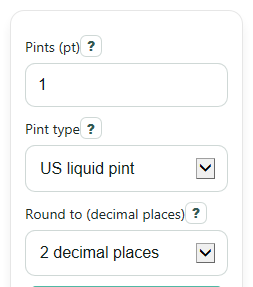
- Enter the amount in Pints. You can use whole numbers or decimals like 1.5.
- Choose the correct Pint type based on your recipe, container, or source: US liquid pint, US dry pint, or UK imperial pint.
- Pick Round to if you want a cleaner displayed answer, then click Calculate.
- Read Milliliters as your main answer, then check Conversion factor used and Pint type used to make sure the calculator used the unit you meant.
- Use Quick comparison as a sanity check: if the result seems too high or too low, your Pint type is the first thing to verify.
Definitions
Pints: The starting volume you want to convert, measured in pt.
Pint type: The definition of pint you want to use. In this calculator, choices are US liquid pint, US dry pint, and UK imperial pint.
Milliliters: The converted metric volume. One milliliter is a very small volume, and 1,000 mL equals 1 liter.
Conversion factor used: The number of milliliters in 1 pint for the selected pint type.
Round to: How many digits the calculator shows after the decimal point in the displayed answer.
Quick comparison: A short note that helps you spot whether your selected pint type is smaller or larger than the other common pint types.
Common mistakes and quick fixes
Mistake: Entering a value in Pints but leaving the wrong Pint type selected.
Fix: Match Pint type to the source you are using before trusting the Milliliters result.
Mistake: Assuming every pint means a US liquid pint.
Fix: Check Pint type used after calculating. If your source is dry goods or UK-based, change Pint type and recalculate.
Mistake: Typing text or leaving Pints blank.
Fix: Enter a numeric value in Pints , such as 1, 0.5, or 2.25.
Mistake: Rounding too early and then using that rounded number in more work.
Fix: Let the calculator compute first, and use Conversion factor used for the exact factor. Use Round to only for display.
Mistake: Thinking a negative Milliliters result is always impossible.
Fix: If Pints is negative, the result shows a signed change. For a physical volume, enter a non-negative value in Pints .
Limitations & Key Assumptions / Boundary Conditions
- This calculator converts only from pints to milliliters. It does not convert back from mL to pints on this page.
- The result depends completely on Pint type. Choosing the wrong pint type will give the wrong Milliliters value.
- Round to changes only the displayed answer. The underlying conversion uses the full factor before rounding.
- Zero is allowed and returns 0 mL.
- Negative values are allowed for math purposes, but a negative physical volume usually does not make sense unless you mean a signed change.
- Very small nonzero inputs can look like 0 if you choose too little rounding, so increase Round to when needed.
Methodology
How the calculator works
The calculator multiplies your entered Pints value by the milliliter factor for the selected Pint type.
mL = pt x factor
It uses one of these fixed factors:
US liquid pint: mL = pt x 473.176473
US dry pint: mL = pt x 550.6104713575
UK imperial pint: mL = pt x 568.26125
Worked example
If you enter 2 for Pints and choose US dry pint, the calculator multiplies 2 by 550.6104713575.
mL = 2 x 550.6104713575 = 1101.220942715
If Round to is set to 2 decimal places, the displayed Milliliters result is 1,101.22 mL.
How to interpret the comparison output
Quick comparison helps you catch wrong-unit mistakes. A US liquid pint is smaller than both a US dry pint and a UK imperial pint, so selecting the wrong type can noticeably change the answer.
Assumptions and limits
This method assumes your source volume is already correctly labeled in one of the three pint types listed. It also assumes standard unit definitions for milliliters and pint-size factors. Real containers, recipes, or labels may be unclear, so unit choice can matter more than rounding.