
Enter liters, choose US or Imperial fluid ounces, and calculate the matching liquid volume.
Table of contents
How to use our Liters to Fluid Ounces Converter
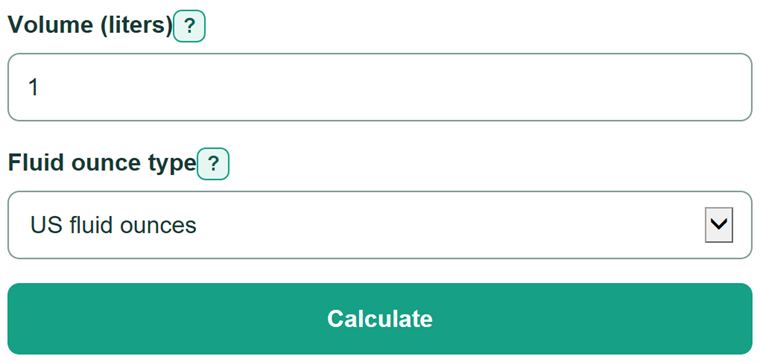
- Enter the volume in liters from a bottle, recipe, package, measuring container, or worksheet.
- Choose US fluid ounces for most US recipes and labels. Choose Imperial fluid ounces only when the source says Imperial or UK units.
- Click Calculate to see the converted volume and the fluid-ounce type used.
- Sanity-check the answer: 1 L is about 33.8 US fluid ounces or 35.2 Imperial fluid ounces, so the Imperial result should be larger for the same liter amount.
Definitions
Liter (L): A metric unit of volume equal to 1,000 milliliters.
Fluid ounce (fl oz): A unit of liquid volume. It is not an ounce of weight.
US fluid ounce: A US customary unit of liquid volume. One US fluid ounce is 29.5735295625 mL. [1]
Imperial fluid ounce: A liquid-volume unit in the Imperial system. It is larger than a US fluid ounce, so 1 L converts to more Imperial fluid ounces than US fluid ounces.
Common mistakes and quick fixes
Mistake: Treating oz and fl oz as the same unit.
Fix: Use this converter for liquid volume only. Weight ounces measure mass, while fluid ounces measure volume.
Mistake: Using US fluid ounces for a source that states Imperial or UK units.
Fix: Select Imperial fluid ounces when the recipe, container, or worksheet specifies Imperial or UK fluid ounces.
Mistake: Entering milliliters as liters.
Fix: Change milliliters to liters first. For example, 500 mL is 0.5 L.
Mistake: Using a comma as a decimal mark, such as 1,5.
Fix: Use a decimal point for part of a liter, such as 1.5. A comma is only for thousands grouping, such as 1,500.
Mistake: Rounding the converted amount too early.
Fix: Keep the decimal result until your final measurement or comparison, especially when scaling a recipe.
Limitations & Key Assumptions / Boundary Conditions
- This converter changes volume only. It does not convert fluid ounces to ounces by weight, grams, pounds, or mass.
- US and Imperial fluid ounces are different units. Select the type named by your recipe, container, or worksheet.
- Input must be a nonnegative volume in liters; negative liquid volume is outside this converter's range.
- The displayed answer may be rounded for readability. Keep more digits if your procedure gives a required precision.
Methodology
Calculation
The converter first changes liters to milliliters, then divides by the number of milliliters in the selected fluid ounce. One liter equals 1,000 mL.
US fluid ounces = liters * 1000 / 29.5735295625
The US fluid-ounce factor uses the US customary volume definition. [1]
Imperial fluid ounces = liters * 1000 / 28.4130625
Worked example
For 0.5 L in US fluid ounces, first change 0.5 L to 500 mL. Then divide 500 by 29.5735295625. The result is about 16.907 US fluid ounces, which may display as 16.9 fl oz.
Rounding
The calculator calculates from the entered value before formatting the display. It uses singular wording for exactly 1 fluid ounce and plural wording for every other amount.