
Enter a US fluid-ounce amount to find its equivalent in liters, using the standard or Nutrition Facts label conversion that matches your source.
Advanced options
Table of contents
How to use our Fluid Ounces to Liters Converter
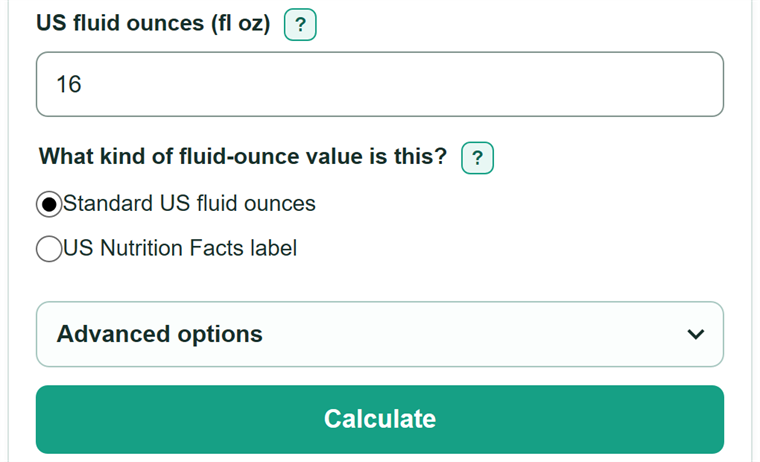
- Enter the liquid volume in US fluid ounces (fl oz), such as 16 or 16 fl oz.
- Choose Standard US fluid ounces for recipes, containers, and ordinary US volume measurements.
- Choose US Nutrition Facts label only when the fluid-ounce amount comes from that US labeling convention.
- Open Advanced options only if you want to change displayed rounding, then select Calculate.
- Check the basis before using the answer: 16 standard US fl oz is about 0.473 L, while 16 Nutrition Facts fl oz is 0.48 L.
Definitions
Fluid ounce (fl oz): A unit of liquid volume. It is different from an ounce used to measure weight.
Liter (L): A metric unit of volume equal to 1,000 milliliters.
Milliliter (mL): One-thousandth of a liter.
Standard US fluid ounce: The ordinary US customary liquid-volume unit. One standard US fluid ounce equals 0.0295735295625 L.
US Nutrition Facts label convention: A US food-labeling convention in which 1 fl oz is treated as 30 mL. It differs from the standard US customary conversion.
Common mistakes and quick fixes
Mistake: Entering 16 oz instead of a liquid measure.
Fix: Check US fluid ounces (fl oz) and then recalculate. Enter 16 fl oz. A weight in ounces needs the substance density before it can be converted to volume.
Mistake: Using the standard choice for a number copied from a US Nutrition Facts label.
Fix: Check US fluid ounces (fl oz) and then recalculate. Select US Nutrition Facts label when that is the source of the fluid-ounce amount.
Mistake: Entering a negative fluid-ounce amount.
Fix: Check US fluid ounces (fl oz) and then recalculate. Enter zero or a positive liquid volume.
Mistake: Typing 1,01 when you mean one point zero one.
Fix: Check US fluid ounces (fl oz) and then recalculate. Use 1.01 for decimals. Use commas only for thousands, such as 1,000.
Mistake: Seeing 0 L after choosing zero decimal places and assuming the converted volume is zero.
Fix: Check US fluid ounces (fl oz) and then recalculate. Choose more decimal places for a small volume. The converter notes when rounding hides a nonzero value.
Limitations & Key Assumptions / Boundary Conditions
- This converter accepts US fluid ounces only and does not convert Imperial fluid ounces.
- A weight in ounces cannot be converted to liters unless the substance density is known. Equal weights of water, oil, and syrup can have different volumes.
- The Standard US fluid ounces and US Nutrition Facts label choices use different factors, so select the choice that matches the source amount.
- Displayed results are rounded to the selected number of decimal places, while the calculation uses the unrounded value.
- Zero is valid. Negative values, ranges, malformed comma grouping, and nonnumeric text are not valid entries.
Methodology
Conversion method
For standard US fluid ounces, the calculator multiplies the entered volume by 0.0295735295625. NIST gives one US fluid ounce as 29.5735295625 mL, which is 0.0295735295625 L.
L = fl oz x 0.0295735295625
For the US Nutrition Facts label selection, the calculator uses 0.03 L per fl oz.
L = fl oz x 0.03
The milliliters value is calculated from the unrounded liters value.
mL = L x 1000
Worked example
For 16 standard US fl oz, 16 x 0.0295735295625 = 0.473176473 L. Multiplying by 1,000 gives 473.176473 mL before display rounding. Under the Nutrition Facts label selection, 16 x 0.03 = 0.48 L, or 480 mL.
Calculation choices
Zero and decimal amounts are allowed. The calculator accepts a matching suffix such as fl oz or fluid ounces, but rejects bare oz because it can mean a weight measurement. Commas must use normal thousands grouping, such as 1,000.