
Enter a mass in milligrams to find the same mass in grams, with rounding for your assignment or record.
Table of contents
How to use our Milligrams to Grams Converter
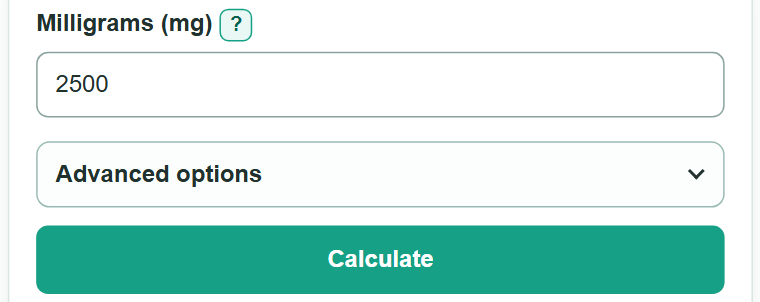
- Copy the source number into "Milligrams (mg)." Enter 2500 or include the matching unit, such as 2500 mg.
- Select "Calculate" to show the same mass in grams.
- Open "Advanced options" if your assignment or record requires a certain number of decimal places.
- Sanity-check the answer by moving the decimal point three places left: 2,500 mg should convert to 2.5 g.
Definitions
Milligram (mg): A unit of mass equal to one-thousandth of a gram.
Gram (g): A unit of mass equal to 1,000 milligrams.
Decimal places: Digits shown to the right of the decimal point. In this calculator, they change display rounding only.
Density: Mass per unit of volume. It is needed to convert a mass in grams or milligrams to a volume in milliliters.
Common mistakes and quick fixes
Mistake: Multiplying the milligram value by 1,000.
Fix: Divide milligrams by 1,000 to get grams.
Mistake: Entering a number copied from a label marked g, mcg, or mL.
Fix: Enter only a value stated in mg. A mass-to-volume conversion from mg to mL needs the material's density.
Mistake: Writing an unusual comma pattern such as 1,01.
Fix: Use commas only for thousands, such as 1,000, or use a decimal point, such as 1.01.
Mistake: Leaving out the zero before a small decimal answer.
Fix: Write 0.0005 g, not.0005 g, so the decimal place is easier to read.
Mistake: Treating more displayed decimal places as a more accurate measurement.
Fix: Match the precision of the source measurement or the instructions you were given.
Limitations & Key Assumptions / Boundary Conditions
- This converter accepts nonnegative physical masses. Negative entries are outside its input range.
- The unit relationship is exact, but the original measurement can still be rounded or uncertain.
- Milligrams and grams measure mass. Converting to milliliters requires the density of the specific material.
- The decimal-place setting rounds only the displayed answer and does not change the conversion.
- A value labeled mcg, g, or mL must not be entered as though it were already in mg.
Methodology
Calculation
One gram equals 1,000 milligrams under the SI prefix relationship.
grams = milligrams / 1000
The calculator divides the entered milligram value by 1,000, then rounds only the displayed answer to the selected number of decimal places.
Worked example
For 2,500 mg, divide 2,500 by 1,000. The mass is 2.5 g.
2500 mg / 1000 = 2.5 g
Rounding
For example, 0.5 mg converts to 0.0005 g. If the selected display precision would show a nonzero answer as zero, the calculator keeps the selected rounding and shows a higher-precision note so the small mass is not mistaken for zero.