
Enter grams to find the same mass in milligrams, or switch directions to convert milligrams into grams.
Advanced options
Table of contents
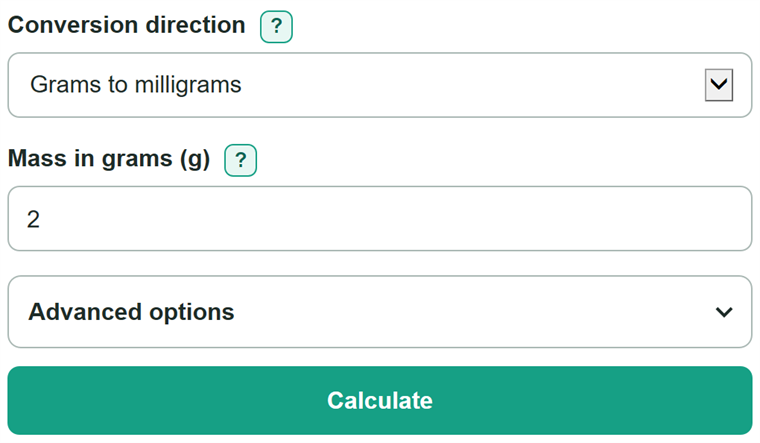
How to use our Grams to Milligrams Converter
- Choose the conversion direction that matches the unit printed next to your number.
- Enter the mass in the visible field. You can type a decimal such as 0.5 or include the matching unit, such as 0.5 g.
- Click Calculate to see the equivalent mass in the other unit.
- Sanity-check the answer: converting g to mg makes the number 1,000 times larger, while converting mg to g makes it 1,000 times smaller.
Definitions
Gram (g): A metric unit of mass.
Milligram (mg): A metric unit of mass equal to one-thousandth of a gram.
Milli-: A metric prefix meaning one-thousandth. One gram equals exactly 1,000 milligrams.
Decimal places: Digits shown after a decimal point. This setting changes display rounding, not the conversion.
Common mistakes and quick fixes
Mistake: Entering an amount labeled mg in the grams field.
Fix: Select "Milligrams to grams" and enter the number in Mass in milligrams (mg).
Mistake: Dividing by 1,000 when converting grams to milligrams.
Fix: Check Conversion direction and then recalculate. Multiply grams by 1,000. For example, 0.5 g equals 500 mg.
Mistake: Thinking 0.001 g is less than 1 mg.
Fix: Check Conversion direction and then recalculate. Convert it: 0.001 g x 1,000 = 1 mg.
Mistake: Typing 1,01 for a decimal amount.
Fix: Check Conversion direction and then recalculate. Use a decimal point, such as 1.01. Use commas only for thousands, such as 1,000.
Mistake: Using the converted amount as medicine or supplement advice.
Fix: Check Conversion direction and then recalculate. This tool changes units only. Follow the product label and ask a qualified clinician about dosing questions.
Limitations & Key Assumptions / Boundary Conditions
- This converter changes mass units only. It does not determine a safe medicine, supplement, or nutrition dose.
- Mass must be 0 or greater. Negative physical mass amounts are not accepted.
- Result decimal places can round the displayed answer. Choose more decimal places if a small nonzero result displays as 0.
- Use the unit printed on the original source. An amount labeled mg must be entered in the milligrams field, not the grams field.
- The gram-to-milligram relationship is exact, but a package label, scale, or lab measurement may already be rounded.
Methodology
Conversion method
The metric prefix milli- means one-thousandth, so 1 gram contains exactly 1,000 milligrams.
milligrams = grams x 1,000
For the reverse direction, divide milligrams by the same exact factor.
grams = milligrams / 1,000
Worked example
To convert 0.5 g, multiply 0.5 by 1,000. The answer is 500 mg. To check in reverse, divide 500 mg by 1,000 to get 0.5 g.
Rounding and limits
The calculator converts the entered mass before rounding the displayed answer. Result decimal places changes only the displayed digits. This calculation converts units and does not check the accuracy of the original measurement or recommend a dose.