
Enter ordinary weight ounces to find the equivalent decimal pounds and pounds-and-ounces measurement.
Optional: reduce the fraction from the decimal ounces you entered, without rounding it first. Ordinary weight ounces only: 16 oz = 1 lb.
Table of contents
How to use our Ounces to Pounds Converter
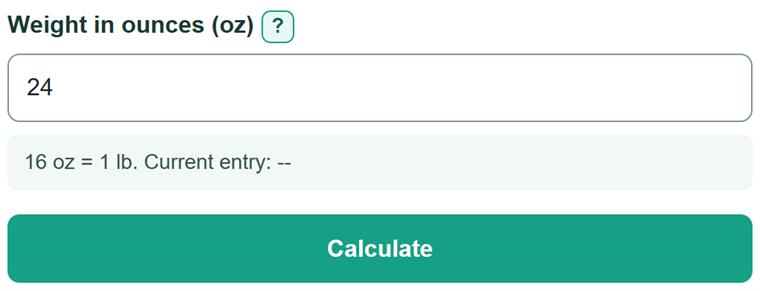
- Enter the total ordinary weight in ounces from a package, scale, shipping record, or classroom problem.
- Use a decimal for part of an ounce when needed, such as 24.5 oz. You may also type an oz suffix.
- Click Calculate to see decimal pounds first, followed by the same weight written as pounds and remaining ounces.
- Sanity-check the result: every 16 oz equals 1 lb, so 32 oz should show 2 lb and 0 oz.
Definitions
Ordinary weight ounce (oz): A customary unit of weight used for many packages, foods, and everyday objects.
Pound (lb): A unit of weight equal to 16 ordinary ounces. [1]
Decimal pounds: A pound amount written with a decimal. For example, 1.5 lb means one and one-half pounds.
Remaining ounces: The ounces left after taking out complete 16-ounce pounds. In 1 lb 8 oz, the remaining amount is 8 oz.
Fluid ounce (fl oz): A unit of volume, not weight.
Common mistakes and quick fixes
Mistake: Entering fluid ounces, such as 8 fl oz.
Fix: Enter ordinary weight ounces only. Fluid ounces measure volume, so a weight conversion also needs the material's density.
Mistake: Typing a mixed measurement such as 2 lb 5 oz.
Fix: Convert it to total ounces first. Two pounds and 5 oz equals 37 oz.
Mistake: Reading 1.5 lb as 1 lb 5 oz.
Fix: The decimal is part of a pound. Since half of 16 oz is 8 oz, 1.5 lb is 1 lb 8 oz.
Mistake: Using troy ounces for gold, silver, or other precious metals.
Fix: Use a troy-weight conversion. This calculator uses ordinary weight ounces.
Mistake: Typing commas in a pattern such as 1,01.
Fix: Use commas only as thousands separators, such as 1,024, or enter 1024 without a comma.
Limitations & Key Assumptions / Boundary Conditions
- This converter uses the ordinary weight relationship of 16 oz per lb.
- It accepts nonnegative total ounces, including fractional ounces. Negative measured weights are outside its supported range.
- Fluid ounces cannot be converted directly to pounds without the material's density.
- Troy ounces and troy pounds use a different weight system and are not included.
- The pounds-and-ounces reading rewrites the entered amount. It does not account for scale accuracy, package tare weight, or label rounding.
Methodology
Conversion method
One ordinary pound contains 16 ordinary ounces. [1] The converter divides total entered ounces by 16 and keeps the unrounded value until it is displayed.
decimal pounds = ounces / 16
Pounds and ounces reading
The complete-pound count is the number of full groups of 16 oz. The amount below the next full pound is shown as remaining ounces.
whole pounds = floor(ounces / 16)
remaining ounces = ounces - (whole pounds * 16)
Worked example
For 24 oz, 24 divided by 16 is 1.5 lb. One full group of 16 oz makes 1 lb, leaving 8 oz, so the mixed reading is 1 lb 8 oz.