
Enter hours to find the equivalent number of 24-hour calendar days and, if needed, compare them with your workday length.
Optional: this adds a planning comparison and does not change the 24-hour calendar-day answer.
Table of contents
How to use our Hours to Days Converter
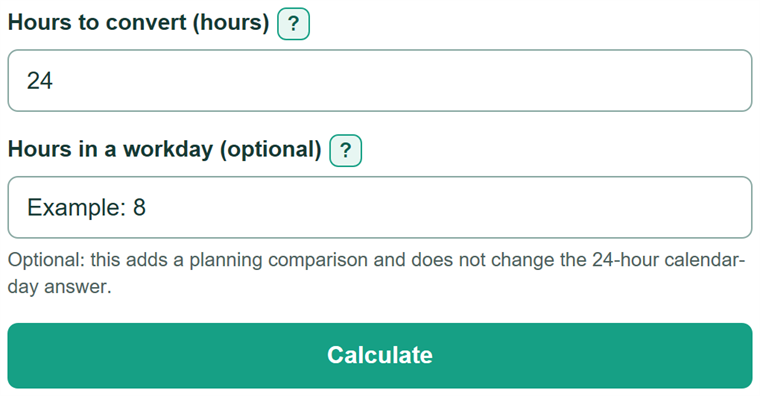
- Enter the duration in Hours to convert (hours). Whole numbers, decimals, and entries such as "36.5 hr" work.
- For a work-planning comparison, enter your schedule's length in Hours in a workday (optional). Otherwise, leave it blank.
- Click Calculate to see the equivalent number of 24-hour calendar days, followed by complete days and remaining hours.
- Sanity-check the mixed result: 36.5 hours should equal 1 whole day and 12.5 remaining hours, because one calendar day has 24 hours.
Definitions
Calendar day: A 24-hour period used for the main conversion.
Decimal day: A day amount that includes part of a 24-hour day. For example, 1.5 days is 1 day and 12 hours.
Whole calendar days: The number of complete 24-hour periods in the entered duration.
Remaining hours: The hours left after complete 24-hour days are removed.
Workday: A planning period set by a job, class, or project schedule. Its length can differ from 24 hours.
Common mistakes and quick fixes
Mistake: Using a workday as if it were a 24-hour calendar day.
Fix: Use the calendar-days answer for time conversion. Enter a workday length only for schedule or project planning.
Mistake: Entering a clock time such as "8:30".
Fix: Enter a duration in decimal hours. For 8 hours 30 minutes, enter 8.5.
Mistake: Reading 1.5 days as 1 day and 5 hours.
Fix: The 0.5 is half of a 24-hour day, or 12 hours. Check the whole-days and remaining-hours results for the mixed-unit form.
Mistake: Entering 0 or a negative number for Hours in a workday.
Fix: Enter a positive length such as 8 or 10 hours, or leave the optional field blank.
Mistake: Typing commas in an unusual pattern, such as "1,01".
Fix: Use commas only as thousands separators, such as "1,000". Use a decimal point for fractions, such as "1.5".
Limitations & Key Assumptions / Boundary Conditions
- This converter changes a plain duration into fixed 24-hour calendar days. It does not find the elapsed time between dates, clock times, or timestamps.
- Date-based elapsed time can depend on time zones, daylight saving time, and the exact start and end times.
- The optional workday answer depends on the workday length you enter. Breaks, overtime rules, and shift schedules may need separate planning.
- Hours must be 0 or greater. If supplied, hours in a workday must be greater than 0.
- Displayed decimal results may be rounded for readability when the entered duration has many decimal places.
Methodology
Calendar-day calculation
The main conversion treats one calendar day as 24 hours. Divide the entered number of hours by 24.
calendar_days = hours / 24
Days and remaining hours
The whole-day value counts complete 24-hour periods. The remaining-hours value is what is left after those complete days are removed.
whole_calendar_days = floor(calendar_days)
remaining_hours = hours - whole_calendar_days * 24
Workday calculation
If you enter a positive workday length, the calculator divides the same hour total by that length. This planning comparison does not change the calendar-day answer.
workdays = hours / workday_hours
Worked example
For 36.5 hours, 36.5 divided by 24 is about 1.5208 calendar days. One complete day uses 24 hours, leaving 12.5 hours.
36.5 / 24 = 1.5208333333...