
Enter an absolute dBm power reading to find its value in watts and milliwatts, or convert watts, mW, or uW back to dBm.
Advanced options
Optional voltage results
Table of contents
How to use our dBm to Watts Calculator
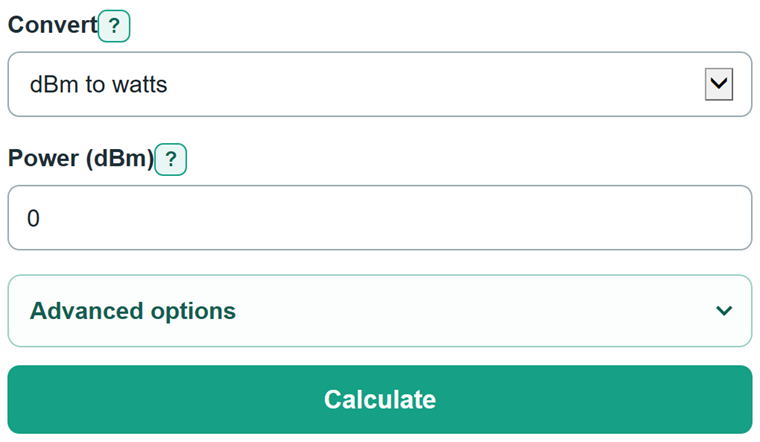
- Choose the conversion direction that matches the unit on the value you already have.
- For dBm to watts, enter the absolute power reading in Power (dBm). Negative and decimal dBm values are valid.
- For watts to dBm, enter a power greater than zero and select the exact unit shown beside it: W, mW, or uW.
- Open Advanced options and turn on voltage results only when you need voltage. Then enter the impedance for the actual system or test point.
- Sanity-check the answer with a reference point: 0 dBm equals 1 mW, and 30 dBm equals 1 W.
Definitions
dBm: An absolute logarithmic power level referenced to 1 milliwatt (mW).
dB: A relative ratio used for gain or loss. It is not an absolute power level by itself.
Watt (W): A unit of power. One milliwatt is 0.001 W, and 1 W is 1,000 mW. [1]
dBW: An absolute logarithmic power level referenced to 1 W. For the same power, dBW is 30 dB lower than dBm.
Impedance: The opposition an AC or RF circuit presents to signal flow, measured in ohms. It is used only for the optional voltage results.
RMS voltage: Root mean square voltage, a standard effective-voltage measurement for an AC signal.
Peak-to-peak voltage: The voltage from a waveform's negative peak to its positive peak.
Common mistakes and quick fixes
Mistake: Entering a value marked dB in Power (dBm).
Fix: Enter a reading marked dBm. A dB value is a relative gain or loss, so it cannot convert to watts without a starting power.
Mistake: Selecting mW when the source value is in W, or the reverse.
Fix: Check Convert and then recalculate. Select the unit printed beside the entered power value. The calculator does not guess the unit from the number.
Mistake: Entering zero or a negative linear power for watts to dBm.
Fix: Check Convert and then recalculate. Enter a power greater than 0. Zero and negative linear power have no real finite dBm value.
Mistake: Entering impedance to get a watts result.
Fix: Check Convert and then recalculate. Leave voltage results off unless voltage is needed. Impedance does not change the watts or milliwatts conversion.
Mistake: Using the impedance of a different cable, load, or measurement point.
Fix: Check Convert and then recalculate. Use the resistance or characteristic impedance documented for the exact point where voltage is being considered.
Limitations & Key Assumptions / Boundary Conditions
- dBm is referenced to 1 mW. A dB gain or loss needs a starting absolute power before it can be converted to watts.
- Watts-to-dBm conversion requires power greater than zero. Zero and negative linear power have no real finite dBm value.
- Optional voltage results assume the calculated power is delivered to the entered resistive or matched impedance. A reactive load, mismatch, or different measurement point can give a different voltage.
- Peak-to-peak voltage uses the sine-wave relationship. A different waveform can have a different peak-to-peak voltage at the same RMS voltage.
- Very small or very large nonzero powers may be shown in scientific notation to avoid displaying them as zero.
Methodology
Power conversion
dBm uses 1 mW, which is 0.001 W, as its reference. The calculator first converts the logarithmic dBm value to watts, then multiplies the unrounded watt value by 1,000 to get milliwatts.
power in watts = 10^((power in dBm - 30) / 10)
power in milliwatts = power in watts * 1000
For reverse conversion, the entered W, mW, or uW value is normalized to watts. The calculator then finds its level compared with the 0.001 W dBm reference.
power in dBm = 10 * log10(power in watts / 0.001)
power in dBW = 10 * log10(power in watts / 1)
Voltage calculation
When voltage results are turned on, the calculator uses the entered impedance with the calculated watts value. RMS means root mean square.
RMS voltage = sqrt(power in watts * impedance in ohms)
peak-to-peak voltage = 2 * sqrt(2) * RMS voltage
Worked example
For 0 dBm, the calculation is 10^((0 - 30) / 10) = 0.001 W. That is 1 mW. For 30 dBm, the result is 1 W. With a 50-ohm impedance, 1 W gives about 7.071 V RMS and 20 V peak-to-peak for a sine wave.
Calculation choices
Watts is the first result for dBm-to-watts conversion, and milliwatts provide a readable cross-check. Separate dBm readings are not added directly because each must first be converted to linear power before powers can be summed.