
Enter a network speed in Mbps to find its equivalent in Gbps and the matching theoretical download rate in MB/s.
Table of contents
How to use our Mbps to Gbps Converter
- Copy the speed number from your internet plan, speed test, or network equipment label.
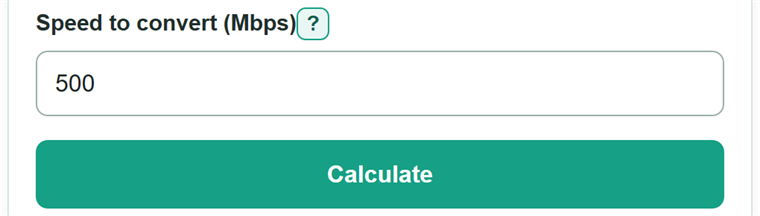
- Enter it in Speed to convert (Mbps). Whole numbers, decimals, and standard commas such as 1,000 are accepted.
- Click Calculate to see the same network rate in gigabits per second (Gbps).
- Use Theoretical download rate to compare with a download display in MB/s. It changes bits to bytes and is not a measured download speed.
- Check the scale: 1,000 Mbps should convert to 1 Gbps and 125 MB/s.
Definitions
Mbps: Megabits per second, a network data rate. The lowercase b means bits. [1]
Gbps: Gigabits per second, a larger network data-rate unit. One Gbps equals 1,000 Mbps. [2]
MB/s: Megabytes per second, a rate often shown in download tools. The uppercase B means bytes.
Byte: A group of 8 bits. Dividing Mbps by 8 gives the matching theoretical rate in MB/s.
Common mistakes and quick fixes
Mistake: Using 1,024 instead of 1,000 for the Mbps-to-Gbps conversion.
Fix: Check Speed to convert and then recalculate. Divide Mbps by 1,000. Network-rate prefixes use decimal units.
Mistake: Treating Mbps and MB/s as the same unit.
Fix: Check Speed to convert and then recalculate. Lowercase b means bits and uppercase B means bytes. Divide Mbps by 8 to get the matching theoretical MB/s rate.
Mistake: Typing commas incorrectly, such as 1,00.
Fix: Check Speed to convert and then recalculate. Use commas only for thousands, such as 1,000, or enter 1000 without a comma.
Mistake: Entering a range such as 500-600 or a negative speed.
Fix: Check Speed to convert and then recalculate. Enter one nonnegative Mbps number. Use 0 if the rate is zero.
Mistake: Expecting the MB/s figure to match an actual download exactly.
Fix: Check Speed to convert and then recalculate. Treat it as a unit translation. Server limits, Wi-Fi, device limits, and network congestion can make real downloads slower.
Limitations & Key Assumptions / Boundary Conditions
- The converter uses decimal network-rate units, so 1 Gbps equals 1,000 Mbps.
- The MB/s figure is a theoretical bits-to-bytes translation, not a promised download speed.
- Wi-Fi signal, server speed, device limits, congestion, and transfer overhead can reduce an actual download rate.
- This calculator converts a rate, not a storage amount. Converting a speed to GB requires a time period.
- Enter one nonnegative number. Ranges, formulas, negative values, and malformed comma grouping are not valid inputs.
Methodology
Calculation
Network speeds use decimal prefixes, so the converter divides the entered Mbps rate by 1,000 to express the same rate in Gbps. It also divides Mbps by 8 to translate bits per second into bytes per second for comparison with an MB/s download display.
Gbps = Mbps / 1,000
MB/s = Mbps / 8
Worked example
For 500 Mbps, 500 divided by 1,000 equals 0.5 Gbps. Then 500 divided by 8 equals 62.5 MB/s. The 62.5 MB/s figure is the equivalent byte rate, not a prediction that every download will reach 62.5 MB/s.