
Convert any amount in billions to trillions and instantly see the full number, scientific notation, and a quick scale check.
How to use our Billion to Trillion Converter Calculator
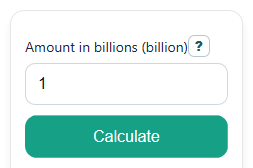
- Enter your value in Amount in billions. You can use decimals like 2.5, and negative values are okay for debt or net-change examples.
- Click Calculate to see Amount in trillions, Full number, Scientific notation, and Check in billions.
- Use Full number to see the commas and zero count, and use Scientific notation to check place value on very large amounts.
- Sanity-check the result by comparing Check in billions with your original Amount in billions. They should match aside from small display rounding.
Definitions
Amount in billions: The starting value, where 1 billion means 1,000,000,000 in US short scale.
Amount in trillions: The converted value, where 1 trillion means 1,000,000,000,000 in US short scale [1].
Full number: The same amount written as an ordinary number with comma separators, like 2,500,000,000.
Scientific notation: A compact way to write large numbers, such as 2.5 x 10^9.
Check in billions: The trillions result converted back to billions to confirm the original value.
Short scale: The naming system commonly used in the US, where billion is 10^9 and trillion is 10^12.
Common mistakes and quick fixes
Mistake: Leaving Amount in billions blank and expecting 0.
Fix: Enter a number in Amount in billions , even if the value is 0.
Mistake: Typing text like "two billion" into Amount in billions .
Fix: Use digits only in Amount in billions , such as 2 or 2.5.
Mistake: Reading Amount in trillions as if it were still in billions.
Fix: Check the label carefully: Amount in trillions is the converted value after dividing by 1,000.
Mistake: Thinking Full number is a different amount from the other results.
Fix: Treat Full number as the same value written out with commas so the zeros are easier to see.
Mistake: Assuming a negative Amount in trillions is an error.
Fix: A negative result can be valid if your Amount in billions represents a loss, decrease, or debt-style amount.
Mistake: Ignoring Scale note when comparing with another source.
Fix: Read Scale note to confirm this page uses the US short scale before comparing terms from other countries or older material.
Limitations & Key Assumptions / Boundary Conditions
- This calculator uses the US short scale only. If a source uses a different naming system, number words may not match.
- It converts only from billions to trillions. It does not switch modes to start from millions, trillions, or other large-number units.
- Displayed results may be rounded for readability, but the reverse check is based on the same underlying conversion.
- The Full number output is intended to stay in ordinary comma-formatted digits when practical, but extremely large values can still be harder to read than Scientific notation.
- Negative values are allowed because they can represent losses, debt, or net decreases, so the tool does not block them as invalid.
Methodology
How the calculator works
The converter treats your entry as a number of billions in the US short scale. Since 1 trillion equals 1,000 billions, the main conversion is a simple divide-by-1,000 step.
Amount in trillions = Amount in billions / 1000
Full number = Amount in billions x 10^9
Check in billions = Amount in trillions x 1000
Scientific notation = normalized form of (Amount in billions x 10^9)
Worked example
If you enter 2.5 in Amount in billions, the calculator divides 2.5 by 1,000 to get 0.0025 trillion. It also writes the same amount as 2,500,000,000 and as 2.5 x 10^9. The reverse check multiplies 0.0025 by 1,000 and returns 2.5 billion.
How to interpret the outputs
If Amount in trillions is less than 1, the amount is less than one trillion. Full number helps you inspect commas and zeros, while Scientific notation helps you verify place value quickly. Check in billions should match your original entry except for minor display rounding.
Assumptions used
This page uses short scale naming in US style, where billion is 10^9 and trillion is 10^12 [1]. Scientific notation is shown in standard power-of-ten form [2].