
Enter a decagram or gram amount to convert it to the matching metric mass in grams or decagrams.
Table of contents
How to use our Decagram to Gram Converter
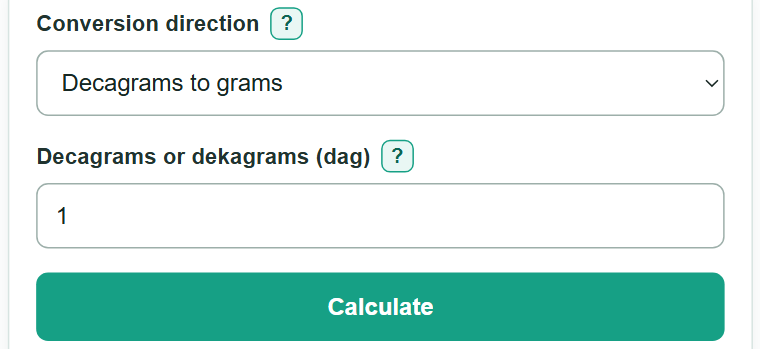
- Choose "Decagrams to grams" if your starting amount is in dag, or choose "Grams to decagrams" if it is in g.
- Enter the amount in the field shown. You can type a number alone or include the matching suffix, such as "2.5 dag" or "25 g".
- Select "Calculate."
- Read the weight shown in the other unit. For a quick check, converting dag to g makes the number 10 times larger; converting g to dag makes it 10 times smaller.
Definitions
Decagram (dag): A metric mass unit equal to 10 grams. "Dekagram" is another spelling for the same unit. [1] [1]
Gram (g): The metric mass unit used for the converted answer.
Decigram (dg): A different metric unit. Its symbol is dg, not dag.
Common mistakes and quick fixes
Mistake: Entering dg when the amount is in decagrams.
Fix: Use dag for decagrams. The symbol dg means decigrams, a different unit.
Mistake: Multiplying grams by 10 to get decagrams.
Fix: Divide the gram amount by 10. For example, 25 g equals 2.5 dag.
Mistake: Typing 1,01 to mean one point zero one.
Fix: Use a decimal point: 1.01. Commas are for thousands grouping only, such as 1,000.
Limitations & Key Assumptions / Boundary Conditions
- This converter handles only decagrams and grams. It does not convert volume, such as cups or milliliters, because volume does not determine mass without knowing the material.
- The result is an exact unit conversion. A scale reading can still be limited by the scale's precision.
Methodology
Conversion rule
The metric prefix deca means 10, so 1 dag equals 10 g.
grams = decagrams × 10
decagrams = grams ÷ 10
Worked example
To convert 2.5 dag to grams, multiply 2.5 by 10. The answer is 25 g. To convert 25 g back to decagrams, divide 25 by 10. The answer is 2.5 dag. Zero is valid, so 0 dag equals 0 g.