
Enter your cell data to calculate the voltage under non-standard conditions using a reaction quotient you know or build from reaction terms.
Table of contents
How to use our Nernst Equation Calculator
- Write and balance the overall redox reaction, then find its standard cell potential, E0, in volts.
- Enter the number of electrons transferred, n, canceled in the balanced overall reaction, plus the temperature and its unit.
- Choose "Enter Q directly" if the problem gives Q, or choose "Build Q from reaction terms" to enter each product and reactant value with its coefficient.
- Calculate, then check the displayed Q expression: products belong above the line, reactants below it, and coefficients become exponents.
- Sanity-check the answer against E0. If Q is 1, ln Q and the voltage correction are zero, so the calculated cell potential must equal E0.
Definitions
Calculated cell potential (E): The cell voltage under the entered conditions, in volts.
Standard cell potential (E0): The cell voltage for the balanced reaction under standard-state conditions, in volts.
Reaction quotient (Q): A unitless ratio of product activities to reactant activities, with each term raised to its reaction coefficient. [3]
Activity: A thermodynamic effective concentration. In many introductory dilute-solution problems, molar concentration is used as an approximation.
Electrons transferred (n): The positive whole number of electrons canceled when the balanced half-reactions are combined.
ln Q: The natural logarithm of Q. It equals zero when Q equals 1.
Kelvin (K): An absolute temperature scale used in the Nernst equation.
Common mistakes and quick fixes
Mistake: Using the electron count from one unscaled half-reaction.
Fix: Balance and combine both half-reactions first, then use the electrons canceled in the overall reaction.
Mistake: Reversing the reaction quotient.
Fix: Put products in the numerator and reactants in the denominator. If you reverse the reaction, reverse the entire quotient and use the matching E0.
Mistake: Leaving coefficients out of Q.
Fix: Raise each activity or concentration to its coefficient in the balanced reaction.
Mistake: Typing a Celsius reading while Kelvin is selected.
Fix: Select Celsius, or add 273.15 before entering the value as kelvin.
Mistake: Including pure solids, pure liquids, or solvent water in a classroom concentration-based Q expression.
Fix: Leave those terms out and include the dissolved ions, other solutes, and gases that belong in the reaction quotient.
Mistake: Treating Q = 1 as invalid.
Fix: Q = 1 is valid. Since ln Q = 0, the calculated cell potential equals E0.
Limitations & Key Assumptions / Boundary Conditions
- The calculator needs a balanced overall redox reaction. It cannot balance a reaction or confirm that n matches the reaction.
- The reaction-term method treats entered activities, or dilute-solution concentrations, as the values used to build Q. Non-ideal solutions can require activity coefficients.
- Pure solids, pure liquids, and solvent water are normally omitted from an introductory concentration-based Q expression. Follow the convention required by your course or experiment.
- Q and every included reaction-term value must be greater than zero, n must be a positive whole number, and temperature after conversion must be above 0 K.
- A negative calculated potential is valid. Its sign follows the reaction direction and signed E0 that you enter.
- The calculator uses the full temperature-dependent equation, so its answer can differ from a 25 deg C shortcut calculation.
Methodology
Calculation method
The calculator converts a Celsius entry to kelvin, accepts a positive unitless Q or builds Q from reaction terms, and then calculates the non-standard cell potential. It uses R = 8.31446261815324 J mol^-1 K^-1 and F = 96485.33212 C mol^-1. [1] [2]
T(K) = T(deg C) + 273.15
The Celsius-to-kelvin offset is 273.15.
Q = (product activities raised to their coefficients) / (reactant activities raised to their coefficients)
E = E0 - (R x T x ln Q) / (n x F)
E is the calculated cell potential in volts, E0 is the standard cell potential in volts, T is temperature in kelvin, and n is the electron count from the balanced overall reaction.
Worked mini-example
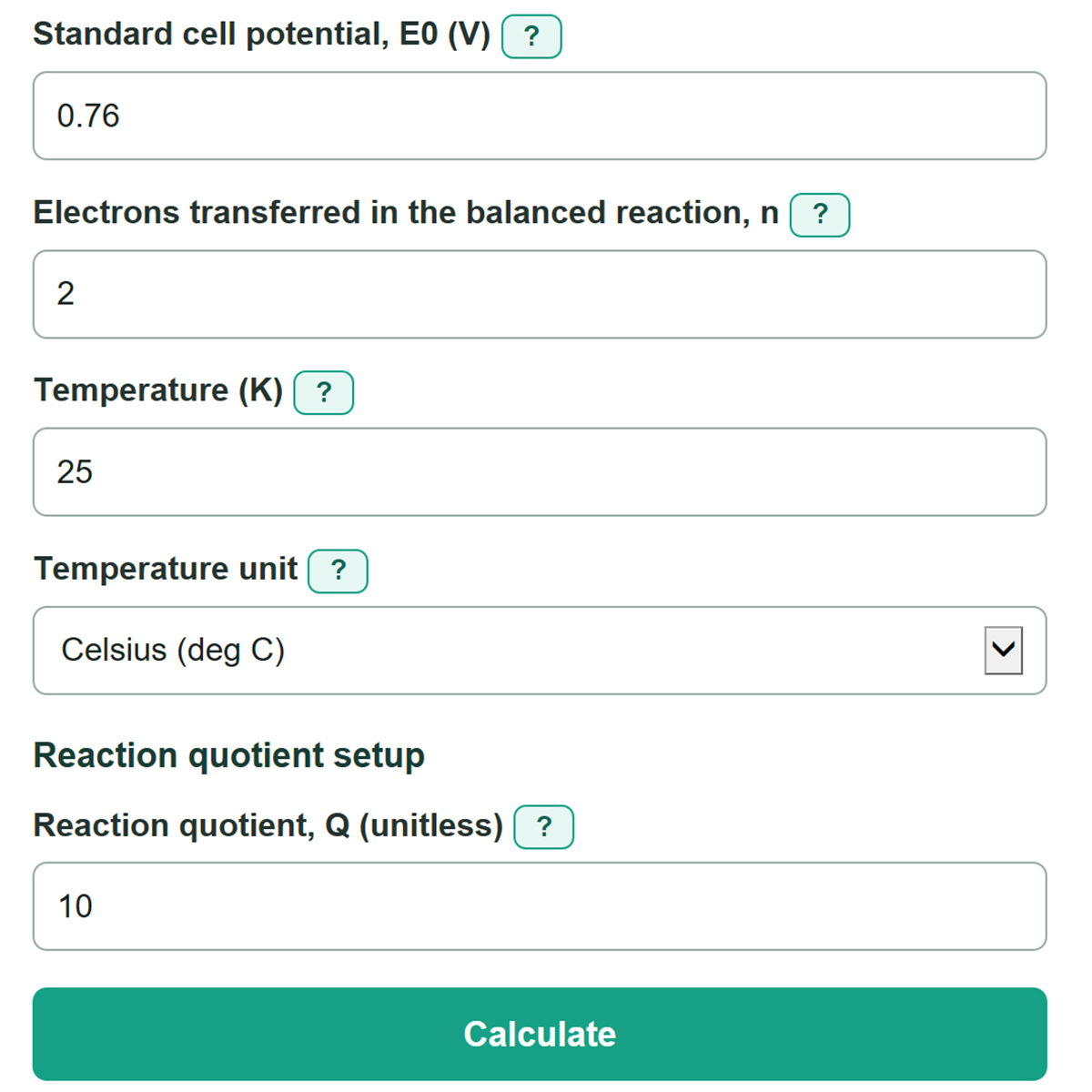
For E0 = 0.76 V, n = 2, Q = 10, and 25 deg C, the temperature used is 298.15 K and ln Q is about 2.3026.
correction = (8.31446261815324 x 298.15 x 2.302585093) / (2 x 96485.33212) = 0.02957967484 V
E = 0.76 V - 0.02957967484 V = 0.7304203252 V
Rounded to four decimal places, the cell potential is 0.7304 V.
Building Q from reaction terms
For the reaction-term method, the calculator adds coefficient x ln(value) for product terms and subtracts coefficient x ln(value) for reactant terms. This finds ln Q without first multiplying extremely large or small values. The displayed Q expression lets you check product/reactant placement and exponents before using the voltage result.