
Use this calculator to find diffusion coefficient, particle radius, or fluid viscosity and quickly compare the result in common diffusion units.
Advanced options
Units and display
How to use our Diffusion Coefficient Calculator
- Choose an option in Find to tell the calculator what you want to work out.
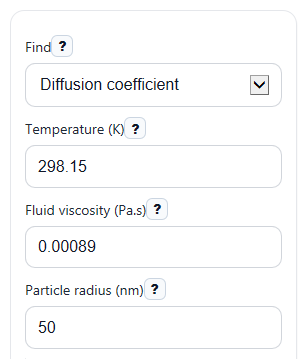
- Enter Temperature (K), Fluid viscosity (Pa.s), and Particle radius (nm) as needed for your chosen mode; if you are solving for radius or viscosity, also enter Diffusion coefficient input (m^2/s).
- Open Advanced options if you want to switch Temperature input unit, change Main result unit, or adjust Number style and Significant digits.
- Click Calculate, then compare Diffusion coefficient with the converted results in Diffusion coefficient (m^2/s), Diffusion coefficient (cm^2/s), and Diffusion coefficient (um^2/s) to sanity-check that the size of the answer makes sense in the unit scale you expect.
Definitions
Diffusion coefficient: A measure of how fast something spreads out in a fluid. In this calculator it can be shown in m^2/s, cm^2/s, or um^2/s.[1]
Particle radius: Half of the particle diameter. The calculator takes this input in nanometers (nm).
Fluid viscosity: A measure of how much the fluid resists flowing. Higher viscosity usually means slower diffusion.
Temperature (K): Absolute temperature in kelvins. If you enter Celsius in Advanced options, the calculator converts it to kelvins before solving.
Stokes-Einstein relation: An equation that links diffusion coefficient to temperature, viscosity, and hydrodynamic radius for a roughly spherical particle in a continuum fluid.[2]
Drag term (6*pi*eta*r): The friction part of the equation. Bigger viscosity or bigger radius makes this term larger and usually lowers diffusion.
Common mistakes and quick fixes
Mistake: Entering 25 in Temperature (K) while leaving Temperature input unit set to Kelvin.
Fix: If your value is in Celsius, change Temperature input unit to Celsius so 25 is treated as 25 C, not 25 K.
Mistake: Typing particle diameter into Particle radius (nm) .
Fix: Enter radius, not diameter. If your particle is 100 nm across, put 50 in Particle radius (nm) .
Mistake: Using 0 or a negative number for Fluid viscosity (Pa.s) , Particle radius (nm) , or Diffusion coefficient input (m^2/s) .
Fix: Each of these must be greater than 0 when used by the selected Find mode.
Mistake: Forgetting that Diffusion coefficient input (m^2/s) must be entered in m^2/s when solving for Particle radius or Fluid viscosity .
Fix: Convert your source value to m^2/s first, then enter it in Diffusion coefficient input (m^2/s) .
Mistake: Reading only Diffusion coefficient and missing the unit scale you chose.
Fix: Check both Main result unit and the converted outputs Diffusion coefficient (m^2/s) , Diffusion coefficient (cm^2/s) , and Diffusion coefficient (um^2/s) .
Mistake: Treating Drag term (6*pi*eta*r) like a separate measured property.
Fix: Use Drag term (6*pi*eta*r) as a support output that combines viscosity and radius in the Stokes-Einstein equation.
Limitations & Key Assumptions / Boundary Conditions
- The calculation uses the Stokes-Einstein relation, which is mainly suited to roughly spherical particles in a continuous fluid.
- Results can be less reliable for crowded media, non-Newtonian fluids, strongly interacting particles, or cases where continuum assumptions break down.
- Temperature must be above absolute zero after any Celsius-to-kelvin conversion.
- When solving for Particle radius or Fluid viscosity, the entered Diffusion coefficient input (m^2/s) must already be in m^2/s.
- The calculator treats viscosity as dynamic viscosity in Pa.s and radius as nanometers converted to meters internally.
- Very small or very large values may be shown with scientific notation depending on the chosen Number style and Significant digits.
Methodology
Formula used
The calculator uses the Stokes-Einstein relation to connect diffusion coefficient, temperature, viscosity, and particle radius.[2]
D = k_B * T / (6 * pi * eta * r)
r = k_B * T / (6 * pi * eta * D)
eta = k_B * T / (6 * pi * r * D)
Unit handling
Temperature is solved in kelvins, so Celsius entries are converted first.
T_K = T_C + 273.15
Particle radius is entered in nanometers and converted to meters before the formula is used.
r_m = r_nm * 1e-9
After solving for diffusion coefficient in SI units, the calculator also converts the result into common chemistry and lab scales.
1 m^2/s = 10^4 cm^2/s = 10^12 um^2/s
Constants
The calculation uses the exact SI Boltzmann constant and the standard value of pi.
k_B = 1.380649e-23 J/K
pi = 3.141592653589793
Worked mini-example
Using the default values, let temperature be 298.15 K, viscosity be 0.00089 Pa.s, and particle radius be 50 nm. First convert 50 nm to 5.0e-8 m. Then compute the drag term and divide k_B*T by that term.
6 * pi * eta * r = 6 * pi * 0.00089 * 5.0e-8 = about 8.388e-10 N.s/m
D = (1.380649e-23 * 298.15) / (8.388e-10) = about 4.911e-12 m^2/s
D = about 4.911e-8 cm^2/s = about 4.911 um^2/s
How to read the outputs
A larger diffusion coefficient means the particle spreads out faster. A larger solved radius means a bigger particle. A larger solved viscosity means a thicker fluid. The Drag term (6*pi*eta*r) is a support value that shows how radius and viscosity combine to resist motion.
Assumptions and limits
This method assumes thermal equilibrium, a roughly spherical particle, and a continuum fluid. Real systems can differ when particles are not spherical, the medium is crowded, or viscosity does not behave like a simple Newtonian fluid.