
Enter each charged ion's concentration and signed charge to calculate ionic strength and check for a missing or mistyped ion.
Table of contents
How to use our Ionic Strength Calculator
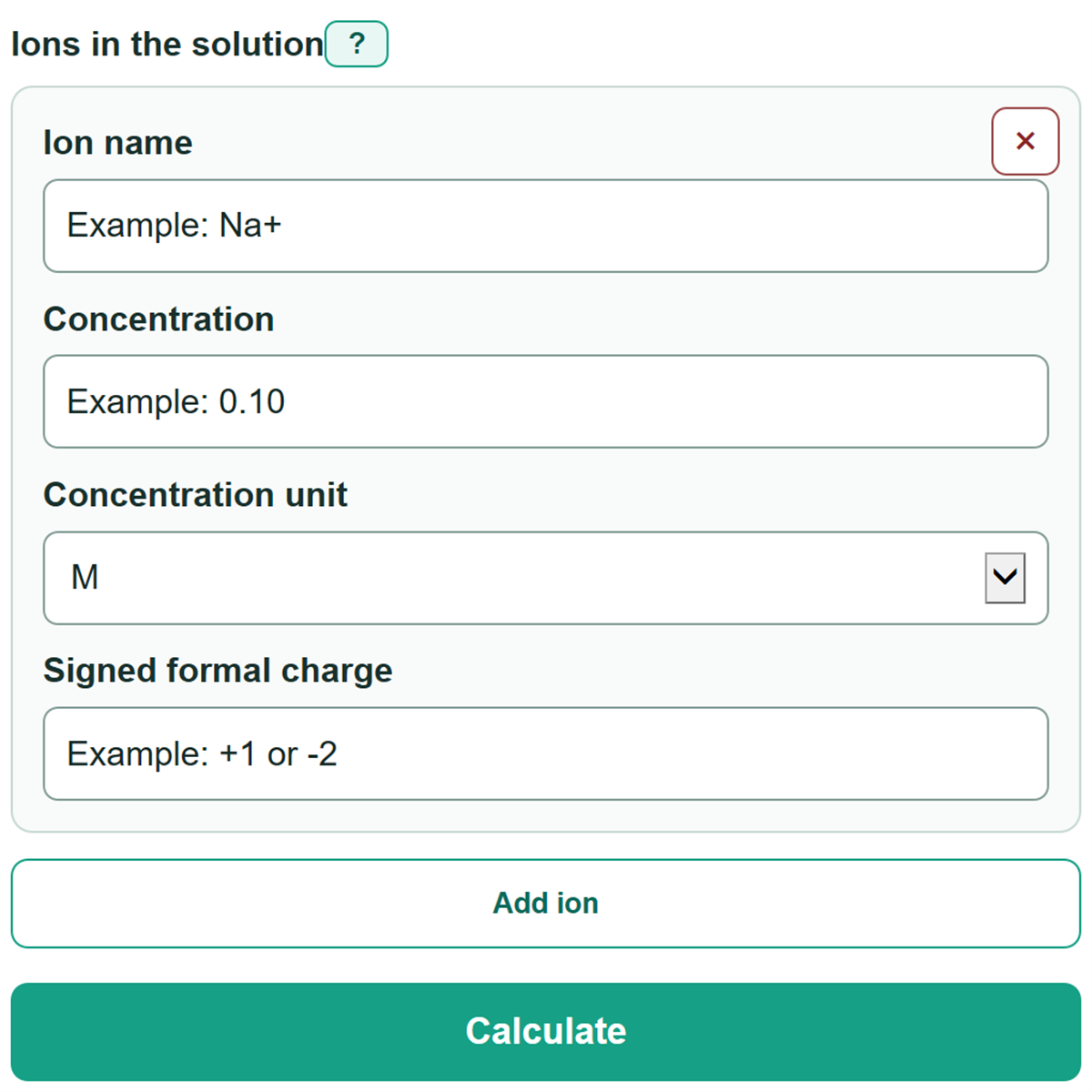
- Add one row for each charged species present after the substances dissolve or dissociate.
- Enter the ion name, concentration, its listed unit (M, mM, or uM), and its signed whole-number charge.
- Click Calculate to get ionic strength in mol/L and mM, along with each ion's contribution.
- Sanity-check the charge-balance result: a value near zero supports a complete bulk-solution list, while a nonzero value may mean an ion is missing or has the wrong charge.
Definitions
Ionic strength (I): A concentration measure that weights each ion by the square of its formal charge. [1]
Molarity (M): Amount of substance in moles per liter of solution, equal to mol/L.
mM and uM: Millimolar and micromolar. One mM is 0.001 mol/L, and one uM is 0.000001 mol/L.
Formal charge (z): The signed whole-number charge used for an ion, such as +1 for Na+ or -2 for SO4 2-.
Charge balance: A check that adds each ion concentration times its signed charge. A complete electrically neutral bulk solution has a net value of zero.
Ion contribution: One ion's concentration multiplied by the square of its charge, before the calculator adds all rows and divides by two.
Common mistakes and quick fixes
Mistake: Entering 0.10 M MgCl2 as 0.10 M for both Mg2+ and Cl-.
Fix: Expand it after dissociation: enter 0.10 M Mg2+ and 0.20 M Cl-.
Mistake: Leaving out a counterion from the list.
Fix: Add every charged species included by the recipe or chemical formula. The charge-balance check can help find an omission.
Mistake: Using an unsigned charge or the wrong sign.
Fix: Enter cations as positive values, such as +2, and anions as negative values, such as -1.
Mistake: Adding water, glucose, or another neutral molecule.
Fix: Omit species with charge 0 because they do not contribute to ionic strength.
Mistake: Treating total entered ion concentration as ionic strength.
Fix: Use the ionic-strength result. An ion with charge magnitude 2 has four times the charge-squared weight of a charge-1 ion at the same concentration.
Limitations & Key Assumptions / Boundary Conditions
- The calculation assumes each entered concentration already describes the individual dissolved ions present in the solution.
- It does not predict dissociation, acid-base equilibrium, complex formation, precipitation, ion pairing, or activity coefficients.
- Enter molar concentrations only. Convert molality or mass concentration first, and expand a salt formula concentration into its individual ion concentrations.
- A balanced charge check supports the entered list but does not prove that every species in a real sample was identified.
- The charge-balance warning is an entry-checking aid, not a laboratory acceptance limit or a measurement-uncertainty analysis.
- A partial or intentionally incomplete ion list can still produce ionic strength, but its signed net ionic charge may not be zero.
Methodology
Calculation
The calculator converts each row to mol/L, multiplies that concentration by the square of the ion's signed formal charge, adds the rows, and divides by two. Squaring means that +2 and -2 make the same ionic-strength contribution when their concentrations are equal. This follows the concentration-and-charge definition of ionic strength. [1]
I = 0.5 × Σ(ci × zi2)
In the formula, I is ionic strength in mol/L, ci is one ion concentration in mol/L, and zi is that ion's signed formal charge. M is converted by 1, mM by 0.001, and uM by 0.000001 before calculation.
Charge-balance check
The balance check keeps the charge sign instead of squaring it.
net ionic charge = Σ(ci × zi)
A positive result means the entered positive charge is greater than the entered negative charge; a negative result means the reverse. The calculator calls the list balanced when the absolute net charge is no greater than the larger of 1e-12 mol/L of charge or one part per million of total absolute entered charge. This threshold only helps catch entry mistakes.
Worked example
For 0.10 M Na+ and 0.10 M Cl-, both charges have magnitude 1, so each contribution is 0.10 mol/L.
I = 0.5 × (0.10 + 0.10) = 0.10 mol/L
The signed charge check is (0.10 × +1) + (0.10 × -1) = 0, so the listed charges balance. For 0.10 M Mg2+ and 0.20 M Cl-, the ionic strength is 0.30 mol/L because the Mg2+ term is multiplied by 2 squared.