
Use this Gibbs phase rule calculator to find degrees of freedom, see the equation used, and understand what the result means for equilibrium.
How to use our Gibbs Phase Rule Calculator
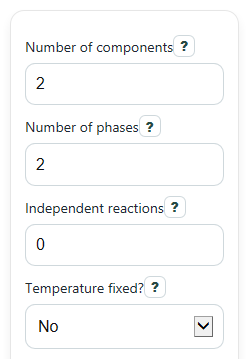
- Enter the Number of chemical species, Number of phases, and Independent reactions as whole numbers.
- Choose Yes or No for Temperature fixed? and Pressure fixed? based on the problem statement.
- Click Calculate to get Degrees of freedom, System type, Equation used, and any Feasibility note.
- Sanity-check the result: for a pure substance with 1 component and 1 phase, a value of 2 is reasonable, while a negative value usually means the setup is over-constrained or counted incorrectly.
Definitions
Degrees of freedom: The number of independent intensive variables you can still change without changing how many phases are at equilibrium.
Species and components: Chemical species: A distinct chemical substance. Components are the independent count remaining after reaction constraints: C = S - r.
Phase: A physically distinct part of matter, such as a solid, liquid, or gas.
Independent reactions: Separate equilibrium reactions that each reduce the degrees of freedom by 1.
Temperature fixed? If yes, temperature is already set, so one degree of freedom is removed.
Pressure fixed? If yes, pressure is already set, so one degree of freedom is removed.
Invariant, univariant, divariant: Names for systems with 0, 1, or 2 degrees of freedom. Larger values are often called multivariant.
Common mistakes and quick fixes
Mistake: Entering independent components and also subtracting reactions in the Number of chemical species .
Fix: Enter species before reactions are subtracted, or enter an already independent component count with reactions set to 0. Do not subtract the same reactions twice.
Mistake: Counting Number of phases wrong by treating two solid regions of the same phase as different phases.
Fix: Count physically distinct phases such as solid, liquid, and gas, not just separate pieces you can see.
Mistake: Entering a decimal like 1.5 for Independent reactions .
Fix: Use whole-number counts only. If you are unsure, start with 0 and check whether the problem clearly gives equilibrium reactions.
Mistake: Choosing No for Temperature fixed? even though the problem says temperature is held constant.
Fix: Switch Temperature fixed? to Yes so the calculator subtracts that constraint correctly.
Mistake: Choosing No for Pressure fixed? when the system is at constant pressure.
Fix: Set Pressure fixed? to Yes if pressure is externally fixed.
Mistake: Thinking a negative Degrees of freedom means the calculator is broken.
Fix: Read the Feasibility note . A negative result usually means the stated combination of phases, components, reactions, and constraints is not feasible as written.
Limitations & Key Assumptions / Boundary Conditions
- This calculator assumes the system is at equilibrium, which is when the Gibbs phase rule applies.
- Inputs are counts, so Number of chemical species, Number of phases, and Independent reactions must be whole numbers.
- The result depends on choosing a consistent species or component basis. In reactive systems, the number of components can be smaller than the total number of chemical species.
- Each independent reaction is assumed to subtract exactly 1 from the degrees of freedom in the reactive form used here.
- If Temperature fixed? or Pressure fixed? is set to Yes, the calculator subtracts 1 for each fixed intensive variable.
- A negative result is shown as entered and usually means the specified equilibrium setup is over-constrained or not feasible under the stated conditions.
Methodology
Formula used
The calculator starts from the standard Gibbs phase rule for equilibrium systems [1][3].
F = C - P + 2
Here, F is degrees of freedom, C is the number of components, and P is the number of phases. The +2 comes from temperature and pressure in the classical form [3].
When reactions or fixed constraints are included, the calculator uses the species-based form with C = S - r.
F = S - P + 2 - r - dT - dP
S is the entered species count before reaction constraints (C = S - r). In this version, r is the number of independent reactions, dT is 1 if Temperature fixed? is Yes and 0 if No, and dP is 1 if Pressure fixed? is Yes and 0 if No.
How the result is interpreted
If Degrees of freedom is 0, the system is labeled invariant. That means the equilibrium is fixed at a single condition set. If it is 1, the system is univariant. If it is 2, it is divariant. If it is 3 or more, it is shown as multivariant. A negative value is kept and flagged because it usually means the specification is not feasible as written.
Mini example
Suppose you enter 3 for Number of chemical species, 2 for Number of phases, 1 for Independent reactions, Yes for Temperature fixed?, and No for Pressure fixed?.
F = 3 - 2 + 2 - 1 - 1 - 0
F = 1
So the system has 1 degree of freedom and is univariant, meaning one independent intensive variable can still change while keeping the same number of phases at equilibrium.
Assumptions behind the math
This calculator assumes an equilibrium thermodynamics problem, correct counting of chemical species before reactions, and independent reactions that have not already been subtracted. Real textbook or lab problems can differ if the system definition, component choice, or reaction independence is set up differently.