
Enter molality or mass data to calculate the boiling-point rise and estimated solution boiling point.
Advanced options
Table of contents
How to use our Boiling Point Elevation Calculator
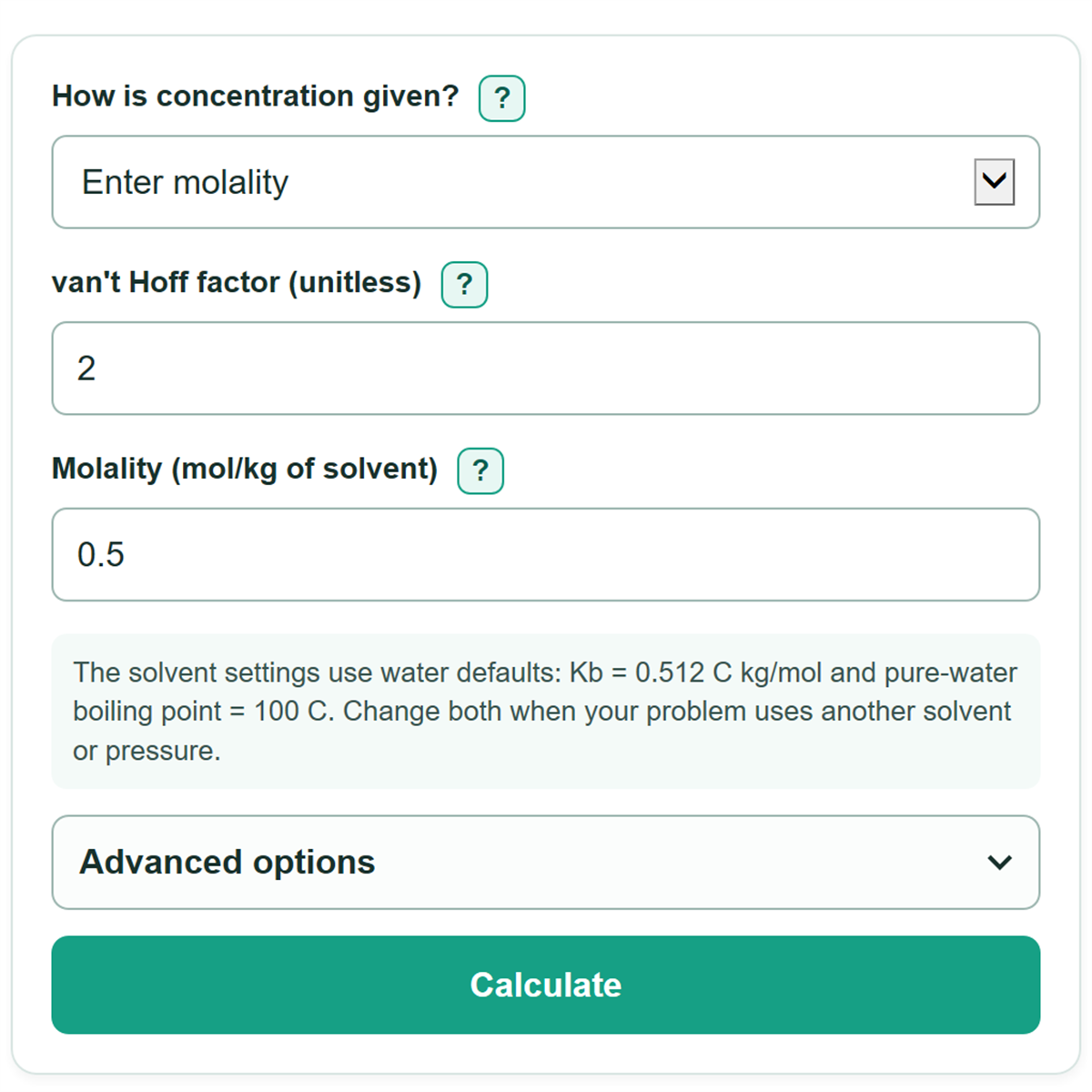
- Choose how your problem gives concentration: enter molality, or use solute mass, molar mass, and solvent mass.
- Enter the van't Hoff factor, the effective number of dissolved particles per formula unit used in your problem.
- Enter the concentration value or mass values. In mass entry, use the solvent mass before solute was added.
- Keep the water settings in Advanced options, or replace the solvent Kb and pure-solvent boiling point if your problem gives another solvent or condition.
- Select Calculate, then check that the elevation is zero only when molality is zero and that the solution boiling point is the pure-solvent boiling point plus the elevation.
Definitions
Molality (m): Moles of solute divided by kilograms of solvent.
van't Hoff factor (i): The effective number of dissolved particles per formula unit of solute.
Boiling-point elevation (ΔTb): How much hotter a solution boils than the pure solvent at the same pressure.
Ebullioscopic constant (Kb): A solvent property that connects particle molality to boiling-point elevation. For water in this dilute-solution model, Kb is 0.512 C kg/mol [1].
Molar mass: The mass of one mole of a substance, usually in g/mol.
Nonvolatile solute: A dissolved substance that is treated as not adding a meaningful amount of vapor in this model.
Common mistakes and quick fixes
Mistake: Entering liters of solution or total solution mass as molality.
Fix: Use moles of solute per kilogram of solvent. Molality does not use solution volume or total solution mass.
Mistake: Using total solution mass for solvent mass in mass entry.
Fix: Enter only the mass of the solvent before the solute was added.
Mistake: Entering molar mass as the van't Hoff factor.
Fix: Enter the particle factor stated by the problem or experiment, not a value in g/mol.
Mistake: Adding 32 to a boiling-point elevation when using Fahrenheit.
Fix: Multiply a temperature difference by 9/5. Add 32 only when converting an actual temperature, such as the final boiling point.
Mistake: Combining a pure-solvent boiling point from one pressure with a solution value at another pressure.
Fix: Use the pure-solvent boiling point and solution conditions at the same pressure. This calculator does not adjust for altitude or pressure.
Limitations & Key Assumptions / Boundary Conditions
- This is an ideal dilute-solution calculation for a nonvolatile solute.
- The calculator uses the entered van't Hoff factor. Real solutions can have a different effective particle count because dissolved particles can interact.
- The pure-solvent and solution boiling points must be compared at the same pressure. Altitude and pressure changes are not calculated.
- The default water values, Kb = 0.512 C kg/mol and pure-solvent boiling point = 100 C, fit the normal boiling-point classroom model. Replace them when the problem states another solvent or condition.
- Zero molality is valid and gives zero elevation. Negative solute mass and negative molality are outside this physical model.
Methodology
Calculation method
The calculator uses entered molality or first calculates molality from the mass data. In mass entry, solvent grams are converted to kilograms before division.
m = (solute mass in g / molar mass in g/mol) / (solvent mass in g / 1000)
It multiplies molality by the van't Hoff factor to find the effective particle molality.
effective particle molality = i * m
The boiling-point elevation is the solvent's ebullioscopic constant times the effective particle molality.
ΔTb (C) = i * Kb * m
The estimated solution boiling point equals the pure-solvent boiling point plus that elevation.
Tsolution (C) = Tpure (C) + ΔTb (C)
For Fahrenheit, multiply a temperature difference by 9/5. To convert a boiling temperature, multiply by 9/5 and add 32.
ΔTb (F) = ΔTb (C) * 9/5
Tsolution (F) = Tsolution (C) * 9/5 + 32
Worked example
For water with i = 2, Kb = 0.512 C kg/mol, and m = 0.50 mol/kg, the elevation is 2 * 0.512 * 0.50 = 0.512 C. Starting at 100 C, the estimated solution boiling point is 100.512 C. The water Kb value follows the classroom reference model [1].