
Enter your reaction information to calculate the maximum grams and moles of the product it can make.
Table of contents
How to use our Theoretical Yield Calculator
- Choose "Known limiting reagent" if the reactant that runs out first is already known. Choose "Full reaction" if you have a balanced equation and amounts for every reactant.
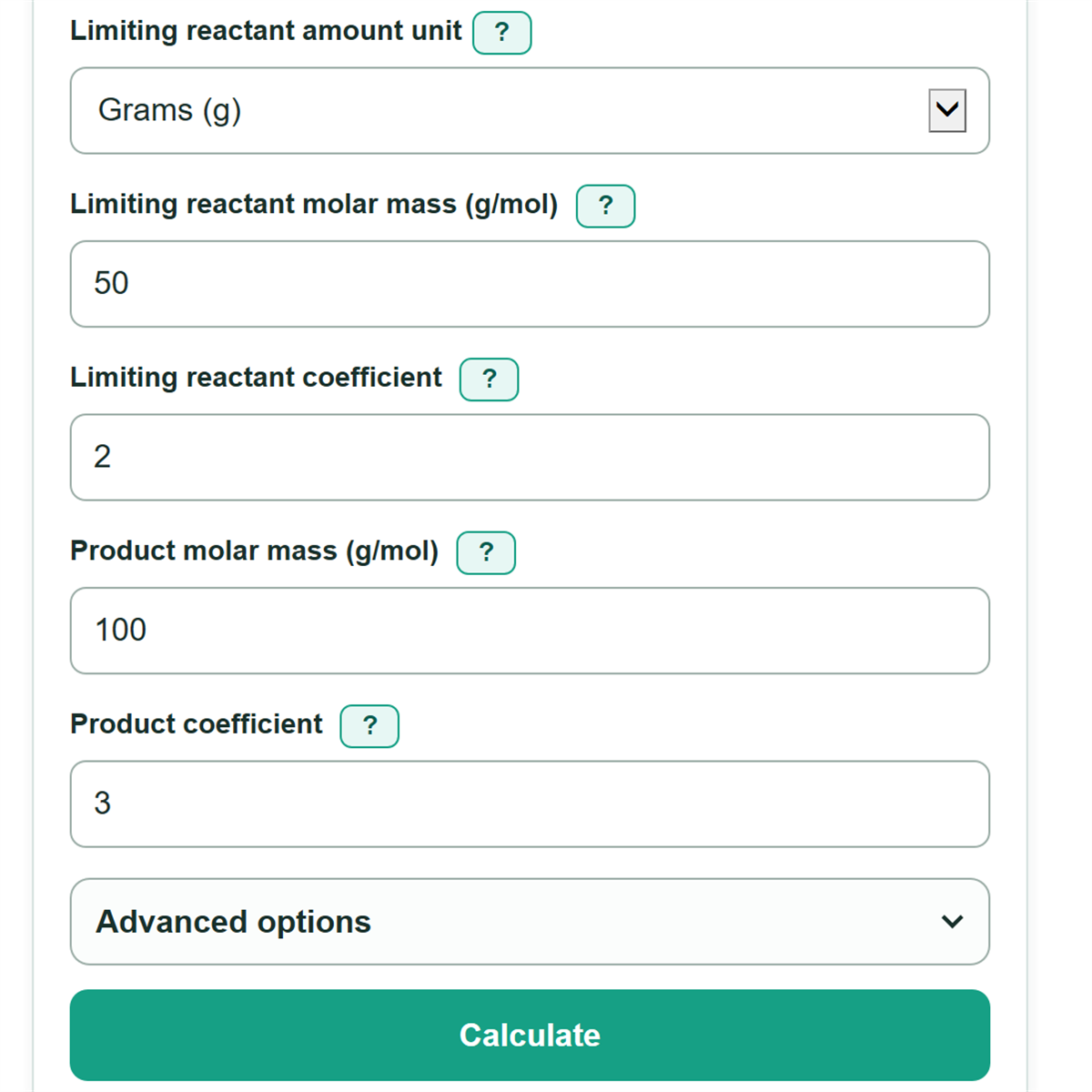
- In Known limiting reagent mode, enter the reactant amount and unit, molar masses, and the two coefficients from the balanced equation.
- In Full reaction mode, enter the balanced equation, choose the product you want, and enter a positive amount in g or mol for every generated reactant row.
- Click Calculate. Read the theoretical yield in grams first, then check the mole amount and, in Full reaction mode, the reactant that runs out first.
- Sanity-check that the equation is balanced and that the limiting reactant has the smallest available moles divided by its coefficient. For a lab result, enter Actual yield collected in Advanced options to calculate percent yield.
Definitions
Theoretical yield: The greatest amount of a chosen product the stated reaction can make from the available reactants.
Limiting reactant: The reactant that runs out first and therefore sets the maximum product amount.
Stoichiometric coefficient: The whole number before a formula in a balanced equation. It gives the mole relationship between substances.
Molar mass: The mass of one mole of a substance, written in g/mol.
Reaction progress: The number of moles of the balanced reaction that can occur. For each reactant, divide available moles by its coefficient; the smallest value controls the reaction.
Actual yield: The amount of product actually collected or measured in an experiment.
Percent yield: Actual yield divided by theoretical yield, multiplied by 100. [2]
Common mistakes and quick fixes
Mistake: Entering an equation that is not balanced.
Fix: Balance it first. Each element must have the same atom count on both sides of the arrow.
Mistake: Comparing reactant masses in grams to decide what runs out first.
Fix: Enter the correct g or mol unit for each reactant. The calculator compares moles divided by coefficients, not raw masses.
Mistake: Reversing the limiting reactant and product coefficients in Known limiting reagent mode.
Fix: Copy each coefficient from the substance it belongs to. Use 1 when no number is written before a formula.
Mistake: Entering a formula mass as the limiting reactant amount.
Fix: Put the measured or given quantity in Limiting reactant amount and put the formula mass in Limiting reactant molar mass (g/mol).
Mistake: Treating actual yield as required for theoretical yield.
Fix: Leave Actual yield collected blank unless you need to compare a measured lab result with the theoretical maximum.
Mistake: Entering charges, hydrate dots, or phase labels in Full reaction mode.
Fix: Use neutral formulas with whole-number subscripts and parentheses, or use Known limiting reagent mode for reactions with unsupported notation.
Limitations & Key Assumptions / Boundary Conditions
- The result assumes the entered balanced equation is the reaction that controls formation of the chosen product.
- Full reaction mode accepts neutral formulas with element symbols, whole-number subscripts, and parentheses. It does not accept ionic charges, electrons, isotope notation, hydrate dots, phase labels, or fractional coefficients.
- Every consumed reactant in Full reaction mode needs a positive amount. A zero amount is rejected instead of being reported as a zero-yield case.
- The calculation uses formula molar masses and treats reactants as pure. It does not account for purity, incomplete conversion, equilibrium, side reactions, product loss, solution concentration, gas volume, or density.
- An actual yield above 100% is shown rather than hidden. Check for wet product, impurities, incorrect units, or measurement error.
- Result decimal places change display rounding only. Keep enough digits during calculations to meet your class or lab instructions.
Methodology
Calculation method
A balanced equation is required because its coefficients state mole relationships. If an amount is entered in grams, it is converted to moles before stoichiometric ratios are used; raw gram amounts cannot be compared directly. [1]
n (amount in mol) = m (mass in g) / M (molar mass in g/mol)
In Known limiting reagent mode, the limiting reactant amount is already in moles or is converted from grams. The calculator divides that amount by its coefficient to find the largest possible reaction progress.
ξ (reaction progress in mol) = n (reactant amount in mol) / c (reactant coefficient)
In Full reaction mode, the calculator checks that each element count matches on both sides, calculates molar masses for supported formulas, and compares n/c for every reactant. The smallest value identifies the limiting reactant. [3]
The target product coefficient converts reaction progress to product moles, and product molar mass converts those moles to grams.
n(product in mol) = ξ (reaction progress in mol) x c (product coefficient)
m(product in g) = n(product in mol) x M(product molar mass in g/mol)
Worked mini-example
Suppose 10 g of a limiting reactant has a molar mass of 50 g/mol and a coefficient of 2. The chosen product has coefficient 3 and molar mass 100 g/mol. The reactant amount is 10 / 50 = 0.2 mol. Reaction progress is 0.2 / 2 = 0.1 mol, product amount is 0.1 x 3 = 0.3 mol, and theoretical yield is 0.3 x 100 = 30 g.
Actual-yield comparison
If Actual yield collected is entered, the calculator converts it to the same product amount unit when needed, then compares it with the theoretical yield.
percent yield = 100 x actual yield / theoretical yield
collected mass difference (g) = actual mass (g) - theoretical mass (g)
A negative collected-mass difference means less product was collected than the calculated maximum. A positive difference means the reported mass is above that maximum and should be checked.