
Enter a balanced reaction and its equilibrium measurements to calculate Kc or Kp and check which species belong in the expression.
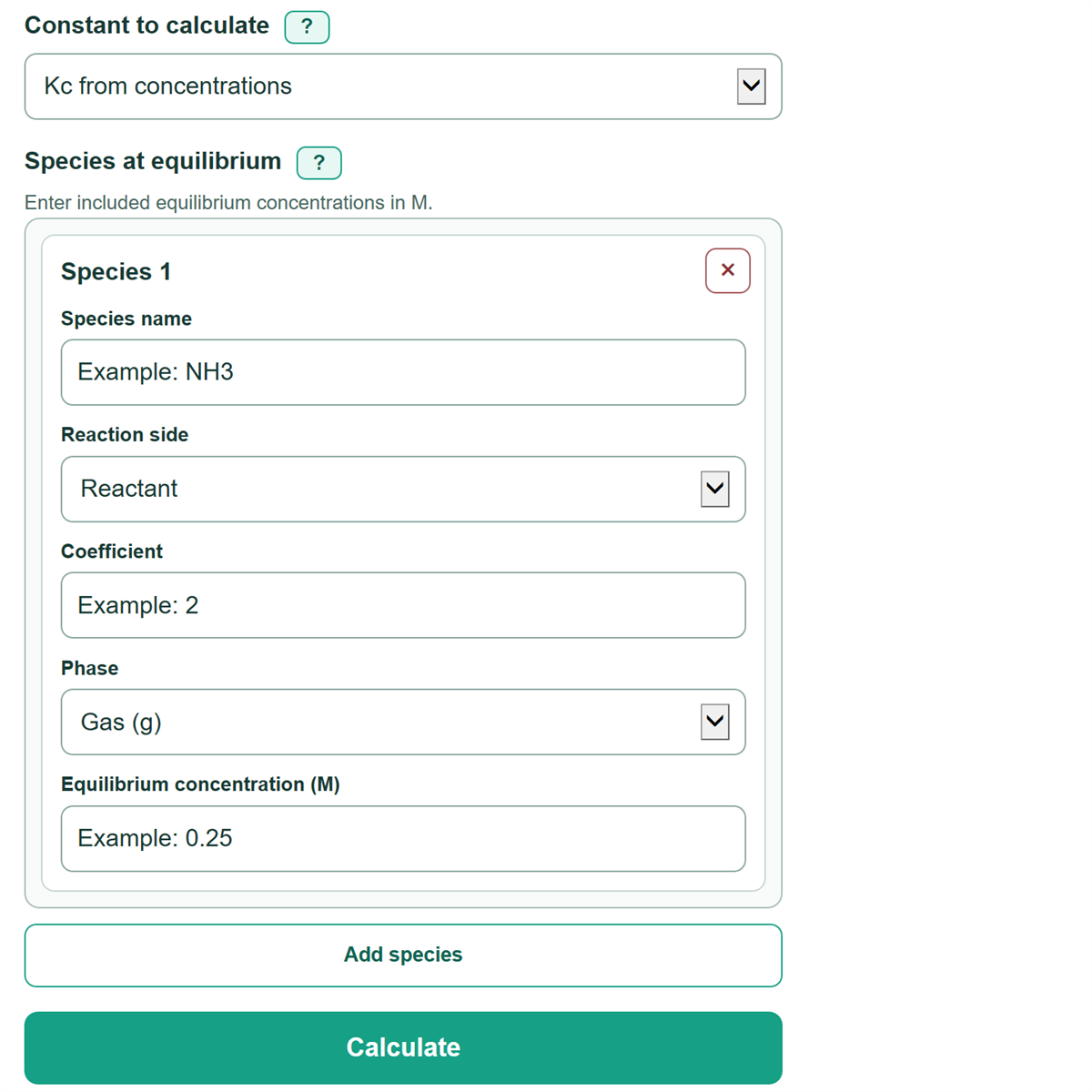
Enter included equilibrium concentrations in M.
Table of contents
How to use our Equilibrium Constant Calculator
- Choose Kc when the problem gives equilibrium concentrations in M, or choose Kp when it gives equilibrium partial pressures in atm.
- Add every species from the balanced reaction and enter its name, side, coefficient, and phase.
- Enter the equilibrium value for each included species. Do not enter an initial value or an ICE-table change.
- Click Calculate, then compare the displayed expression with the balanced reaction. Each coefficient should appear as an exponent.
- Check the included and omitted species summary before using the answer. Pure solids and liquids are omitted, and Kp also omits aqueous species.
Definitions
Equilibrium constant (K): A number calculated from the equilibrium mixture for a reaction written in one specific balanced form.
Kc: The equilibrium constant calculated from equilibrium concentrations, usually entered in M.
Kp: The equilibrium constant calculated from equilibrium partial pressures of gases, usually entered in atm.
Partial pressure: The part of the total pressure contributed by one gas in a gas mixture.
Stoichiometric coefficient: The number before a chemical formula in a balanced reaction. It becomes that species' exponent in the equilibrium expression.
Pure solid or pure liquid: A substance marked (s) or (l) that is omitted from the introductory equilibrium expression.
Activity ratio: The formal basis of K. Classroom Kc and Kp calculations use concentrations or partial pressures compared with standard reference values, so K is treated as dimensionless.
Common mistakes and quick fixes
Mistake: Using coefficients from an unbalanced reaction.
Fix: Balance the reaction first. Each coefficient becomes an exponent in the equilibrium expression.
Mistake: Entering an initial concentration, initial pressure, or ICE-table change.
Fix: Enter only the final concentration or partial pressure after equilibrium is reached.
Mistake: Choosing Kc for pressure data or Kp for concentration data.
Fix: Use Kc with values in M and Kp with gas partial pressures in atm.
Mistake: Including a pure solid or pure liquid in the expression.
Fix: Leave its measurement blank. Pure solids and pure liquids are omitted from this introductory expression.
Mistake: Including an aqueous species in Kp.
Fix: This calculator uses gaseous species only for Kp, so omit aqueous species.
Mistake: Treating a large K value as proof that a reaction is fast.
Fix: K describes the equilibrium mixture, not the speed of the reaction.
Limitations & Key Assumptions / Boundary Conditions
- Use a balanced reaction exactly as written. Reversing the reaction or multiplying all coefficients changes the numerical value of K.
- This calculator uses the introductory approximation of concentration divided by 1 M for Kc and partial pressure divided by 1 atm for Kp.
- For Kc, aqueous and gaseous species are included. For Kp, only gaseous species are included. Pure solids and pure liquids are omitted.
- Every included measurement must be a positive equilibrium value. Zero, negative, blank, or nonnumeric values cannot be used.
- The calculator finds K directly from supplied equilibrium data. It does not solve ICE tables, convert between Kc and Kp, calculate Q, predict reaction direction, or account for nonideal activity.
- At high gas pressures or in concentrated solutions, real activities can differ from the simple concentration or pressure values entered here.
Methodology
Mass-action calculation
The calculator puts included products in the numerator and included reactants in the denominator. Each coefficient in the balanced reaction becomes an exponent. [1]
Kc = (included product concentrations raised to their coefficients) / (included reactant concentrations raised to their coefficients)
Kp = (included product partial pressures raised to their coefficients) / (included reactant partial pressures raised to their coefficients)
Phase rules
For Kc, aqueous and gaseous species are included. For Kp, only gases are included. Pure solids and pure liquids are omitted, and aqueous species are also omitted from Kp. [1]
Worked mini-example
For N2(g) + 3H2(g) <=> 2NH3(g), use equilibrium concentrations of 0.20 M N2, 0.30 M H2, and 0.50 M NH3.
Kc = [NH3]^2 / ([N2] x [H2]^3) = 0.50^2 / (0.20 x 0.30^3) = 46.3
The unrounded value is 46.296..., so the displayed value is about 46.3. This value applies only to the reaction written in that direction with those equilibrium measurements.