
Enter a number to find its principal square root, plus the positive and negative solutions when solving x squared equals that number.
Advanced options
The square-root symbol means the nonnegative principal root.
This line answers the equation problem, which is different from evaluating the square-root symbol.
Table of contents
How to use our Square Root Calculator
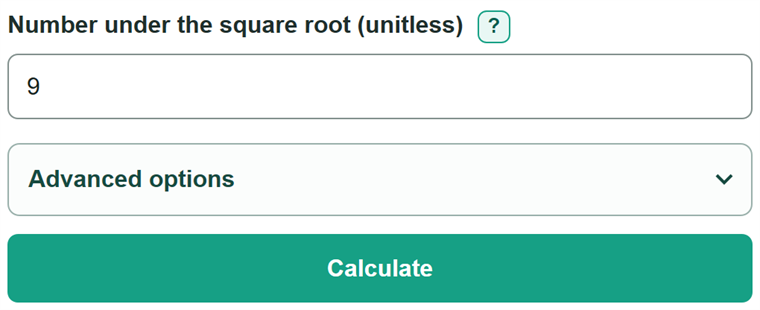
- Enter one value in "Number under the square root," such as 8, 2.25, or 1e-6. Calculate any expression first, then enter its single numeric answer.
- Open "Advanced options" and choose "Decimal places" only when your assignment asks for a particular rounding level.
- Click "Calculate" and read "Principal square root" first. This is always the nonnegative value named by the square-root symbol.
- If your problem asks you to solve x squared equals a number, use "Solutions to x squared = the entered number." This line includes both positive and negative solutions when the entered number is positive.
- Check the answer by squaring the exact form, or a decimal with enough digits. The result should equal, or be very close to, the number you entered.
Definitions
Radicand: The number under a square-root symbol. It is the number entered in this calculator.
Principal square root: The one nonnegative square root selected by the square-root symbol. The principal square root of 9 is 3, not -3. [1]
Perfect square: A nonnegative whole number formed by multiplying a whole number by itself, such as 0, 1, 4, 9, or 16.
Simplified radical: An exact square-root form with a perfect-square factor moved outside the radical, such as 2 sqrt(2) for sqrt(8). [2]
Decimal approximation: A rounded decimal used to show a square root when an exact form is not a simple terminating decimal.
Common mistakes and quick fixes
Mistake: Writing plus or minus as the value of a square-root symbol.
Fix: Use the nonnegative "Principal square root." Use the equation-solutions line only when solving x squared equal to the entered number.
Mistake: Treating a rounded decimal as an exact answer.
Fix: Keep the simplified radical when one is shown, or label the decimal as an approximation.
Mistake: Expecting a real answer for a negative number.
Fix: A negative number has no real square root, and x squared equal to that number has no real solutions.
Mistake: Entering an expression such as 4+5.
Fix: Evaluate the expression first, then enter the one resulting number.
Mistake: Rounding before checking the answer.
Fix: Use more "Decimal places" or the exact radical form before squaring the answer.
Limitations & Key Assumptions / Boundary Conditions
- The calculator works with real numbers only. A negative input correctly returns no real square root and no real equation solutions; it does not calculate complex-number answers.
- "Decimal places" rounds only the displayed decimal. Use an exact radical when shown if your problem requires an exact answer.
- For nonnegative whole numbers through 1,000,000,000,000, the calculator checks for a simplified radical. Larger whole numbers still receive a decimal approximation but may not receive a fully simplified radical.
- The entry must be one finite number. Expressions, ranges, NaN, Infinity, and values larger than 1e308 are rejected.
- A very small nonzero root can display as zero at low precision. Increase "Decimal places" before concluding that the root is zero.
Methodology
Calculation
The calculator first checks that the entry is one finite real number. For a nonnegative input, it calculates the nonnegative principal root, which is the value meant by the square-root symbol. [1]
decimal approximation = sqrt(radicand), for radicand >= 0
For a positive entered number, x squared equal to that number has two real solutions:
the principal root and its negative. For zero, the only solution is x = 0. For a negative number, there is no real square root and no real solution.
x = +/- sqrt(radicand), for radicand > 0
Exact forms
For supported nonnegative whole numbers, the calculator finds a perfect-square factor and moves its root outside the radical. [2]
sqrt(radicand) = sqrt(square factor) * sqrt(remaining factor)
For example, 8 = 4 * 2, so sqrt(8) = sqrt(4) * sqrt(2) = 2 sqrt(2). Rounded to six decimal places, its decimal approximation is 2.828427. The equation x squared = 8 has the two solutions x = 2 sqrt(2) and x = -2 sqrt(2).
Decimal-place choices affect only the displayed approximation, not the underlying calculation. The calculator simplifies supported whole-number inputs through 1,000,000,000,000; other finite nonnegative inputs still receive a decimal result.