
Choose the blank position and enter the other three values to solve the missing number in an equal-ratios proportion.
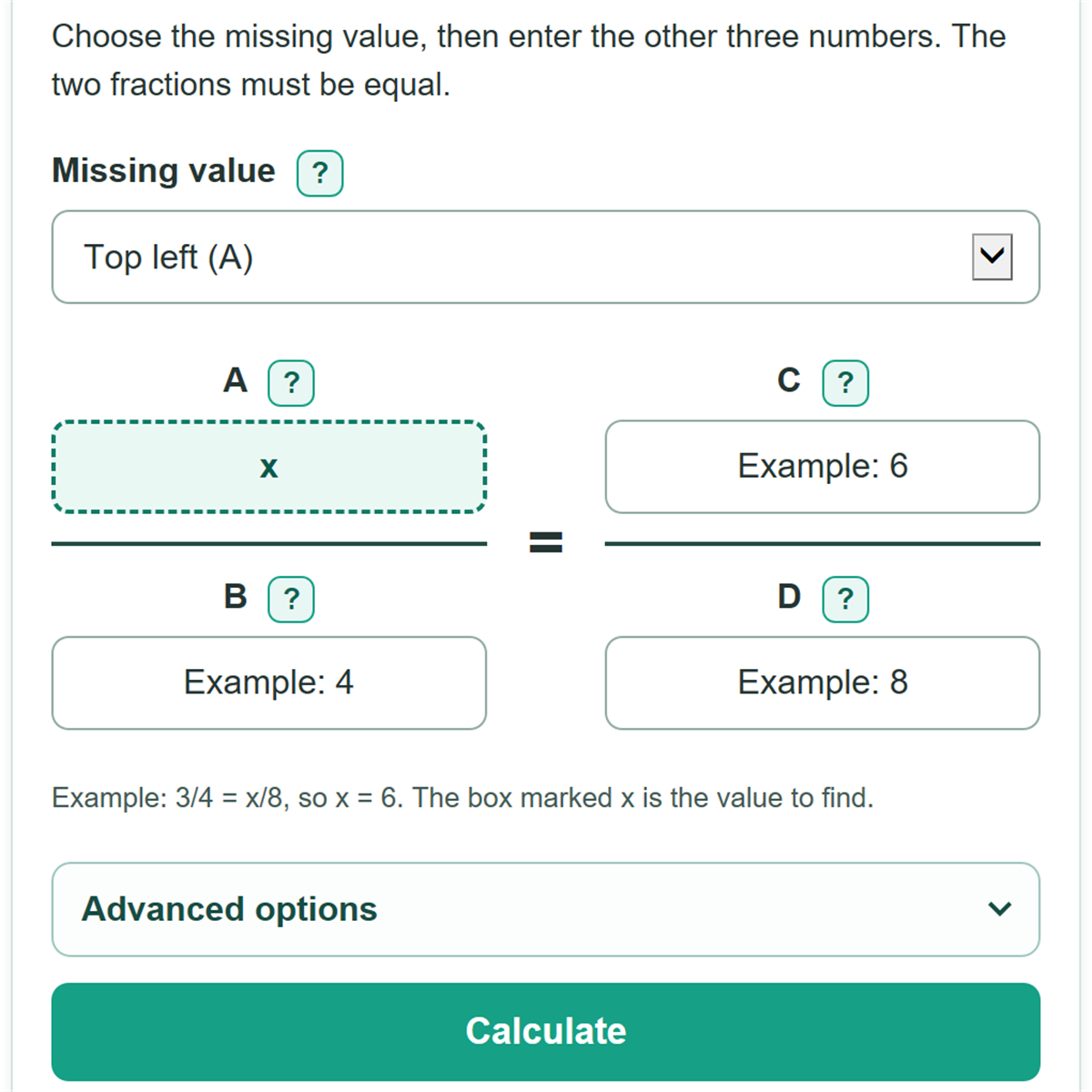
Choose the missing value, then enter the other three numbers. The two fractions must be equal.
Example: 3/4 = x/8, so x = 6. The box marked x is the value to find.
Advanced options
Table of contents
How to use our Proportion Calculator
- Choose the position of the blank, question mark, or x under "Missing value."
- Enter the other three numbers in their matching positions in A/B = C/D. The selected missing position is hidden.
- Click "Calculate" to get the missing value and see the completed proportion.
- Sanity-check the answer: both ratios should have the same value, and the two cross products should match.
- For a word problem, open "Advanced options" and enter the quantity or unit words beside each position. Check any warning before using the answer.
Definitions
Proportion: An equation that says two ratios are equal, such as A/B = C/D. [1]
Ratio: A comparison made by division. A/B is the left ratio, and C/D is the right ratio.
Numerator: The top number in a ratio. A and C are numerators.
Denominator: The bottom number in a ratio. B and D are denominators and cannot be zero in a completed proportion.
Cross products: The diagonal products A times D and B times C. They are equal in a completed proportion.
Setup label warnings: Warnings shown when both labels in the top row or both labels in the bottom row differ after capitalization and extra spaces are ignored. They do not change the math answer.
Common mistakes and quick fixes
Mistake: Selecting top left (A) when the blank is in another position.
Fix: Check Missing value and then recalculate. Look at A/B = C/D and choose the same position as the blank, question mark, or x.
Mistake: Treating division by zero as zero or infinity.
Explanation: A supplied zero in B or D makes that fraction undefined, even for 0/0. The calculator reports Undefined and explains why; it does not change the entered problem.
Mistake: Assuming every zero means the same thing.
Explanation: With nonzero denominators, a missing numerator can equal zero. For a missing denominator, 0/x = 0/4 has infinitely many solutions (every nonzero real x), while 2/x = 0/4 has no solution. The original denominator restrictions still apply.
Mistake: Putting unlike quantities in matching positions, such as cups at the top left and servings at the top right.
Fix: Check Missing value and then recalculate. Put matching quantity types across the top row and across the bottom row. Convert units first if needed.
Mistake: Using the missing value without checking the completed equation.
Fix: Check Missing value and then recalculate. Confirm that both ratios are equal and that A times D equals B times C.
Limitations & Key Assumptions / Boundary Conditions
- This calculator solves equal ratios written as A/B = C/D. It cannot determine whether a word problem needs a direct proportion, an inverse relationship, or a different equation.
- The calculator works over the real numbers. B and D must be nonzero. It distinguishes an undefined supplied fraction, a unique answer (including zero), no solution, and infinitely many solutions with the zero denominator excluded.
- Negative and decimal values can be calculated, but they may not make sense for quantities such as people or physical items.
- Optional quantity and unit labels are compared as text. Matching labels do not prove units are compatible, and different labels may still be convertible.
- Values too large for ordinary numeric calculation cannot be calculated. Rescale every value in the proportion consistently and try again.
Methodology
Cross multiplication
A proportion is written as A/B = C/D. Multiplying across the diagonals gives A times D = B times C. The calculator uses this equality to solve the selected missing position. [2]
A/B = C/D
A x D = B x C
Missing-value formulas
A = (B x C) / D
B = (A x D) / C
C = (A x D) / B
D = (B x C) / A
Worked example
For A/4 = 6/8, solve A with (4 x 6) / 8 = 3. The completed proportion is 3/4 = 6/8. Each ratio is 0.75, and both cross products are 24.
A = (4 x 6) / 8 = 3
3 x 8 = 4 x 6 = 24
Checks used
After filling the missing position, the calculator compares A times D with B times C and calculates both ratios. If you enter optional labels, it also compares the two top labels and the two bottom labels after ignoring capitalization and repeated spaces. A blank label does not create a warning.
Calculation choices
The calculator first checks the original denominators. A supplied zero denominator makes a fraction undefined. If the missing value is a denominator, zero is excluded: both zero numerators give infinitely many nonzero real solutions, and exactly one zero numerator gives no solution. Otherwise it calculates the unique missing value. Numeric overflow or underflow is a calculation limit, not a mathematical no-solution result. A label warning can reveal a possible swapped setup, but cannot confirm that different units were converted correctly.