
Enter your mixture values to find percent concentration, solute needed, or final solution amount for w/w, w/v, or v/v solutions.
Table of contents
How to use our Percent Solution Calculator
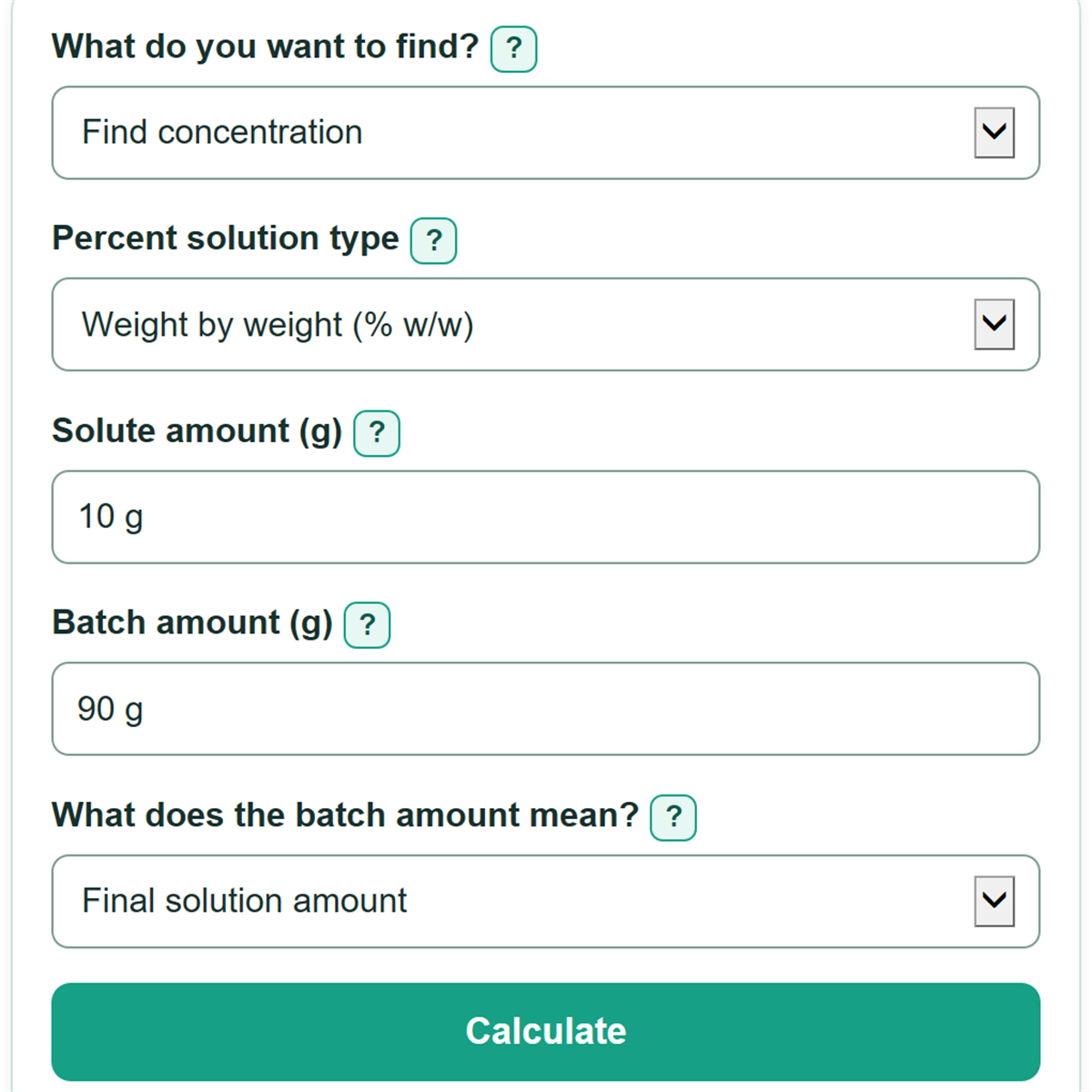
- Choose whether to find concentration, solute amount, or final solution amount.
- Select the percent type from your problem: % w/w, % w/v, or % v/v.
- Enter the known measurements. You can type mg, g, kg, uL, mL, or L; a number without a unit uses the unit shown in the label.
- When finding concentration, choose whether the batch amount is the final solution or solvent only, then select Calculate.
- Check that the answer uses the intended percent type and that its final solution amount is the total mixture amount, not just the starting solvent.
Definitions
% w/w (weight by weight): Solute mass per 100 g of final solution.
% w/v (weight by volume): Solute mass in grams per 100 mL of final solution.
% v/v (volume by volume): Solute volume per 100 mL of final solution.
Solute: The material dissolved or mixed into the solution.
Final solution amount: The total mass or measured final volume after preparation. It is the denominator, or whole amount, in the percent calculation.
Solvent-only amount: The starting mass or volume of water or another carrier before solute is included. This calculator can turn it into a final amount only for the supported % w/w setup.
Metric prefixes: 1 g = 1,000 mg, 1 kg = 1,000 g, 1 mL = 1,000 uL, and 1 L = 1,000 mL.
Common mistakes and quick fixes
Mistake: Treating the water or solvent amount as though it were the final solution amount.
Fix: For a % w/w mixture, choose "Solvent-only amount" when the stated amount is only solvent. The calculator adds the solute mass to get the final mass.
Mistake: Selecting % w/w when the problem gives a final volume in mL.
Fix: Use % w/v for grams of solute per final mL of solution. Use % v/v for mL of solute per final mL of solution.
Mistake: Entering a volume in % w/w or a mass in % v/v.
Fix: Use mg, g, or kg for % w/w. Use uL, mL, or L for % v/v. For % w/v, the solute is a mass and the final solution is a volume.
Mistake: Entering 0.05 for a target of 5%.
Fix: Enter 5. The percent field expects the percent number, not its decimal form.
Mistake: Adding liquid ingredient volumes to estimate the final volume for % w/v or % v/v.
Fix: Enter the stated or measured final solution volume. Mixing liquids or dissolving a solid can change the final volume.
Limitations & Key Assumptions / Boundary Conditions
- This calculator uses percent concentration only. It does not calculate molarity, molality, ppm, or other concentration systems.
- For solvent-only input, it adds solute mass and solvent mass only in % w/w mode. The entered masses must describe the components of the final mixture.
- For % w/v and % v/v, use a measured or stated final solution volume. Ingredient volumes may not add up to the final volume after mixing.
- For % w/w and % v/v, solute cannot exceed the final solution amount, so the percent cannot exceed 100%. This same limit does not apply generally to % w/v because grams and mL measure different things.
- The calculation does not account for purity, density, temperature, evaporation, chemical reactions, or laboratory safety requirements.
Methodology
Calculation method
A percent solution compares the solute amount with the final solution amount. The selected percent type sets whether the amounts are masses or volumes.
Percent concentration = 100 × solute amount / final solution amount
Solute amount needed = target percent × final solution amount / 100
Final solution amount needed = 100 × solute amount / target percent
For % w/w only, an entered solvent-only mass is converted to final solution mass by adding the solute mass and solvent mass.
Final solution mass = solute mass + solvent mass
Worked example
With 10 g of solute in 90 g of final solution, the calculation is 100 times 10 divided by 90, or about 11.1% w/w. If 90 g means solvent only, final mass is 10 g plus 90 g, or 100 g. The concentration is then 10.0% w/w.
Calculation boundaries
The calculator converts mass entries to grams and volume entries to mL before calculating. Zero solute in a positive final amount is a valid 0% solution. A positive solute amount cannot make a 0% solution with any finite final amount. If both solute and target percent are zero, any positive final amount fits, so there are infinitely many solutions.