
Convert w/w, w/v, or v/v percent solutions to molarity and see the implied solute amount in 1 L so you can catch setup mistakes fast.
Advanced options
How to use our Percentage Concentration to Molarity Calculator
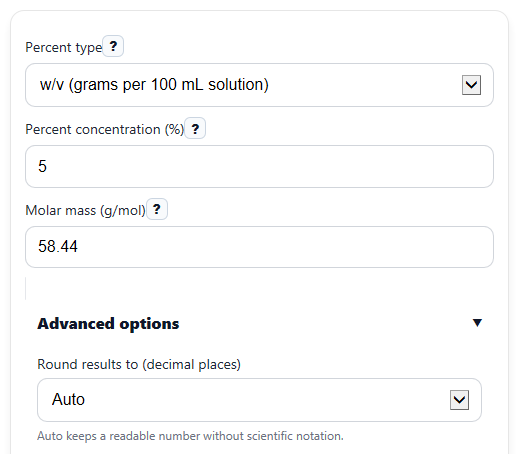
- Choose Percent type to match your label exactly: w/v means grams per 100 mL solution, w/w means grams per 100 g solution, and v/v means mL per 100 mL solution.
- Enter Percent concentration (%) and Molar mass (g/mol), then fill in the density field only if that percent type needs it.
- If you picked v/v, enter Solute density for v/v (g/mL). If you picked w/w, enter Solution density (g/mL). Leave unused density fields alone.
- Click Calculate, then check Formula used and Solute amount in 1 L of solution to make sure the calculator used the basis you intended.
- Use Molarity as the main answer, and compare it with Moles in 1 L of solution. For a 1 L basis, those two numbers should match numerically.
Definitions
Percent type: The meaning of the percent label. Here it can mean grams per 100 mL solution (w/v), grams per 100 g solution (w/w), or mL per 100 mL solution (v/v).
Percent concentration (%): The numeric percent value entered without the percent sign as a decimal fraction. For example, enter 5 for 5%.
Molar mass (g/mol): The mass of one mole of the solute. It converts grams of solute into moles.
Solution density (g/mL): Mass of the whole solution per milliliter. It is needed for w/w because w/w starts from grams per 100 g solution.
Solute density for v/v (g/mL): Mass of the liquid solute per milliliter. It is needed for v/v to turn solute volume into solute mass.
Molarity (mol/L): Moles of solute per liter of solution [1].
Solute amount in 1 L of solution: The intermediate amount implied by the chosen percent basis before the final mole conversion.
Common mistakes and quick fixes
Mistake: Picking the wrong Percent type , such as using w/w when your label is really w/v.
Fix: Match the wording exactly before you calculate. Then check Formula used to confirm the basis.
Mistake: Typing 0.05 in Percent concentration (%) for a 5% solution.
Fix: Enter the percent number itself, so use 5 for 5%.
Mistake: Entering solution density into Solute density for v/v (g/mL) in v/v mode.
Fix: For v/v, use the liquid solute's own density in Solute density for v/v (g/mL) , not the mixture density.
Mistake: Using Solution density (g/mL) for w/v calculations.
Fix: In w/v mode, density is not part of the formula. Focus on Percent concentration (%) and Molar mass (g/mol) .
Mistake: Entering the wrong chemical value in Molar mass (g/mol) .
Fix: Recheck the compound formula and units. A wrong molar mass changes both Moles in 1 L of solution and Molarity .
Mistake: Ignoring the intermediate check values after calculating.
Fix: Read Solute amount in 1 L of solution first. If that amount looks too big or too small, your Percent type or density input may be wrong.
Limitations & Key Assumptions / Boundary Conditions
- This calculator is for standard percent solution definitions only and accepts Percent concentration (%) from 0 to 100.
- For w/w, the result depends on Solution density (g/mL). If that value is off, Molarity will also be off.
- For v/v, the result depends on Solute density for v/v (g/mL). Using mixture density instead will give the wrong answer.
- The method assumes the percent label refers to the final solution, not to solvent alone.
- Real solutions can change density with temperature, so lab values may differ if the density you use was measured under different conditions.
- v/v works best for liquid solutes. It is not meant for solids described with other concentration units.
- Rounding settings change only how values are displayed, not the underlying calculation.
Methodology
Core idea
The calculator converts the chosen percent basis into the amount of solute in 1 L of solution, then divides by Molar mass (g/mol) to get moles. Because the basis is 1 L, the numeric value of Moles in 1 L of solution matches Molarity [1].
Formulas by percent type
M = (percent concentration x 10) / molar mass
Use this for w/v. A w/v percent means grams of solute per 100 mL solution, so multiplying by 10 gives grams per liter [2].
M = (percent concentration x solution density x 10) / molar mass
Use this for w/w. In 1 L of solution, total solution mass is solution density x 1000 grams. The solute is the chosen percent of that mass [1].
M = (percent concentration x solute density for v/v x 10) / molar mass
Use this for v/v. A v/v percent gives mL of solute per 100 mL solution. Multiply by 10 to get mL per liter, then use solute density to convert that volume into grams [1].
Compact worked example
Example in w/v mode: 5% solution with Molar mass (g/mol) = 58.44.
solute amount in 1 L = 5 x 10 = 50 g/L
moles in 1 L = 50 / 58.44 = 0.855578...
molarity = 0.855578... mol/L
That means the solution contains about 0.856 moles of solute in each liter.
How to sanity-check the result
First read Solute amount in 1 L of solution. If you expected about 50 g/L but see a value based on mass of solution or mL of solute, your Percent type is probably wrong. Then confirm that Formula used matches the label on your bottle or worksheet.
Assumptions used here
This calculator follows standard textbook meanings of molarity, w/w, and w/v [2][2]. For v/v, it assumes you know the liquid solute density well enough to convert solute volume into mass. Results can differ from real lab preparations when density changes with temperature or when labels use a nonstandard basis.