
Use this mass percent calculator to find percent by mass or solve for solute, total, or solvent mass with clear chemistry wording.
How to use our Mass Percent Calculator
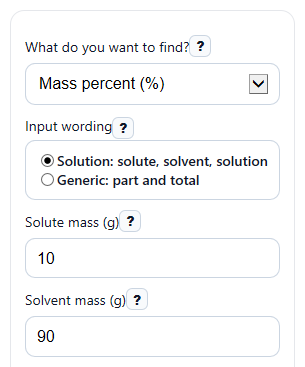
- Choose What do you want to find? and pick the missing value: Mass percent (%), Solute mass (g), Total mass (g), or Solvent mass (g).
- Set Input wording to Solution if you want chemistry labels like solute and solvent, or Generic if part and total wording feels easier.
- Enter the visible fields only, using grams for masses and a percent value for Mass percent (%). For example, enter 12.5, not 0.125, in Mass percent (%).
- Click Calculate, then read Answer first, Mass fraction second, and Check on your inputs last to see whether the masses fit total mass = solute mass + solvent mass.
- Do a quick sanity check: mass percent should be between 0 and 100, and the solute mass should be smaller than the total mass in a normal solution problem.
Definitions
Mass percent (%): The mass of the part you care about divided by the total mass, then multiplied by 100.
Mass fraction: The decimal form of mass percent. A mass fraction of 0.10 means 10% by mass.
Solute mass (g): The mass of the substance being dissolved, or the tracked part in a generic part-of-total problem.
Solvent mass (g): The mass of the material that does the dissolving. In generic wording, this is the other mass not counted as the tracked part.
Total mass (g): The full mass of the mixture or solution. In solution problems, it equals solute mass plus solvent mass.
Input wording: A label switch that changes whether you see solution words like solute and solvent or generic words like part and total. The math stays the same.
Common mistakes and quick fixes
Mistake: Entering 0.125 in Mass percent (%) when the problem says 12.5%.
Fix: Type 12.5 in Mass percent (%). The calculator expects a percent, not a decimal.
Mistake: Using Solvent mass (g) as the denominator when finding Mass percent (%).
Fix: Use Total mass (g) as the whole amount. In solution wording, total mass = solute mass + solvent mass.
Mistake: Entering a Solute mass (g) larger than Total mass (g).
Fix: Check both mass entries. Solute mass (g) cannot be greater than Total mass (g) for this calculator.
Mistake: Mixing up Solute mass (g) and Solvent mass (g).
Fix: Put the dissolved substance in Solute mass (g) and the dissolving material in Solvent mass (g), or switch Input wording to Generic if part-and-total wording is clearer.
Mistake: Thinking Check on your inputs changes the math for Answer.
Fix: Read it as a consistency message only. If it says the masses do not match, fix Solute mass (g), Solvent mass (g), or Total mass (g).
Mistake: Using negative numbers or zero for a mass that should be positive.
Fix: Enter positive values for Solute mass (g), Solvent mass (g), and Total mass (g). If Total mass (g) is used in the formula, it must be greater than 0.
Limitations & Key Assumptions / Boundary Conditions
- This calculator uses the standard mass-percent idea: part mass divided by total mass times 100. It does not do percent by volume or mass-per-volume.
- Masses must be entered in the same unit family. The inputs are labeled in grams, which matches most school chemistry problems.
- When solving from Mass percent (%) and Total mass (g), the calculator assumes a normal percent-by-mass setup where the percent is greater than 0 and not above 100.
- If you choose Solvent mass (g), a negative result is treated as an input error because a solvent mass cannot be less than 0 in this context.
- The Check on your inputs message compares the entered masses to the rule total mass = solute mass + solvent mass, using a small tolerance for rounding.
- Real lab measurements can differ slightly because of rounding, measurement uncertainty, evaporation, or problem wording, but classroom exercises usually follow the exact formulas shown here.
Methodology
Core formulas
The calculator uses the standard chemistry definition of mass percent: the mass of the solute or tracked part divided by the total mass, then multiplied by 100 [1][2].
mass percent = (solute mass / total mass) x 100
total mass = solute mass + solvent mass
solute mass = (mass percent / 100) x total mass
total mass = solute mass / (mass percent / 100)
solvent mass = total mass - solute mass
How each solve mode works
If you solve for Mass percent (%), the calculator first finds total mass from solute mass plus solvent mass, then divides solute mass by total mass and multiplies by 100.
If you solve for Solute mass (g), it turns the percent into a decimal by dividing by 100, then multiplies by Total mass (g).
If you solve for Total mass (g), it divides Solute mass (g) by the mass fraction. For example, 30% becomes 0.30 before dividing.
If you solve for Solvent mass (g), it subtracts Solute mass (g) from Total mass (g). It also shows Mass fraction as solute mass divided by total mass.
Mini example
Suppose a solution has 10 g of solute and 90 g of solvent.
total mass = 10 + 90 = 100 g
mass percent = (10 / 100) x 100 = 10%
mass fraction = 10 / 100 = 0.10
So the solution is 10% by mass, and its mass fraction is 0.10.
Checks and assumptions
The calculator blocks impossible inputs such as negative masses, total mass of 0 in denominator-based formulas, mass percent at or below 0 when solving for total mass, mass percent above 100 for standard solution problems, and solute mass greater than total mass when solving for solvent mass.
The consistency message checks whether the entered masses satisfy total mass = solute mass + solvent mass. A mismatch usually means one value was copied wrong or rounded differently from the others.