
Enter matching air and fuel mass data or a gauge reading to calculate your air-fuel ratio, lambda, and rich, stoichiometric, or lean status.
Advanced options
Table of contents
How to use our Air Fuel Ratio Calculator
- Choose "Air and fuel amounts" when you have air and fuel mass data or matching mass-flow data. Choose "A gauge or log reading" when an instrument already shows lambda or AFR.
- Select "Fuel reference". Use "Custom fuel or blend" only if you can copy its stoichiometric AFR from the tune, fuel supplier, or calibration documentation.
- For air and fuel data, enter both values and select their units. Use mass units for both entries, or flow units for both entries.
- For a gauge or log, select what the instrument reports, then enter the displayed number. Check the gauge or software setting before choosing a gasoline-referenced AFR.
- Select "Calculate". Confirm "How the input was interpreted" matches your source, then use the lambda and mixture status as a ratio check, not as a vehicle-specific tuning target.
Definitions
Air-fuel ratio (AFR): Air mass divided by fuel mass, written as a ratio such as 14.7:1.
Stoichiometric AFR: The air-fuel mass ratio used as the chemically balanced reference for a fuel. The gasoline selection uses 14.7:1. [1]
Lambda: Actual AFR divided by the selected fuel's stoichiometric AFR. Lambda below 1 is rich, 1 is stoichiometric, and above 1 is lean.
Rich mixture: A mixture with lambda below 1, meaning more fuel relative to air than the selected fuel's stoichiometric reference.
Lean mixture: A mixture with lambda above 1, meaning less fuel relative to air than the selected fuel's stoichiometric reference.
Fuel equivalence ratio: The reciprocal of lambda. A value above 1 indicates a rich mixture.
Gasoline-referenced AFR: An AFR display scaled using the 14.7:1 gasoline reference, which may differ from an AFR stated on the selected fuel basis.
Common mistakes and quick fixes
Mistake: Dividing air volume by fuel volume.
Fix: Enter mass or mass-flow data. This calculator divides air mass by fuel mass.
Mistake: Combining air flow, such as g/s, with a one-time fuel mass, such as g.
Fix: Use flow units for both entries or mass units for both entries.
Mistake: Assuming every AFR display is already based on the fuel in the engine.
Fix: Check the gauge or logging software setting and choose Lambda, gasoline-referenced AFR, or selected-fuel AFR.
Mistake: Selecting "Custom fuel or blend" without its documented stoichiometric AFR.
Fix: Copy the fuel-specific ratio from tune, supplier, or calibration documentation. Do not estimate it from ethanol percentage alone.
Mistake: Treating rich, stoichiometric, or lean as a tuning instruction.
Fix: Treat the status as a comparison with the selected reference. Use vehicle-specific calibration guidance for operating targets.
Limitations & Key Assumptions / Boundary Conditions
- The calculation uses mass quantities only. It cannot use fuel volume, air volume, or a pump-volume reading unless those values are first converted using suitable density information.
- Air and fuel must have the same basis: both one-time mass values or both mass-flow values.
- The gasoline selection uses a 14.7:1 reference. A custom-fuel answer depends on the stoichiometric AFR entered from the applicable documentation.
- A gauge or log reading must be identified correctly as lambda, gasoline-referenced AFR, or selected-fuel AFR before conversion.
- Rich, stoichiometric, and lean describe a mathematical comparison with the selected reference. They do not establish a safe, efficient, or correct target for a particular engine, load, temperature, or operating condition.
- Changing result decimal places changes displayed rounding only. The calculations use unrounded values.
Methodology
Mass-based calculation
AFR uses matching mass values or matching mass-flow values. The calculator converts grams, kilograms, and pounds to a common mass basis before dividing. One pound is exactly 0.45359237 kilograms.
AFR = air mass / fuel mass
AFR = air mass flow / fuel mass flow
Fuel reference and lambda
The selected fuel needs a stoichiometric AFR reference. The gasoline selection uses 14.7:1. [1] A custom fuel or blend uses the positive reference value entered by the user.
λ (mixture ratio) = actual AFR / selected-fuel stoichiometric AFR
Lambda below 1 is rich, lambda equal to 1 is stoichiometric, and lambda above 1 is lean. A tolerance of 0.000000001 around 1 only prevents floating-point rounding noise from changing the status.
fuel equivalence ratio = 1 / λ
Gauge and log conversion
A lambda reading already gives the normalized mixture. For a gasoline-referenced AFR display, the calculator divides the displayed AFR by 14.7 to find lambda, then multiplies lambda by the selected fuel's stoichiometric AFR. A selected-fuel AFR display is divided by that fuel's stoichiometric AFR to find lambda.
λ = gasoline-referenced AFR / 14.7
selected-fuel AFR = λ * selected-fuel stoichiometric AFR
Worked example
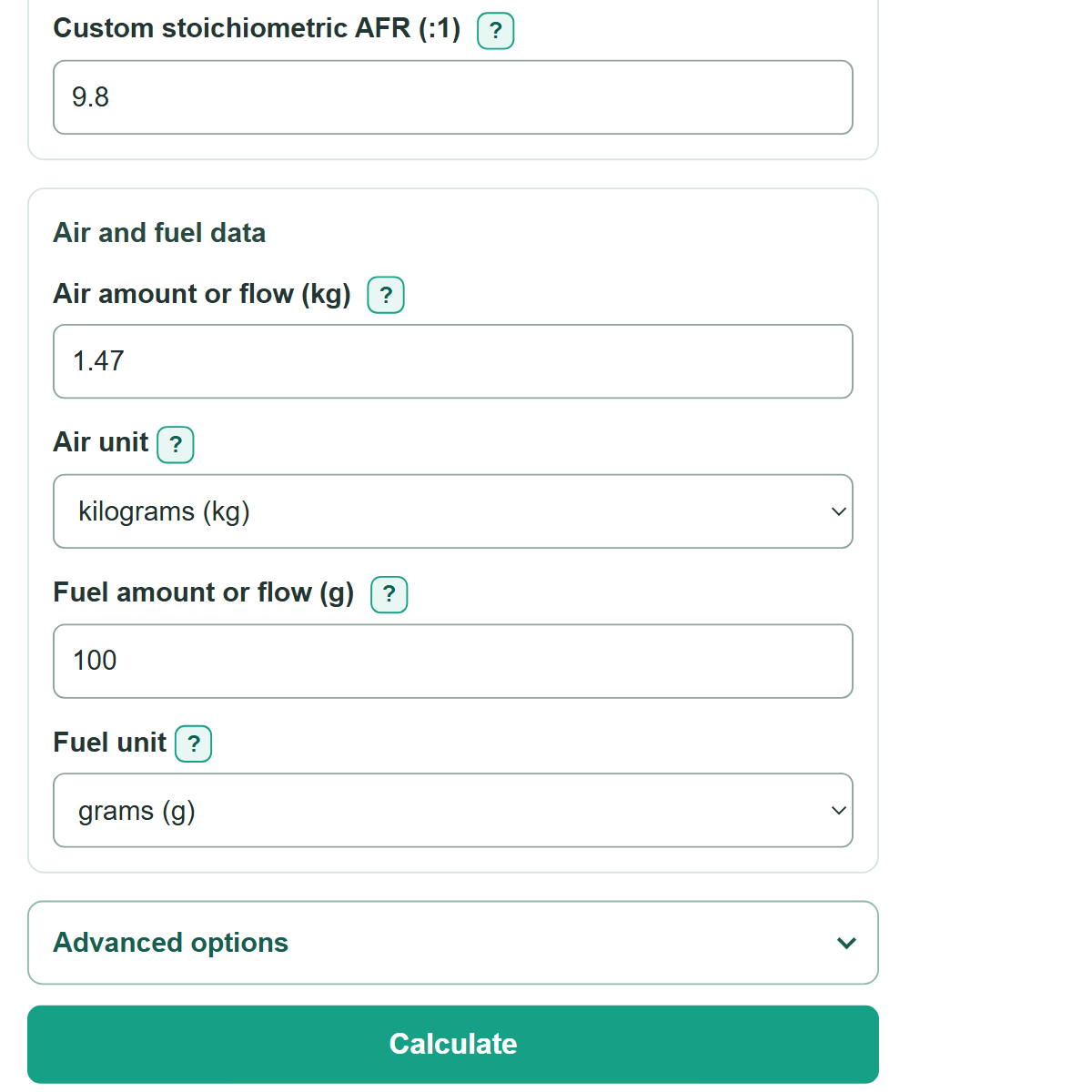
With 1.47 kg of air and 100 g of fuel, fuel mass is 0.10 kg. AFR is 1.47 / 0.10 = 14.7:1. For a fuel with a 9.8:
1 stoichiometric AFR, lambda is 14.7 / 9.8 = 1.5, so the mixture is lean. If a gasoline-referenced gauge reads 14.7 for that same fuel, lambda is 14.7 / 14.7 = 1 and the selected-fuel AFR is 9.8:1.