
Compare two elements on the Pauling scale or calculate Mulliken electronegativity from ionization energy and electron affinity.
Advanced options
How to use our Electronegativity Calculator
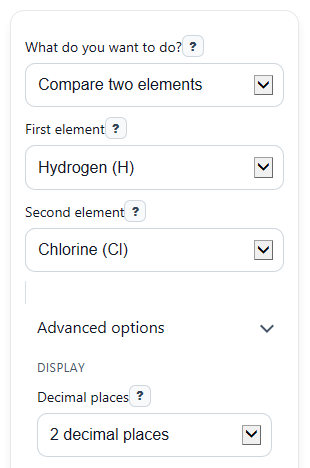
- Choose What do you want to do? Pick Compare two elements for most class bond questions, or Find Mulliken electronegativity if you were given energy values.
- For compare mode, select First element and Second element. For Mulliken mode, enter Ionization energy (eV) and Electron affinity (eV) as positive numbers.
- If you want, open Advanced options and choose a Bond-type guide and Decimal places. Turn the bond label off if you only want the number.
- Click Calculate, then read Electronegativity result first. In compare mode, also check Stronger pull on shared electrons, First electronegativity, Second electronegativity, and the Scale note.
- Sanity-check the output before using it in homework: if you used compare mode, both values should be on the same built-in Pauling scale, and if you used Mulliken mode, do not directly compare that result to Pauling values.
Definitions
Electronegativity: A measure of how strongly an atom attracts shared electrons in a bond.
Pauling scale: A common classroom electronegativity scale with dimensionless values used for comparing elements.
Mulliken electronegativity: A value found from ionization energy and electron affinity using an average formula [1].
Ionization energy (eV): The energy needed to remove one electron from a neutral atom.
Electron affinity (eV): In this calculator, the positive amount of energy released when a neutral atom gains one electron.
Electronegativity difference: The absolute difference between two electronegativity values on the same scale.
Bond-type guide: A set of classroom cutoff values used to label a difference as nonpolar covalent, polar covalent, or ionic.
Common mistakes and quick fixes
Mistake: Using Find Mulliken electronegativity and then treating the Electronegativity result like a Pauling difference.
Fix: Read the Scale note . Mulliken and Pauling values are defined differently, so do not mix them in one comparison.
Mistake: Entering a blank, zero, or negative number for Ionization energy (eV) .
Fix: In Mulliken mode, enter a positive eV value for Ionization energy (eV) before calculating.
Mistake: Typing Electron affinity (eV) as a negative number because some tables use a different sign convention.
Fix: This calculator expects the released-energy amount as a positive number, so enter the magnitude as a positive value in Electron affinity (eV) .
Mistake: Thinking Bond-type estimate is an exact law of nature.
Fix: Treat Bond-type estimate as a classroom guide based on the chosen Bond-type guide , not as a guaranteed category for every real substance.
Mistake: Ignoring Stronger pull on shared electrons and only looking at the difference number.
Fix: In compare mode, use Stronger pull on shared electrons to see which atom attracts the shared electrons more strongly.
Mistake: Assuming a larger Electronegativity result always means a fully ionic bond in every situation.
Fix: Use the result as a rough polarity clue, then check Bond-type estimate and your class rule set for how your teacher wants it labeled.
Limitations & Key Assumptions / Boundary Conditions
- Compare mode uses only the built-in Pauling values for the listed elements. If an element is not in the menu, this calculator does not estimate it.
- The two modes use different scales. Pauling lookup results and Mulliken results should not be directly mixed or subtracted.
- Bond-type labels are rules of thumb based on the selected guide, not exact physical boundaries.
- Mulliken mode requires Ionization energy (eV) and Electron affinity (eV) entered as positive eV values using this calculator's sign convention.
- Results are rounded only for display. Small differences in source tables or rounding can change the last decimal place.
- Real bond behavior also depends on structure, environment, and the whole compound, so electronegativity alone does not describe every bonding detail.
Methodology
How the calculator works
In Compare two elements mode, the calculator looks up each selected element's Pauling electronegativity from the built-in table, then finds the absolute difference. It also shows which element has the larger value, meaning it pulls shared electrons more strongly.
Δχ = |χA - χB|
Here, χA and χB are the two electronegativity values on the same scale. The absolute value bars mean the result is always zero or positive.
Mulliken mode
In Find Mulliken electronegativity mode, the calculator uses the average of Ionization energy (eV) and Electron affinity (eV) [1].
χM = (IE + EA) / 2
The result here is based on energy values in eV, so it should not be directly compared with built-in Pauling numbers unless a separate conversion is explicitly defined. This calculator does not perform that conversion [1].
Bond-type estimate
If a Bond-type guide is turned on, the calculator applies simple classroom thresholds to the electronegativity difference in compare mode.
if Δχ < t1, nonpolar covalent; else if Δχ < t2, polar covalent; else ionic
For the HS classroom guide, t1 = 0.4 and t2 = 1.7. For the college-general guide, t1 = 0.5 and t2 = 1.8. These are teaching cutoffs, not exact natural boundaries.
Mini-example
Example in compare mode:
hydrogen has 2.20 and chlorine has 3.16 on the built-in Pauling scale, so the difference is |2.20 - 3.16| = 0.96. Chlorine has the stronger pull on shared electrons.
Δχ = |2.20 - 3.16| = 0.96
Example in Mulliken mode:
if IE = 13.60 eV and EA = 0.75 eV, then the Mulliken electronegativity is (13.60 + 0.75) / 2 = 7.175.
χM = (13.60 + 0.75) / 2 = 7.175
Assumptions used
This calculator ignores hidden inputs in the inactive mode, blocks invalid numbers to avoid NaN or Infinity, and rounds only the final displayed values. If you pick the same element twice in compare mode, the difference is 0, which gives the least polar label under the selected guide.