
Enter an element and occupied subshell to calculate Slater-rule effective nuclear charge and see how electron shielding changes the nucleus's pull.
Enter an element to identify its occupied subshells.
Table of contents
How to use our Effective Nuclear Charge Calculator
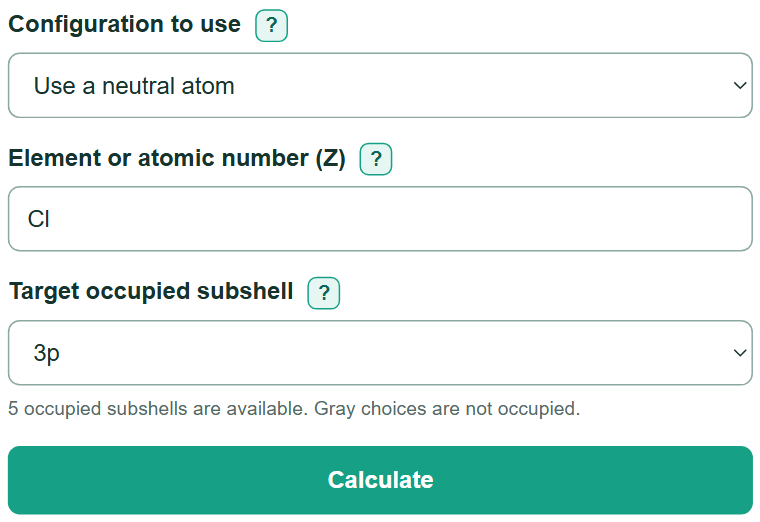
- Choose "Use a neutral atom" for a neutral element, or choose "Use a different configuration" if the problem gives an ion or a specific electron configuration.
- Enter the element name, symbol, or atomic number in "Element or atomic number (Z)".
- If you chose "Use a different configuration," enter the assigned configuration, such as [Ar] 3d5, then choose the occupied subshell that contains the selected electron.
- Click "Calculate." Read the effective nuclear charge first, then check the shielding steps: the selected electron should be excluded and the group coefficients should match the target subshell.
Definitions
Effective nuclear charge (Zeff): The estimated positive pull from the nucleus felt by one electron after shielding by other electrons.
Atomic number (Z): The number of protons in an element's nucleus.
Shielding constant (S): The amount subtracted from Z because other electrons partly reduce the nucleus's pull.
Electron configuration: Notation showing occupied subshells and their electron counts, such as 1s2 2s2 2p6.
Subshell: A labeled electron group within a shell, such as 3p or 3d.
Slater's rules: Counting rules that estimate shielding with different coefficients for s/p and d/f target electrons. [1]
Common mistakes and quick fixes
Mistake: Counting the selected electron as part of its own shielding group.
Fix: Subtract one electron from the target group before applying its coefficient.
Mistake: Using 0.35 for the other electron in a 1s group.
Fix: Use 0.30 for the other 1s electron. The 0.35 coefficient applies to same-group electrons in other s and p groups.
Mistake: Treating 3s and 3p as separate groups for a 3p target.
Fix: Combine the 3s and 3p electrons into one same-shell group, then exclude the selected 3p electron.
Mistake: Using a neutral configuration for an ion.
Fix: Choose "Use a different configuration" and enter the configuration assigned for that atom or ion.
Mistake: Changing Z when an atom becomes an ion.
Fix: Keep Z equal to the element's proton count. Forming an ion changes the electron count, not the nuclear charge.
Mistake: Applying the s/p rule to a d or f target electron.
Fix: For a d or f target, count other electrons in that d or f group at 0.35 each and every group to the left at 1.00 each.
Limitations & Key Assumptions / Boundary Conditions
- This calculator gives a Slater-rules estimate, not a directly measured charge or a full quantum-mechanical calculation.
- The neutral-atom path uses built-in ground-state configurations only for hydrogen through uranium, atomic numbers 1 through 92.
- For an ion, the element still sets Z, while the entered electron configuration sets the shielding count.
- The answer applies to an electron in an occupied subshell; electrons in the same subshell receive the same Slater-rule estimate.
- Custom configurations must use whole-number occupancies within subshell capacities: s up to 2, p up to 6, d up to 10, and f up to 14.
- Slater's rules simplify electron-electron interactions, so more detailed atomic models can produce different values.
Methodology
Calculation method
The calculator finds atomic number Z from the entered element. It then uses either the neutral ground-state configuration or the configuration you enter, and counts shielding with Slater's rules. The selected electron is excluded from its own group before its group's coefficient is applied. [1]
Zeff = Z - S
For an ns or np target, other electrons in the same ns/np group count as 0.35 each, except another 1s electron counts as 0.30. Electrons in shell n - 1 count as 0.85 each, and electrons in shell n - 2 or lower count as 1.00 each.
S = (same-group count x coefficient) + (n - 1 count x 0.85) + (lower-shell count x 1.00)
For an nd or nf target, other electrons in the same d or f group count as 0.35 each. Every electron in groups to the left counts as 1.00 each, while groups to the right contribute zero. [1]
S = (same d/f-group count x 0.35) + (left-side count x 1.00)
Worked mini-example
For a neutral chlorine 3p electron, Z is 17 and the configuration is 1s2 2s2 2p6 3s2 3p5. The same 3s/3p group has 6 other electrons, contributing 6 x 0.35 = 2.10. The n - 1 shell contributes 8 x 0.85 = 6.80, and the lower shell contributes 2 x 1.00 = 2.00.
S = 2.10 + 6.80 + 2.00 = 10.90
Zeff = 17 - 10.90 = 6.10
The shielding breakdown lists each counted group, coefficient, and subtotal so you can compare the calculation with your class work.