
Enter a living tree's trunk measurement and species to estimate its age range in years without cutting it down.
Table of contents
How to use our Tree Age Calculator
- Choose Circumference if you wrapped a flexible tape around the trunk, or Diameter if you already have a straight-across trunk measurement.
- Measure at 4.5 feet above the ground, choose the tape's unit, and enter the trunk measurement.
- Choose the tree species. Select Custom growth factor only when you have a local factor stated in years per inch of diameter.
- Click Calculate. Use the estimated tree age range as the main answer; the midpoint is the center of that range.
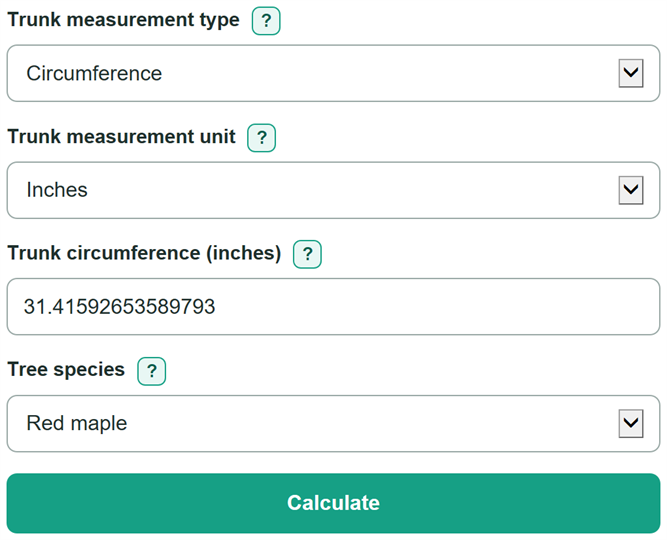
- Check the displayed diameter at breast height. For a circumference entry, the diameter should be much smaller than the number entered because the calculator divides circumference by pi.
Definitions
Circumference: The distance all the way around a tree trunk.
Diameter: The straight-line width through the center of a trunk.
Diameter at breast height (DBH): The trunk diameter measured 4.5 feet above the ground.
Growth factor: An estimated number of years for each inch of trunk diameter, stated in years per inch.
Midpoint age estimate: DBH in inches multiplied by the selected growth factor.
Estimated tree age range: A displayed band from 20 percent below to 20 percent above the midpoint estimate. It is not a statistical confidence interval.
Common mistakes and quick fixes
Mistake: Measuring around the flared base where the trunk meets the ground.
Fix: Measure 4.5 feet above the ground, where the trunk is usually more regular.
Mistake: Choosing Diameter after wrapping a tape around the tree.
Fix: A tape wrapped around a trunk measures circumference. Choose Circumference unless you measured straight across the trunk.
Mistake: Entering centimeters while Inches is selected.
Fix: Choose the unit printed on the tape or measurement record. Changing the unit converts the current measurement.
Mistake: Picking a species from bark color or leaf color alone.
Fix: Check a plant tag, property record, tree guide, or local tree expert before choosing a growth factor.
Mistake: Treating the midpoint as the tree's exact age or planting year.
Fix: Use the displayed age range. Growth changes with site conditions, crowding, health, climate, and past damage.
Limitations & Key Assumptions / Boundary Conditions
- This is a non-destructive estimate based on trunk size, not a verified age from counted annual rings.
- The listed growth factors apply only to the species shown. Use a custom factor only when it comes from a suitable local tree reference or tree-care professional.
- Soil, water, temperature, sunlight, crowding, pruning, disease, injury, and care can change a tree's trunk growth.
- The usual 4.5-foot measurement may need adjustment for a trunk that forks below that height, grows on a slope, or has a swelling at the measurement point.
- The displayed plus-or-minus 20 percent band communicates uncertainty. It is not a tested error margin, and the actual age can fall outside it.
Methodology
Calculation method
The calculator uses trunk diameter at breast height, or DBH. It converts centimeter entries to inches because the selected growth factors are in years per inch. For circumference, it divides the around-the-trunk measurement by pi to find diameter. It then multiplies the diameter by the selected species factor.
measurement in inches = measurement in centimeters / 2.54
DBH in inches = circumference in inches / π
midpoint age = DBH in inches x growth factor in years per inch
age range = midpoint age x 0.80 through midpoint age x 1.20
Preset growth factors
The calculator uses these years-per-inch factors: red maple 4.5, silver maple 3.0, sugar maple 5.5, white oak 5.0, red oak 4.0, pin oak 3.0, black walnut 4.5, American elm 4.0, and cottonwood 2.0. A custom factor replaces a preset only when Custom growth factor is selected.
Worked example
A red maple with a circumference of 31.4159 inches has a DBH of about 10 inches after dividing by π. Multiplying 10 inches by 4.5 years per inch gives a midpoint estimate of 45.0 years. Applying the display band gives 36 to 54 years after each end is rounded to a whole year.