
Use this tree diameter calculator to convert a trunk wrap or direct diameter measurement into DBH-sized diameter with clear field notes.
How to use our Tree Diameter Calculator
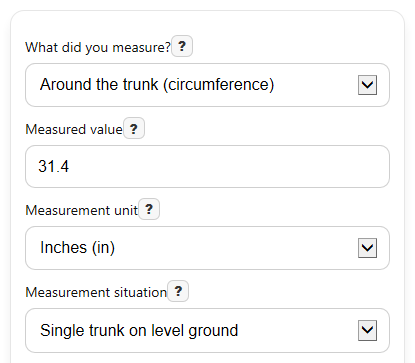
- Choose What did you measure? and pick either Around the trunk (circumference) or Across the trunk (diameter).
- Enter your Measured value, then choose the matching Measurement unit so inches and centimeters do not get mixed.
- Select the Measurement situation that best matches the tree, such as a slope, fork, or butt swell, then choose Rounding shown.
- Click Calculate and read Tree diameter at measuring height first, then check Where to measure for standard DBH and Field note for your tree setup before treating it as true DBH.
- Sanity-check the result by reading Formula used: if you measured around the trunk, it should show circumference divided by pi; if you measured across the trunk, it should show the entered diameter directly.
Definitions
DBH: Diameter at breast height. In US practice, this usually means trunk diameter measured 4.5 ft above the ground on the uphill side if the tree is on a slope [1][2].
Circumference: The distance all the way around the trunk. If you measured this, the calculator converts it to diameter.
Diameter: The distance straight across the trunk through the center.
Pi: A math constant, about 3.14159, used to convert circumference to diameter.
Measurement unit: The length unit you used for Measured value, either inches or centimeters.
Butt swell: Extra widening or flare near the base of a tree that can make a normal DBH reading misleading if you measure there.
Fork below measuring height: A trunk split that happens below the standard DBH point, so each stem is often treated separately rather than as one trunk.
Common mistakes and quick fixes
Mistake: Picking Across the trunk (diameter) in What did you measure? when you actually wrapped a tape around the tree.
Fix: Change What did you measure? to Around the trunk (circumference) so the calculator divides by pi.
Mistake: Entering centimeters in Measured value but leaving Measurement unit set to inches.
Fix: Match Measurement unit to the tape you used, then compare Same diameter in the other unit as a quick check.
Mistake: Measuring too low on the trunk near the root flare, then assuming Tree diameter at measuring height is standard DBH.
Fix: Read Where to measure for standard DBH and remeasure at the standard height if needed.
Mistake: Choosing Single trunk on level ground in Measurement situation for a tree that forks below measuring height.
Fix: Change Measurement situation to Fork splits below measuring height and follow the Field note for your tree setup , which usually means measuring stems separately.
Mistake: Measuring over a branch bump or swollen area and trusting the first number.
Fix: Use the correct Measurement situation and read Field note for your tree setup to see whether you should measure slightly above or below the irregular spot.
Mistake: Thinking Rounding shown changes the real calculation.
Fix: Use Rounding shown only for display preference; the underlying diameter stays the same and Formula used does not change.
Limitations & Key Assumptions / Boundary Conditions
- This calculator gives trunk diameter at the point you measured; it is standard DBH only if you measured at the standard DBH height.
- The math assumes a roughly round trunk cross-section. Irregular, oval, ridged, or heavily flared trunks can make the converted diameter less representative.
- The Measurement situation setting changes the guidance note, not the base math.
- If a fork splits below measuring height, one wrap around both stems is usually not a standard single-stem DBH measurement.
- If bumps, branches, scars, butt swell, or heavy flare affect the measuring point, project-specific field rules may require remeasuring above or below the irregularity.
- Very small positive values still calculate, but rounding can make tiny differences look larger or smaller than they really are.
- Outputs depend on entering the correct unit. Mixing inches and centimeters will change the result.
Methodology
How the calculator works
The calculator first reads your measurement type. If you measured around the trunk, it converts circumference to diameter. If you already measured across the trunk, it uses that diameter directly.
D = C / pi
D = D_entered
Here, D is diameter and C is circumference. The calculator uses pi = 3.141592653589793.
Unit conversion
The main result stays in the same unit you entered. The second result shows the same diameter in the other unit using the exact inch-centimeter conversion.
cm = in x 2.54
in = cm / 2.54
Worked mini-example
If you wrapped a tape around the trunk and got 31.4 inches, the calculator uses the circumference formula.
D = 31.4 / 3.141592653589793 = 9.995...
With Rounding shown set to the nearest 0.1, the displayed Tree diameter at measuring height is 10.0 in. The alternate unit is 25.4 cm.
How the guidance notes are used
The standard US DBH point is 4.5 ft above ground, commonly expressed as 1.37 m in metric terms [1][2]. For a sloped site, measure from the uphill side [2]. The calculator's situation notes help you apply common field exceptions such as slope, bumps, branches, forks, and butt swell, but those notes do not change the diameter formula itself.
Assumptions and limits
This method assumes the measured cross-section is regular enough that a single diameter is meaningful. Real field protocols can differ by agency, inventory, or class project, especially for forked or unusually shaped trunks. If the note says your setup may not represent standard DBH, remeasure according to your project's rules before reporting the number as DBH.