
Enter a tree measurement, fixed-plot tally, or prism count to calculate basal area for one tree or estimate stand basal area per acre.
Advanced options
Table of contents
How to use our Basal Area Calculator
- Choose One tree, Fixed-area plot, or Prism or angle gauge to match the method used for your field measurements.
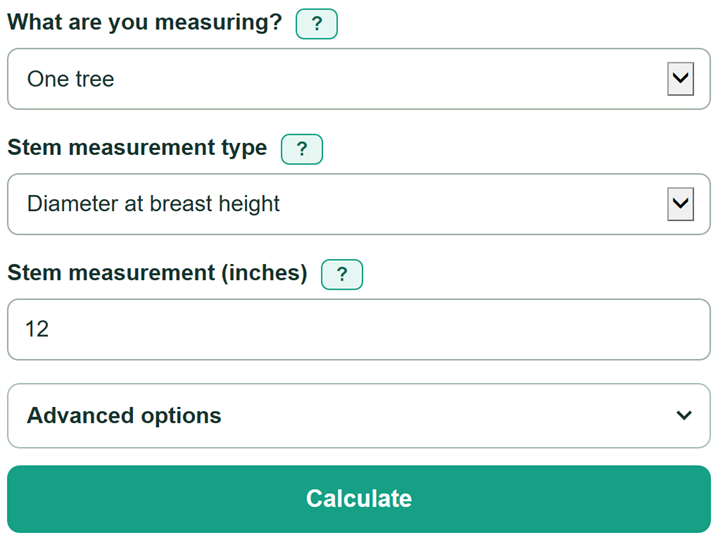
- For one tree, choose Diameter at breast height or Circumference at breast height, then enter the tape reading in inches.
- For a fixed plot, add one DBH row for each measured tree and enter the known plot area in acres.
- For a prism sample, enter the BAF printed on the prism or angle gauge and the full-in and borderline-tree counts for every point. Add the optional DBH rows only when you also need estimated trees per acre.
- Check the units before using the answer: one-tree basal area is in square feet, while a stand estimate is in square feet per acre. A prism BAF is not a plot area.
Definitions
Basal area: The cross-sectional area of a tree stem at breast height. Stand basal area adds or estimates those stem areas for one acre.
DBH: Diameter at breast height, usually measured in inches at 4.5 feet above the ground in US forestry practice. [2]
Circumference: The distance around a tree trunk. The calculator divides circumference by π to find diameter.
Fixed-area plot: A plot with a known land area. The measured tree basal areas are added and divided by plot acres to estimate basal area per acre. [2]
BAF: Basal area factor, the square-feet-per-acre factor printed on a prism or angle gauge.
Full in tree: A tree counted as 1 at a prism sample point.
Borderline tree: A tree exactly at the prism limit. A true borderline tree counts as 0.5 in the effective tally. [1]
Common mistakes and quick fixes
Mistake: Entering a tape measurement around the trunk while Diameter at breast height is selected.
Fix: Select Circumference at breast height for a regular tape wrapped around the trunk.
Mistake: Using one average DBH for all trees in a fixed plot.
Fix: Add every measured tree as its own DBH row. Larger trees add much more basal area than smaller trees.
Mistake: Entering a prism BAF as the fixed plot area.
Fix: Use Fixed-area plot only when you know the plot area in acres. Use Prism or angle gauge when the number comes from the tool's BAF marking.
Mistake: Counting each borderline prism tree as a full tree.
Fix: Enter true borderline trees in the borderline column so each receives a 0.5 weight.
Mistake: Multiplying prism tree count by BAF to estimate trees per acre.
Fix: Add the DBH and full-or-borderline status for every tallied prism tree. Each tree's DBH changes its expansion to trees per acre.
Limitations & Key Assumptions / Boundary Conditions
- The calculator uses stem measurements at breast height. Swells, damage, forks, steep ground, and unusual stems can require field-method judgment before measuring.
- Fixed-plot results depend on representative plot locations, the correct plot area, and a complete tally of trees inside each plot.
- Prism results depend on the correct BAF and accurate full-in, out-tree, and borderline calls at every sample point.
- Estimated trees per acre from prism DBHs is shown only when the optional DBH rows match the full and borderline tallies at each point.
- Basal area is not timber volume, tree health, canopy cover, stocking suitability, or a thinning recommendation.
Methodology
One tree
The calculator uses diameter in inches. If you enter circumference, it first converts that tape reading to diameter, then finds the area of the circular stem cross section.
DBH (inches) = circumference (inches) / π
Basal area (sq ft) = π x DBH2 / 576
The 576 combines the circle formula's division by 4 with the 144 square inches in one square foot.
Fixed-area plot
The calculator finds the basal area of every listed tree, adds the areas, and divides by the known plot area in acres.
Plot tree area (sq ft) = (π / 576) x (DBH12 + DBH22 +...)
Stand basal area (sq ft per acre) = plot tree area (sq ft) / plot area (acres)
For example, DBHs of 10, 12, and 14 inches total about 2.40 sq ft of basal area. For a 0.1-acre plot, 2.40 divided by 0.1 gives about 24.00 sq ft per acre.
Prism or angle gauge
For each sample point, a full-in tree counts as 1 and a true borderline tree counts as 0.5. The calculator averages the effective counts across the complete points, then multiplies that average by BAF. [1]
Average effective count = (full trees + 0.5 x borderline trees) / number of points
Stand basal area (sq ft per acre) = BAF x average effective count
If you enter a complete prism DBH list, each full tree contributes BAF divided by its own basal area. Each borderline tree contributes half that amount. The calculator averages those contributions across points to estimate trees per acre.
Trees per acre = sum of weighted [BAF / (π x DBH2 / 576)] / number of points