
Estimate how many vegetable seeds, transplants, and seed packets you need from row length, bed size, or planting area.
Advanced options
Sowing details
Buying cushion and rounding
How to use our Vegetable Seed Calculator
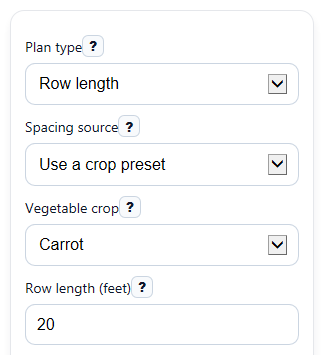
- Choose Plan type: use Row length for one or more rows, Raised bed for a bed with rows across the width, or Area with your own spacing for a quick square-foot style estimate.
- Pick Spacing source. Use Vegetable crop if you want a preset, or enter Space between plants in the row (inches) and Space between rows (inches) yourself from your seed packet or transplant tag.
- Enter your size inputs, then choose Planting method. If you pick direct sowing, fill in Expected germination (%), which means the share of seeds you expect to sprout.
- If you want a shopping estimate, enter Seeds per packet and, in Advanced options, adjust Seeds sown at each spot, Extra buying buffer (%), or How to round packet purchases.
- Click Calculate, then sanity-check the result by comparing Spacing used and Plant density with your packet or garden plan before you buy.
Definitions
Plan type: The kind of space you are planting in: a row, a raised bed, or a total area.
Spacing source: Whether spacing comes from a crop preset or from numbers you type yourself.
Space between plants in the row (inches): The distance from one plant spot to the next in the same row.
Space between rows (inches): The distance from the center of one row to the center of the next row.
Planting method: Direct sow means putting seeds in the garden. Transplants means planting young starter plants.
Expected germination (%): The percent of seeds expected to sprout. Example: 80% means about 8 out of 10 seeds may come up.
Seeds sown at each spot: How many seeds you place where you want one final plant, often followed by thinning extra seedlings.
Plant spots to fill: The number of final plant positions that fit in your space before seed-loss adjustments.
Plant density: A quick check of how tightly you are planting, shown per row or per square foot depending on your plan.
Packets to buy: The number of seed packets needed from your seed count and Seeds per packet.
Common mistakes and quick fixes
Mistake: Leaving Spacing source on a preset while expecting your typed Space between plants in the row (inches) and Space between rows (inches) to control the math.
Fix: Switch Spacing source to the custom option when you want your own spacing values used.
Mistake: Typing 0 or a negative number for Space between plants in the row (inches) or Space between rows (inches) .
Fix: Enter values greater than 0 so the calculator can fit real plant spots.
Mistake: Using Expected germination (%) as 0, leaving it blank, or entering more than 100 when Planting method is direct sowing.
Fix: Enter a real sprouting estimate from 1 to 100 for Expected germination (%) .
Mistake: Expecting Expected germination (%) to change the result when Planting method is set to transplants.
Fix: For transplants, focus on Seeds or transplants needed as plant count; germination only applies to direct-sown seeds.
Mistake: Entering a packet size in Seeds per packet and assuming the store sells fractional packets.
Fix: Check How to round packet purchases . Use whole-packet rounding for a real shopping number, or exact packets for planning only.
Mistake: Seeing a low or zero result in a bed because Bed width (inches) is smaller than Space between rows (inches) .
Fix: Widen the bed, reduce Space between rows (inches) , or choose another Plan type .
Limitations & Key Assumptions / Boundary Conditions
- Results are planning estimates, not a guarantee of harvest or survival.
- Crop presets use common spacing values, but your seed packet, variety, trellis setup, or local advice may differ.
- Fit-based counts use only full planting spaces that fit, so small leftover space is not counted as another plant spot.
- Raised bed mode assumes straight, evenly spaced rows across the bed width.
- Area with your own spacing treats each plant as using a simple rectangle of space, which is a quick estimate rather than a detailed layout.
- Expected germination (%) affects direct-sown seeds only. It does not change transplant counts.
- Seeds per packet is optional. If it is blank or not greater than 0, packet-buying results are not shown.
- The extra buffer adds a buying cushion for gaps, losses, or replanting, but it cannot capture every real-world issue such as pests, weather, or poor soil.
Methodology
How the calculator counts planting spots
The calculator first finds how many final plant positions fit in your chosen space. It uses floor-based geometry, which means only full spaces that truly fit are counted.
row plant spots = floor((Row length in feet x 12) / Space between plants in the row) x floor(Number of rows)
rows that fit in a bed = floor(Bed width in inches / Space between rows)
bed plant spots = rows that fit x floor((Bed length in feet x 12) / Space between plants in the row)
area plant spots = floor((Planting area in square feet x 144) / (Space between plants in the row x Space between rows))
Here, 12 converts feet to inches, and 144 converts square feet to square inches.
How seed or transplant need is calculated
If you choose direct sowing, the calculator adjusts your target spots for sprouting losses and any extra seeds placed at each spot.
seeds needed = ceil(Plant spots to fill x Seeds sown at each spot / (Expected germination / 100) x (1 + Extra buying buffer / 100))
If you choose transplants, germination is ignored because you are buying or setting out already started plants.
transplants needed = ceil(Plant spots to fill x (1 + Extra buying buffer / 100))
How packet buying is calculated
If you enter Seeds per packet, the tool converts the needed count into packet count.
exact packets = Seeds or transplants needed / Seeds per packet
packets to buy = ceil(exact packets) when whole-packet rounding is selected
If exact packet mode is selected, the calculator shows the decimal packet amount for planning, but stores usually sell whole packets.
Worked mini-example
Suppose you plant 2 rows that are 20 feet long, with 4 inches between plants in the row, direct sowing, 80% germination, 1 seed at each spot, and a 10% extra buffer.
Plant spots to fill = floor((20 x 12) / 4) x 2 = 60 x 2 = 120
Seeds or transplants needed = ceil(120 x 1 / 0.80 x 1.10) = ceil(165) = 165
If the packet holds 100 seeds, then:
exact packets = 165 / 100 = 1.65
Packets to buy = 2
That means the space fits 120 final plant spots, but you should start with 165 seeds to cover expected sprouting loss and a small cushion.
Assumptions behind the estimate
The math assumes even spacing, straight rows, and simple rectangular use of space. Real gardens can differ because of path space, edge gaps, thinning choices, variety size, and local growing advice. Crop presets should be treated as a practical starting point, then checked against your packet or tag.