
Enter air temperature and humidity to calculate current air vapor pressure deficit in kPa and understand how dry the air is relative to saturation.
Advanced options
Table of contents
How to use our Vapor Pressure Deficit Calculator
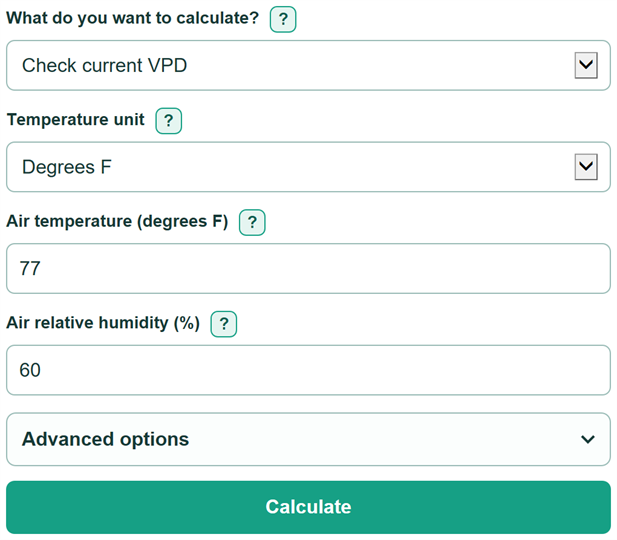
- Choose whether you want to check current VPD, plan humidity for a target VPD, or plan temperature for a target VPD.
- Select degrees F or degrees C to match the unit shown by your thermometer, controller, or sensor.
- To check current VPD, enter air temperature and relative humidity measured near the plants at about the same time.
- For a target plan, enter your target VPD and the condition you want to keep fixed: air temperature for a humidity plan, or relative humidity for a temperature plan.
- Check that the planned result is possible for your equipment. Humidity must be from 0% to 100%, and conditions at the plants can differ from a room sensor.
Definitions
Vapor pressure deficit (VPD): The difference between the water vapor pressure at saturation and the water vapor pressure actually present. This calculator reports VPD in kilopascals (kPa).
Relative humidity (RH): The amount of water vapor in the air as a percentage of the maximum amount the air could hold at its current temperature.
Saturation vapor pressure: The water vapor pressure when air is fully saturated at a given temperature.
Air VPD: VPD calculated from the entered air temperature and relative humidity.
Leaf VPD: VPD calculated using measured leaf temperature and the entered air moisture condition. It can differ from air VPD when leaves are warmer or cooler than the air.
Target VPD: A VPD setpoint chosen for a particular crop plan or growing stage. It is not a universal recommendation.
Common mistakes and quick fixes
Mistake: Using a temperature reading from outside the plant area.
Fix: Use air temperature measured near the plants, close to where the humidity reading was taken.
Mistake: Entering a Fahrenheit reading while degrees C is selected, or the reverse.
Fix: Select the unit printed by the thermometer, controller, or sensor before entering temperature.
Mistake: Looking at relative humidity without considering temperature.
Fix: Enter both air temperature and relative humidity. The same RH percentage can give a different VPD at another temperature.
Mistake: Treating air VPD and leaf VPD as the same number.
Fix: Enter a measured leaf temperature in Advanced options when you need the leaf-based value.
Mistake: Using a target VPD as a universal crop setting.
Fix: Use a target from your crop plan, advisor, or facility setpoint, then check whether the calculated setting is practical.
Limitations & Key Assumptions / Boundary Conditions
- The calculator uses an empirical saturation-vapor-pressure equation, so the answer is an estimate based on the measurements entered.
- Temperature and humidity can vary within a tent or greenhouse. A sensor far from the plants may not describe plant conditions.
- Leaf VPD appears only when you enter a measured leaf temperature. The calculator does not assume a leaf-to-air temperature difference.
- Target-setting results hold one room condition fixed. Ventilation, lighting, outside air, and equipment limits can prevent the planned setting from being maintained.
- A target VPD is a mathematical setpoint, not a crop-health recommendation. Suitable conditions also depend on crop type, growth stage, irrigation, and airflow.
- Humidity planning is possible only when the calculated RH is from 0% to 100%. Temperature planning requires RH below 100% and a target VPD greater than 0 kPa.
Methodology
Calculation method
Source for the saturation vapor-pressure equation: FAO ETo Calculator Reference Manual, section 3.3, equation 3.4. This is an empirical temperature relationship, not a crop-specific target recommendation.
The calculator converts Fahrenheit to Celsius when needed. It estimates saturation vapor pressure from temperature, then uses relative humidity to calculate the water vapor pressure deficit.
es = 0.6108 x exp(17.27 x T / (T + 237.3))
In this equation, es is saturation vapor pressure in kPa, T is temperature in degrees C, and exp means raise e to a power.
Air VPD = es x (1 - RH / 100)
RH is relative humidity as a percentage. Higher VPD means the entered air is further below saturation. Lower VPD means it is closer to saturation.
Leaf temperature and target plans
When a measured leaf temperature is entered, the calculator finds saturation vapor pressure at the leaf temperature and subtracts the air vapor pressure. A humidity plan rearranges the air-VPD equation while holding air temperature fixed. A temperature plan reverses the saturation-vapor-pressure equation while holding relative humidity fixed.
Planned RH = 100 x (1 - target VPD / es)
Worked example
At 25 degrees C and 60% RH, saturation vapor pressure is about 3.17 kPa. Air VPD is about 3.17 x (1 - 0.60) = 1.27 kPa. With a target of 1.00 kPa while holding 25 degrees C, the needed humidity is about 68.43%.
Rounding
The equation uses coefficients 0.6108, 17.27, and 237.3 degrees C. Results are rounded only for display, so changing the number of decimal places does not change the underlying calculation.