
Enter your garden bed, planter, area, or labeled capacity to find the soil needed in cubic feet, cubic yards, and whole bags.
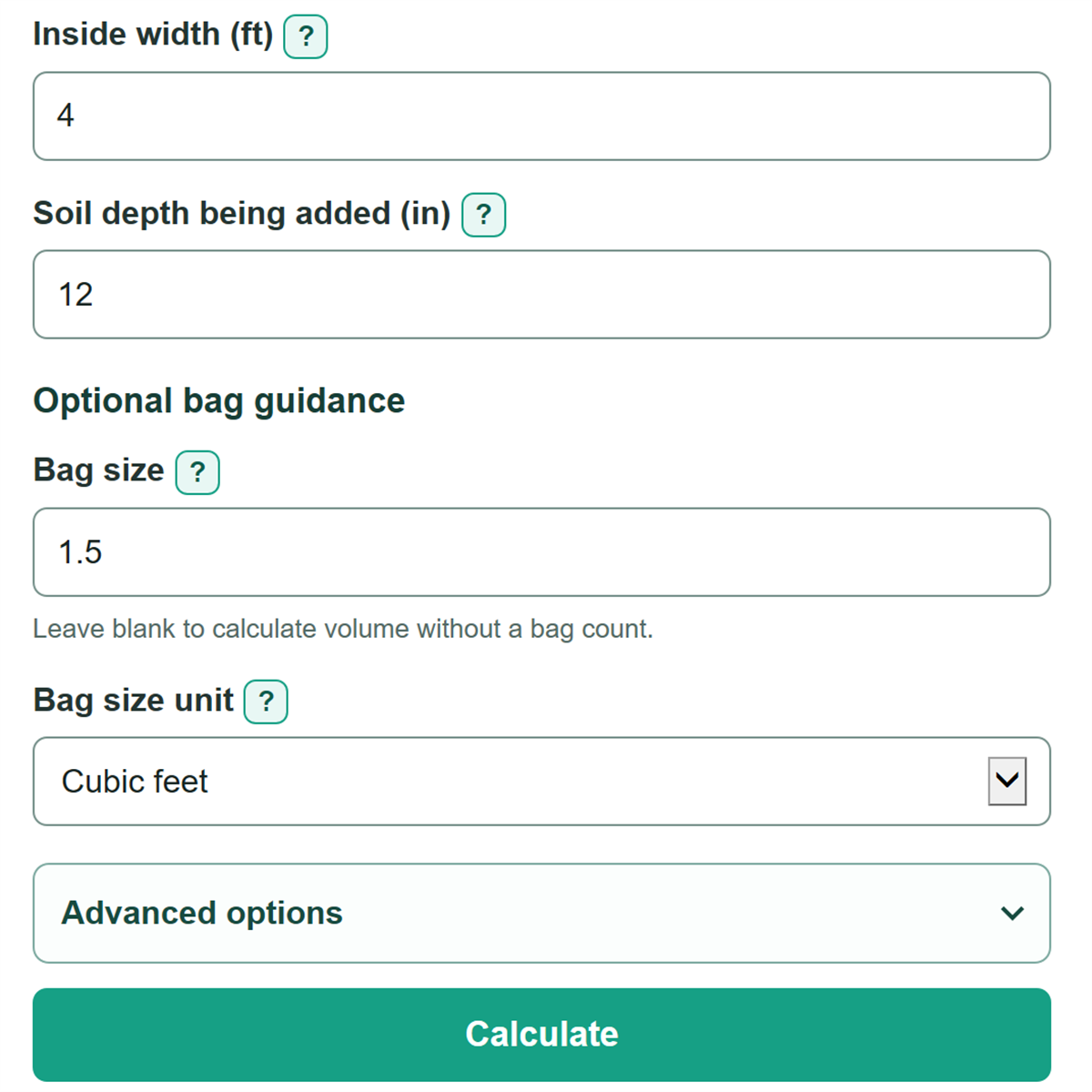
Leave blank to calculate volume without a bag count.
Advanced options
A blank value means 1 space.
Table of contents
How to use our Soil Calculator
- Choose the information you have: rectangle measurements, a round-space diameter, known area, or a container capacity printed on its label.
- Enter the visible measurements for that choice. Measure inside a bed or planter, and enter only the soil depth you plan to add.
- To get a purchase count, enter the volume printed on the soil bag and choose cubic feet or US dry quarts. Leave bag size blank if you only need soil volume.
- Open Advanced options to multiply identical spaces or add extra soil for settling and small measurement differences.
- Check that the reported depth and total soil amount fit your project. The bag count rounds up, so it may be more than the exact calculated volume.
Definitions
Cubic foot (cu ft): A volume that fills a space 1 foot long, 1 foot wide, and 1 foot deep.
Cubic yard (cu yd): A bulk-material volume equal to 27 cubic feet. [1]
US dry quart: A US volume unit that may be printed on soil bags or container labels. It is not the same as a liquid quart.
Soil-covered area (sq ft): The flat footprint that will receive soil, measured before depth is included.
Extra soil allowance (percent): An optional percentage added after the measured volume to plan for settling or small measurement differences.
Common mistakes and quick fixes
Mistake: Measuring the outside of a raised-bed frame.
Fix: Check How will you enter the space? and then recalculate. Measure the usable inside length and width where the soil will sit.
Mistake: Entering the full wall height when you are only topping up soil.
Fix: Check How will you enter the space? and then recalculate. Enter only the depth of the new soil layer being added.
Mistake: Treating square feet as a soil volume.
Fix: Check How will you enter the space? and then recalculate. Enter square feet only as the flat soil-covered area. The calculator combines it with depth to find cubic feet.
Mistake: Entering a bag weight in pounds as the bag size.
Fix: Check How will you enter the space? and then recalculate. Use the bag's printed volume in cubic feet or US dry quarts. Weight cannot be converted to volume without product-specific density.
Mistake: Buying the unrounded bag amount.
Fix: Use Whole bags to buy, which rounds upward because partial bags are not sold.
Mistake: Assuming extra soil is already included.
Fix: Check How will you enter the space? and then recalculate. Enter an extra allowance if you want one, or leave it at 0 to use only the measured volume.
Limitations & Key Assumptions / Boundary Conditions
- The calculator estimates soil volume, not price. It does not include bag prices, delivery fees, taxes, or supplier minimum orders.
- Rectangle and round measurements assume straight sides and a level, evenly filled soil layer.
- Use usable inside dimensions. Tapered pots, sloped sides, false bottoms, rocks, drainage layers, and existing soil can reduce the amount needed.
- Enter the depth of soil being added. A partially filled bed or container needs less soil than its full wall height suggests.
- The labeled-capacity route is appropriate only when the stated capacity matches the amount you plan to fill.
- Bag counts use the volume printed on the selected product and round upward. Soil can settle or pack differently during filling.
- Number of identical spaces applies only when every included bed or container has the same size and fill depth.
Methodology
Volume calculation
For a measured space, the calculator changes soil depth from inches to feet, then multiplies the footprint by that depth. A rectangle uses inside length and width. A round space uses the area of its circular footprint. The known-area route starts with the area you already have. The labeled-capacity route uses the container volume shown on its label and converts US dry quarts to cubic feet when needed.
depth in feet = soil depth in inches / 12
rectangle volume = inside length x inside width x depth in feet
round volume = π x (inside diameter / 2)2 x depth in feet
known-area volume = soil-covered area x depth in feet
If you enter a number of identical spaces, the one-space volume is multiplied by that whole number. A blank count means one space. The calculator then applies the optional extra soil allowance to show the total purchase volume.
total soil required = base soil volume x (1 + extra allowance / 100)
Bulk soil and bags
The calculator divides the unrounded total cubic feet by 27 for bulk cubic yards. [1] When you enter a bag size, it converts the bag volume to cubic feet if needed, divides the soil total by that volume, and rounds up to a whole bag.
bulk soil required in cu yd = total soil required in cu ft / 27
whole bags to buy = ceiling(total soil required / bag volume)
Worked example
An 8 ft by 4 ft bed filled with 12 in of soil has a depth of 1 ft. Its volume is 8 x 4 x 1 = 32 cu ft. With 1.5 cu ft bags and no extra allowance, 32 / 1.5 = 21.33, so rounding up gives 22 whole bags.