
Choose a crop and enter its amount to convert between bushels, pounds, US short tons, and metric tons using its standard weight.
Advanced options
Converted grain quantity
Measured test weight comparison
Table of contents
How to use our Grain Conversion Calculator
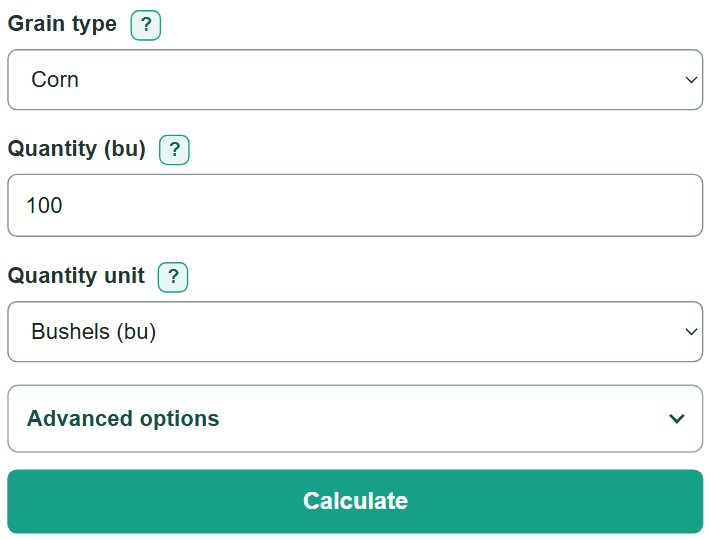
- Choose the grain type shown on your scale ticket, bin record, invoice, bid, contract, or yield report.
- Enter the quantity exactly as recorded, then choose the unit printed with it.
- Open "Advanced options" only if you have a measured test weight in lb/bu or want more or fewer displayed decimal places.
- Click "Calculate" to see the standard equivalent bushels, pounds, metric tons, and US short tons.
- Check the selected crop and source unit against your record. In particular, a US short ton and a metric ton are different amounts.
Definitions
Bushel (bu): A US grain-marketing quantity. Its standard mass depends on the selected crop.
Standard pounds per bushel: The crop-specific reference weight used to convert between bushels and pounds. USDA wheat conversion documentation uses 60 lb per bushel for wheat. [1]
Actual test weight (lb/bu): A measured pounds-per-bushel value for a specific load. It can differ from the standard crop reference.
US short ton: A mass of 2,000 lb.
Metric ton (t): A mass of 1,000 kg, equal to about 2,204.62 lb.
Common mistakes and quick fixes
Mistake: Choosing a crop different from the one on the source record.
Fix: Match the grain type on the ticket, contract, bid, invoice, or yield report because each crop has its own standard pounds-per-bushel value.
Mistake: Treating a US short ton as a metric ton.
Fix: Choose the unit printed on the record. A US short ton is 2,000 lb; a metric ton is 1,000 kg.
Mistake: Typing a malformed comma value such as 1,01.
Fix: Use commas only in thousands groups, such as 1,000 or 12,500. Use a decimal point for part of a unit.
Mistake: Confusing an agricultural grain bushel with the small mass unit abbreviated gr.
Fix: This calculator converts crop quantities using bushels and mass units. It does not convert the small unit called a grain.
Mistake: Using measured test weight as a final settlement weight.
Fix: Treat it as a physical-weight estimate only. Moisture, dockage, grade, and buyer settlement adjustments are separate.
Limitations & Key Assumptions / Boundary Conditions
- Standard conversions use a crop-level pounds-per-bushel reference and are planning estimates, not final settlement calculations.
- A measured test weight changes the estimated physical mass only when the source quantity is bushels. For pounds or tons, the entered mass stays the same and only the bushel equivalent changes.
- The calculation does not include moisture adjustments, dockage, grade factors, shrink, handling loss, contract terms, price, or buyer-specific settlement rules.
- The listed crop choices do not cover every specialty grain, treated seed, or mixed load.
- Zero is a valid quantity. Negative quantities and actual test weights of zero or less are not valid.
Methodology
Calculation method
The calculator first changes the entered quantity into pounds. It then calculates standard bushels, metric tons, and US short tons from those pounds. The selected grain sets the standard pounds-per-bushel reference. For example, USDA wheat documentation uses 60 lb per bushel for wheat conversion. [1]
standard_pounds = quantity * crop_standard_lb_per_bu
Use this equation when the source unit is bushels.
standard_pounds = quantity
Use this equation when the source unit is pounds.
standard_pounds = quantity * 2000
Use this equation when the source unit is US short tons.
standard_pounds = quantity * 2204.6226218487757
Use this equation when the source unit is metric tons.
standard_bushels = standard_pounds / crop_standard_lb_per_bu
standard_metric_tons = standard_pounds / 2204.6226218487757
standard_short_tons = standard_pounds / 2000
Measured test weight
If an actual test weight is entered, the calculator makes a second physical-weight estimate. For a bushel source, it multiplies bushels by the measured lb/bu. For a pounds or tons source, the entered mass stays unchanged, while the equivalent bushel amount changes.
actual_pounds = bushels * actual_test_weight_lb_per_bu
actual_bushels = actual_pounds / actual_test_weight_lb_per_bu
weight_change = actual_pounds - standard_pounds
Mini-example
For 100 bu of corn, the standard basis is 56 lb/bu. Multiplying 100 by 56 gives 5,600 lb, or 2.8 US short tons and 2.540117272 metric tons. With an actual test weight of 54 lb/bu, the physical-weight estimate is 5,400 lb, which is 200 lb less than the standard estimate.